Anthropic officially launched the web and mobile versions of Claude Cowork for its Max subscribers. This intelligent agent, once regarded as the "non-programmer version of Claude Code", is moving from the desktop to a full-scenario knowledge and administrative collaborative work platform. As the product form extends to multiple terminals, competition among AI coding agents has also begun to penetrate into daily office scenes. Who can control the real "space where work occurs" has become the key to a new round of competition.
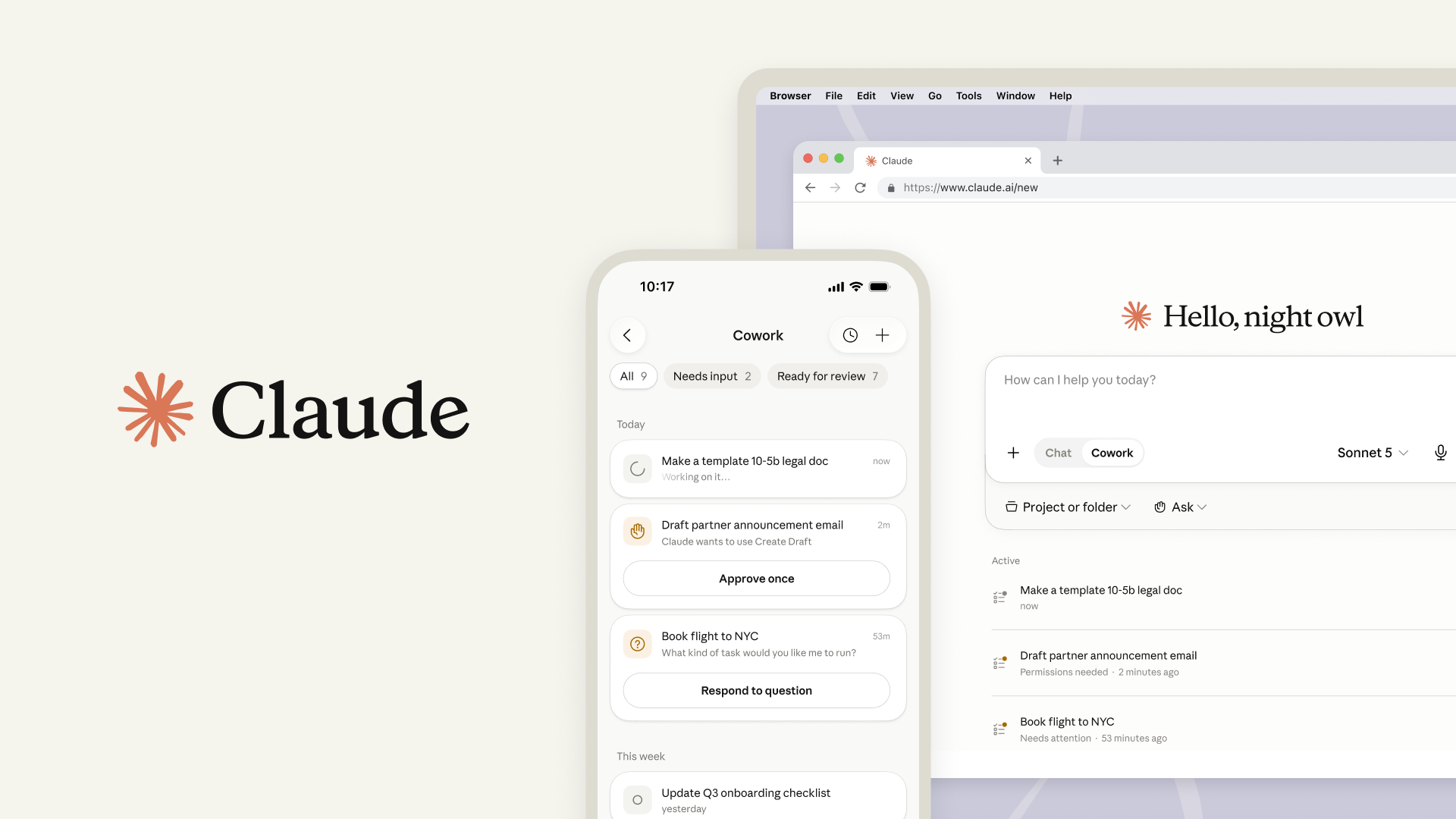
Claude Cowork was originally launched as a desktop application in January this year, mainly for general knowledge work and code-related tasks. After the latest update, Max users can not only create tasks on their computers, but also receive task progress on their phones and continue the results on any device. Background tasks can continue to run even if the laptop is turned off. Anthropic hopes to use this to make Cowork get rid of its positioning as a "coding tool for beginners" and become more like an "agent administrative colleague" that can work continuously in the background across devices and issue confirmation requests to users at key decision-making nodes.
This move is highly consistent with the overall industry trend: AI companies are trying to expand their products from chatbots to various specific work interfaces. OpenAI's Codex is an example. It was originally a tool for software development, but is now increasingly used by non-developers to write reports, produce data tables and presentations, conduct research and data analysis, and other tasks. For these labs, the competition is no longer about whose chatbot is better, but who can take center stage in the interface where users actually do their work.
Anthropic is also strengthening this idea in its internal layout. The recently launched Claude Tag is an "accompanying AI teammate" that resides in Slack, continuously observing corporate chat flows and providing knowledge accumulation and collaboration support. Through multi-point deployment in desktop applications, web pages, mobile terminals and enterprise chat tools, the Claude series is moving closer to "always-on smart office infrastructure".
This expansion of Cowork into a multi-platform application also brings an important capability: tasks can continue to run in the background and are no longer directly bound to the online status of a specific terminal. The example given by Anthropic is: "Set client preparation for Monday at 6 a.m.: Claude will process email threads, meeting minutes and latest news in the background, automatically generate briefing documents, and draft but not send follow-up emails, then wait for you to review when you drink coffee in the morning." The desktop is still positioned as a deep work scenario, Cowork can access files and browsers locally, while the web and mobile versions lower the threshold of use, allowing users who do not have the app installed to directly access it.
Anthropic said that in the future, Claude’s chat function and Cowork will be unified on the web and desktop, and projects and artifacts will be seamlessly shared between the two. This means that users’ experience of initiating, editing, and viewing task results on different interfaces will be more coherent, helping to integrate Cowork into existing knowledge management and collaboration processes.
In order to more clearly define the positioning and value of Cowork, Anthropic released early usage data, emphasizing that the most typical usage scenario of this tool is "work around the work itself." The so-called "work peripheral work" refers to those trivial tasks that support the operation of the company but are not anyone's core responsibilities, such as summarizing updates from various channels, organizing onboarding checklists, reconciling accounts, and maintaining forms, etc. Officials hope that this data can become a reference sample for companies to think about how to introduce AI products into daily processes, and help managers see where the value is really concentrated.
Anthropic categorized and accounted for major usage types based on an analysis of 1.2 million anonymously aggregated Cowork sessions and usage data from more than 600,000 institutions over a two-week period in late May. The largest category is "Business Process Operations", accounting for 33.4% of the total usage, which mainly includes integrating scattered information into unified reports, making onboarding process checklists, and reconciliation and table consolidation. These tasks are mostly concentrated in finance, human resources, and administrative positions. The second largest category is "content creation and copywriting", accounting for 16.4%, covering draft plans, presentation documents, social media content, proposals and various communication documents, which are often completed by marketing and management.
By comparison, software development-related usage only accounts for 8.7% of Cowork's overall usage. This data confirms Anthropic’s judgment: Although “writing code” is still one of the most eye-catching scenarios in AI applications, applications for daily business work are growing rapidly. As companies gradually explore how to embed AI agents into daily processes, products like Cowork that handle "work-related tasks" may be closer to real organizational needs than "programming assistants" in the traditional sense.
Anthropic said in a statement that its goal is to make this use case and data a reference for the industry, providing samples for companies that are still in the exploration stage, and helping them decide which types of work are most efficient and valuable to embed AI products into. As Cowork moves to the web and mobile terminals, the competition between AI agents will also shift from developers’ code editors to a wider range of office software and collaboration spaces—the real battlefield is unfolding in the office.