SpaceX is significantly improving the scale and technical specifications of its next-generation Starlink satellite constellation through the latest regulatory application, applying to the U.S. Federal Communications Commission (FCC) for permission to launch and operate up to 100,000 third-generation (Gen3/V3) low-Earth orbit satellites. According to this latest FCC document, SpaceX plans to deploy these Gen3 satellites in two "very low Earth orbit" (VLEO) orbital shells, with nominal altitudes of approximately 323–327.5 kilometers and 473–477.5 kilometers respectively, and orbital inclinations covering a wide range of 26° to 96.9°.
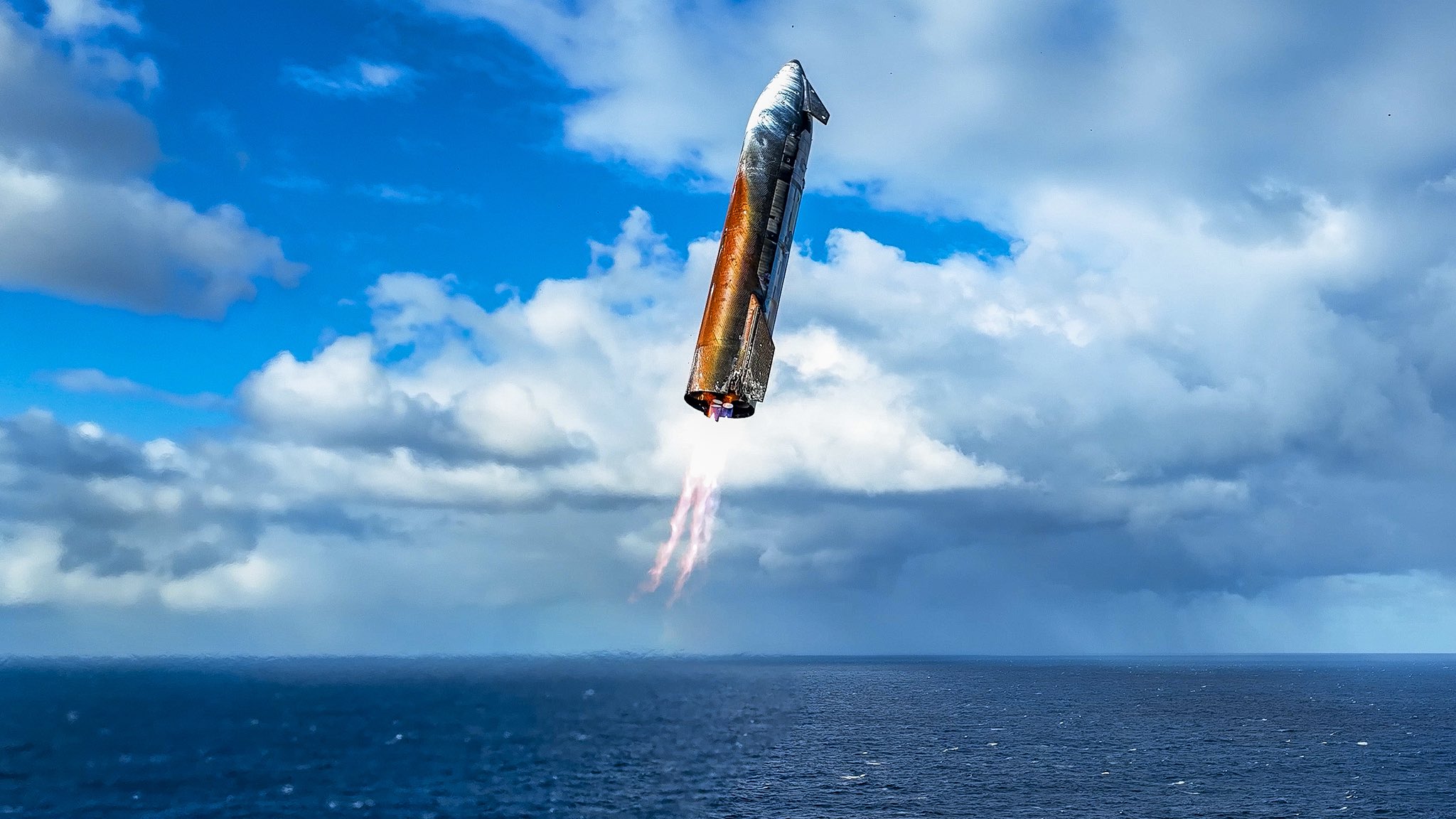
Compared with the second-generation (Gen2/V2) Starlink satellites currently in operation, Gen3 satellites are “comprehensive reconstruction” in terms of structure and capabilities. Compared with the first-generation constellation, existing Gen2 satellites have achieved higher capacity and lower latency, while also bringing about a 20-fold improvement in overall throughput, "Direct-to-Cell" capability to directly connect to unmodified mobile phones, stronger maneuverability, and an autonomous collision avoidance system. The Gen3 design disclosed this time has been further upgraded in many aspects such as communication capabilities, computing capabilities, and propulsion systems.
Judging from the hardware parameters, the weight of a single Gen3 satellite will reach about 2,000 kilograms, while the mass of the Gen2 satellite is only about 575 kilograms, which means that the launch method can almost only rely on the SpaceX "Starship" launch vehicle with stronger thrust and transportation capacity. The Gen3 satellite is specially designed for use in ultra-low orbit environments. The core platform is larger, equipped with longer solar arrays and advanced phased array antennas. Its on-board computers and modem equipment will also be upgraded to a new generation architecture, and argon Hall effect thrusters will be used for orbit maintenance and attitude control.
In terms of communication performance, the target indicators of the Gen3 constellation far exceed existing systems: the downlink capacity is planned to be increased to approximately 1 Tbps per satellite, a tenfold increase from the previous basis; the uplink capacity is increased to 160–200 Gbps, equivalent to an approximately 22-fold increase. Through the integrated RF and laser backhaul design, the total backhaul link capacity of a single satellite is expected to reach approximately 4 Tbps. The entire constellation will use advanced phased-array beamforming, electronic beam steering, optical inter-satellite links and dynamic power control to achieve key functions such as spectrum sharing and interference suppression.
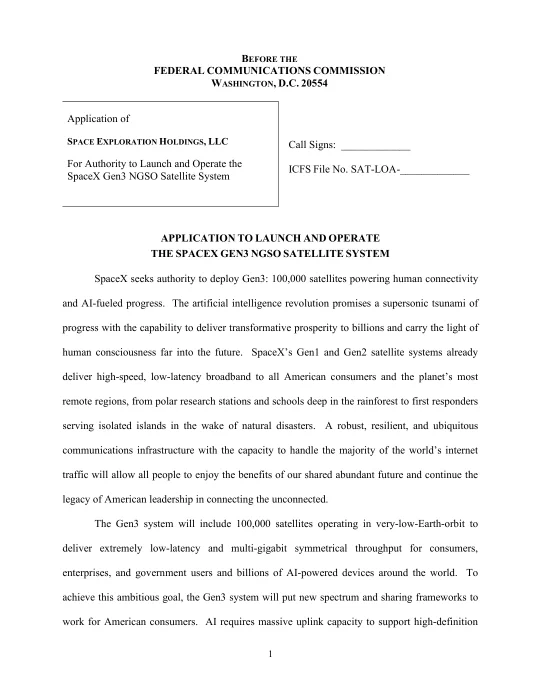
In terms of spectrum use, SpaceX plans to carry out operations in multiple frequency bands such as Ku, Ka, V, E, W, and D, covering downlink frequency bands such as 10.7–13.4 GHz, 17.3–21.2 GHz, 37.5–42.5 GHz, and extending to the higher frequency range of 231.5–275 GHz in the uplink direction to support high-density, high-throughput broadband connections. This also means that existing Starlink user terminals and receiving antenna hardware need to be upgraded to fully unleash the gigabit speed and enhanced downlink capacity of the Gen3 constellation.
In addition to communication constellations, SpaceX also recently announced the first dedicated satellite AI1 designed for artificial intelligence computing power. Its single-satellite peak computing power load can reach 150 kilowatts. It is equipped with liquid radiators, meteorite protection, centralized computing modules and deployable solar arrays. It plans to carry out large-scale production at the "Gigasat" factory in Texas, USA. Although AI1 has not yet been put into mass production, judging from the FCC application and testing information, the mass production preparations for Gen3 satellites are basically ready, and the testing process has been started before full deployment.
It is worth noting that in addition to this application, SpaceX has previously submitted another more radical plan to the regulatory authorities, requesting permission to launch up to 1 million new satellites as a preliminary step towards the so-called "Kardashev II-level civilization." Official documents show that this application is not directly related to this application for “100,000 Gen3 satellites”, and the two are still independent projects.