OpenAI officially launched the GPT-5.6 series of models, achieving stronger performance at lower costs and sending a clear signal to the competitive landscape of the AI industry. This release includes three models: the flagship version Sol, the balanced version Terra, and the cost-effective Luna.It will be open to global users through ChatGPT, Codex and OpenAI API from now on.
In terms of pricing, Sol charges $5/$30 per million input/output tokens, Terra charges $2.50/$15, and Luna charges $1/$6.
OpenAI emphasizes,GPT-5.6 surpasses Anthropic's Claude Fable 5 in several key benchmarks, but the token consumption and reasoning cost are significantly reduced, which means that users can complete more substantive work under the same budget.
For enterprise users and developers, the core impact of this release is the overall improvement of "cost-effectiveness". In Agents’ Last Exam review for professional workflows,GPT-5.6 Sol surpassed Claude Fable 5 by 13.1 percentage points with 53.6 points, and even with medium inference settings, its cost is about a quarter of Fable 5.
What’s even more impactful is thatTerra and Luna, which are positioned at the lower end, still score better than Fable 5 in benchmarks at about one-sixteenth the cost.This "dimensionality reduction strike" price strategy directly compresses the differentiation space of competitors.
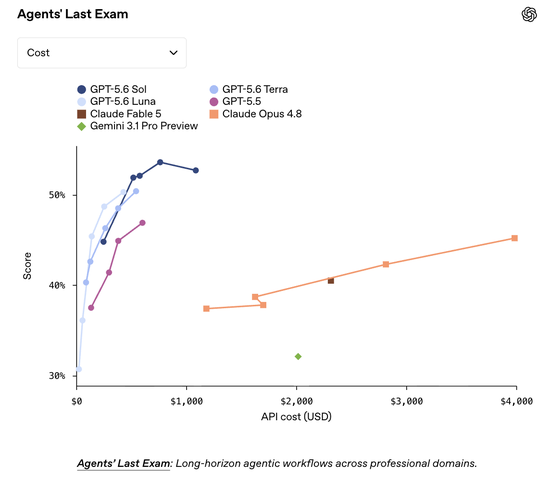
Flagship model Sol sets new benchmark in efficiency
GPT-5.6 Sol has particularly outstanding improvements in programming capabilities. In the Artificial Analysis Coding Agent Index test, Sol (maximum inference setting) set a new record with 80 points, 2.8 points higher than Fable 5, while the number of output tokens was less than half of the latter.The time consumption is reduced by more than half and the cost is reduced by about one third.
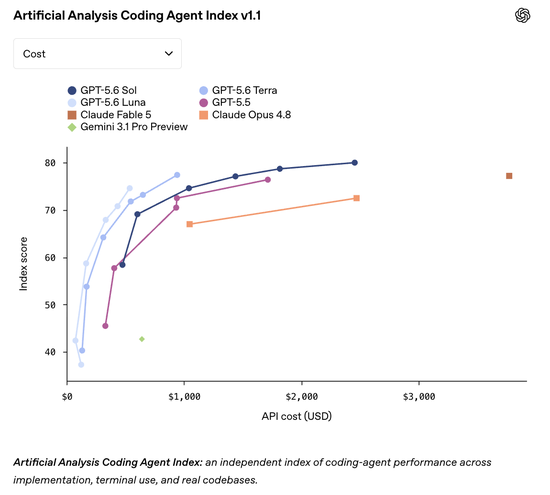
In the complex command line workflow test Terminal-Bench 2.1, Sol leads with a score of 88.8%; in the long-cycle engineering test DeepSWE v1.1 for real code bases, its score reaches 72.7%, which is also at the forefront of the industry.
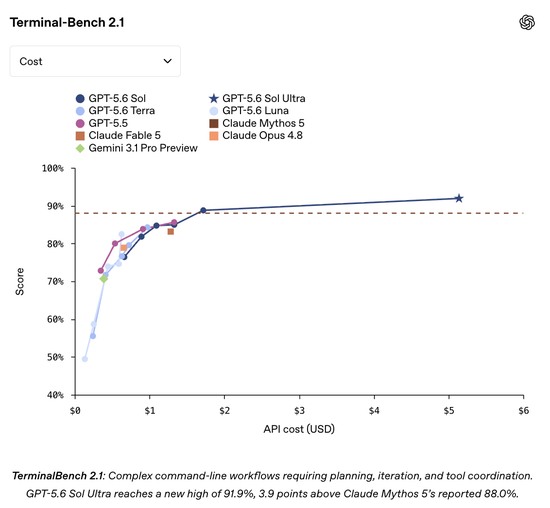
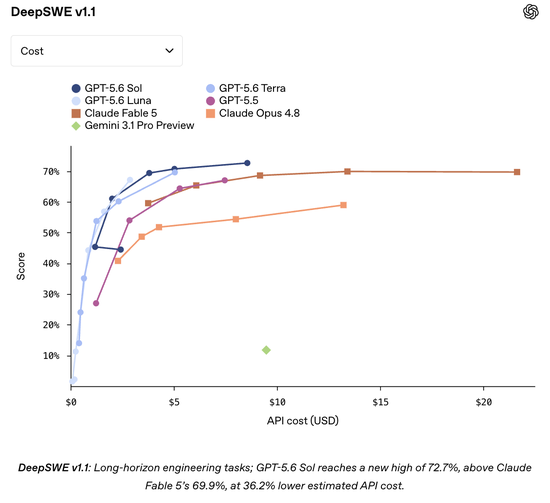
Actual measurement data from enterprise users confirms the above performance. Itamar Friedman, co-founder and CEO of code review platform Qodo, said that GPT-5.6 surpassed GPT-5.5 in both its internal and external benchmark tests.Moreover, the number of tokens required for each code review is reduced by approximately two-thirds, and the median delay is reduced by approximately 50%.
Fabian Hedin, co-founder of AI development platform Lovable, pointed out:
"After adopting GPT-5.6, the steps required for users to complete tasks are reduced by approximately 25%, the number of tool calls is reduced by 35% to 48%, and the project failure rate is reduced by 15%."
Multi-agent architecture turns on "ultra" mode
GPT-5.6 introduces a hierarchical computing scheduling mechanism, allowing users to flexibly choose the inference depth based on task requirements.
In addition to the standard high inference settings, OpenAI adds two new modes: "max" and "ultra":max gives the model longer time to think and modify the plan; ultra coordinates four parallel agents by default, sacrificing higher token consumption in exchange for stronger results and shorter delivery time.
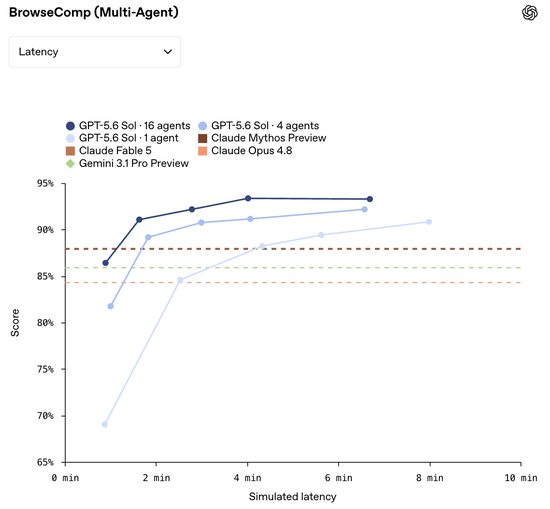
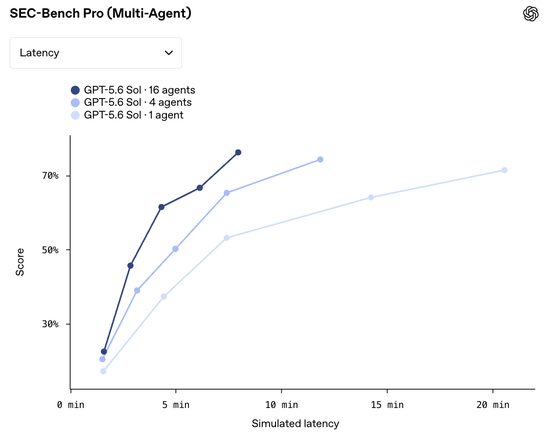
In the BrowseComp test, Sol Ultra set a new record with a score of 92.2%, and surpassed Claude Opus 4.8 in OSWorld 2.0 with a score of 62.6%, and the latter output token usage was 85% more than it. In the SEC-Bench Pro (vulnerability proof-of-concept generation for complex software) test, Sol reached 71.2%, while GPT-5.5 was only 45.8%.
At the API level, OpenAI simultaneously launched the Programmatic Tool Calling function, which allows GPT-5.6 to write and run lightweight programs in memory, autonomously coordinate tools, process intermediate results, and dynamically adjust the workflow during execution, thereby reducing the number of round-trip calls between models and tools while maintaining compatibility with the Zero Data Retention (ZDR) policy.
Cybersecurity and scientific research capabilities have jumped significantly
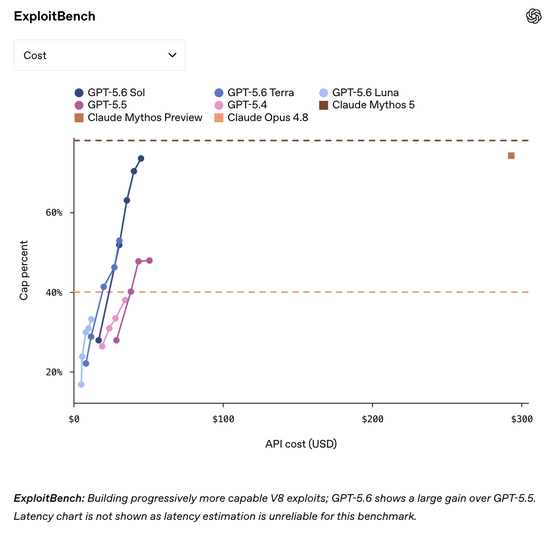
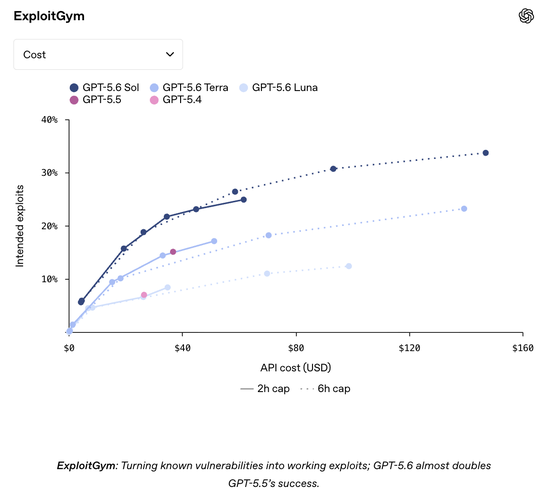
In the field of network security, GPT-5.6 Sol scored 73.5% in the ExploitBench evaluation, while GPT-5.5 was only 47.9%; in ExploitGym, its pass rate within the six-hour limit increased from 15.1% of GPT-5.5 to 33.7%.
OpenAI said that the model also has stronger capabilities on the security defense side, including security code review, vulnerability patching, threat modeling and blue team exercises.
To address dual-use risks, OpenAI, through its "OpenAI Daybreak Trusted Access for Cyber" project, is opening higher levels of defense capabilities to identity-verified individuals and organizations and implementing additional access restrictions on high-risk entities and high-risk areas.
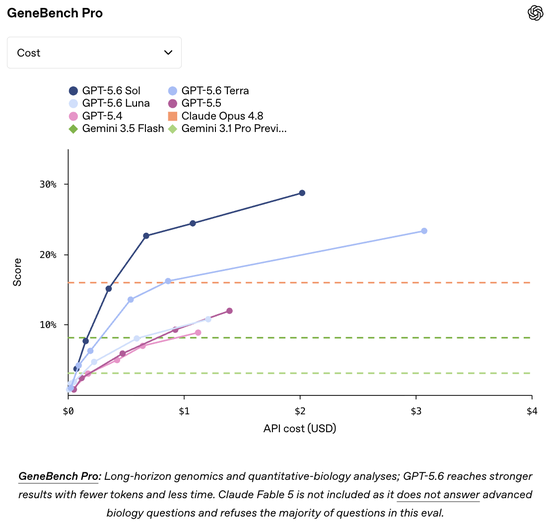
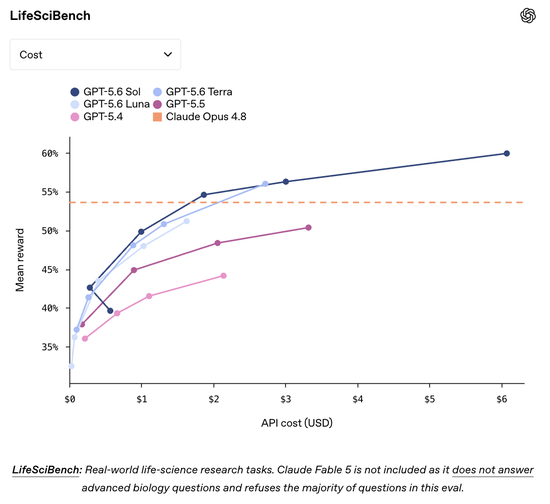
In the field of life sciences, GPT-5.6 Sol scored 28.7% in the GeneBench Pro (long-term genomics and quantitative biology) evaluation, far exceeding GPT-5.5's 12%; LifeSciBench scored 59.9%, higher than GPT-5.5's 50.4%.
OpenAI also stated that its test results show that GPT-5.6 does not yet have the end-to-end ability to create or synthesize high-risk new biological threats.
Security mechanisms are simultaneously upgraded, and conservative deployment strategies continue
As model capabilities improve, OpenAI simultaneously strengthens the security architecture in this release. GPT-5.6 Sol's network security protections block approximately 10 times more potentially harmful activity than previous generations.
Previously, OpenAI conducted about 700,000 A100e GPU hours of black-box automated red team testing before its official release, and collaborated with external experts to complete a large-scale manual and automated dual-track evaluation.
OpenAI said that its security system adopts a multi-layer redundant design: built-in protection of the model works in conjunction with real-time inspection, continuous monitoring and account-level execution mechanisms.
Different from pure classifier interception scheme,GPT-5.6 introduces the "reasoning monitor" to determine potential harm through conversation-by-conversation context analysis, so that the security boundary can be dynamically adjusted according to the usage scenario, and vulnerabilities can be quickly patched without retraining the classifier.
In view of the impact that excessive interception may have on legitimate uses, OpenAI provides a one-click option to switch to a low-capability model and try again in ChatGPT and Codex, and stated that it will continue to optimize to maintain high interception intensity while reducing accidental damage to normal use.
Internal applications demonstrate the self-accelerating trend of AI R&D
The release of GPT-5.6 also revealed major changes in OpenAI’s own research and development model. According to OpenAI, during the internal testing of GPT-5.6, the average daily number of tokens output by each active researcher exceeded twice the historical peak of GPT-5.5.
In the past six months, OpenAI's internal research computing power for programming reasoning has increased by 100 times, and the use of internal agent tokens has increased by approximately 22 times. This trend has extended to sales, marketing, user operations, finance and other functional departments.
In the self-improvement capability evaluation (RSI Index), GPT-5.6 Sol led GPT-5.5 with 57.9 points and 41.7 points, an improvement of 16.2 percentage points.
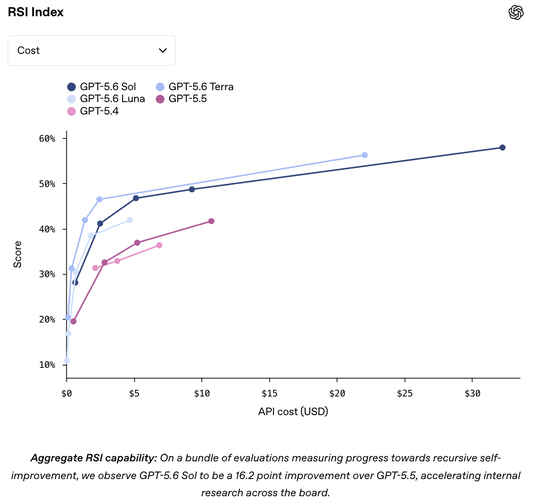
OpenAI interprets this as direct evidence that AI-assisted AI research and development is accelerating, and positions it as one of the core driving forces to promote the efficiency of subsequent model iterations.