Microsoft recently revealed that in order to test the new "shared audio" feature of Windows 11 in a real environment outside the laboratory, the company specially built a full-scale simulated aircraft cabin. This carefully arranged test venue was even later transformed into a short film shooting set, showing the development story behind the feature to the outside world.
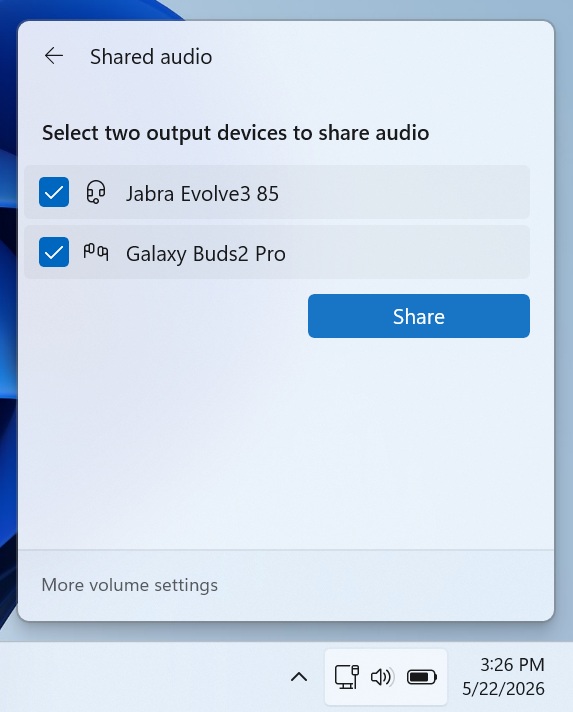
It is reported that the shared audio function of Windows 11 utilizes Bluetooth LE Audio broadcast streaming technology to transmit audio to two different Bluetooth devices at the same time. As long as the device supports this technology, users only need to pair two Bluetooth terminals, whether they are speakers, headphones or hearing aids, to easily achieve synchronized audio sharing. Currently, this feature is being gradually rolled out to all compatible personal computers. Early feedback is very positive, and its user experience is considered to be comparable to similar features in macOS. This is largely thanks to Microsoft's Windows Audio team, which is dedicated to testing the feature in a variety of real-life scenarios, including cabin environments.
Marcus Ash, Microsoft's director of design and research, said the company chose to build a simulated cabin because they wanted the integration of the technology to be more "humane" rather than just on a cold "technical level." Management hopes to gain a deeper understanding of users' actual usage and further optimize the experience by conducting tests in real-life scenarios such as airplane cabins, where people are densely populated, the space is small, and there is potential background noise. Marcus pointed out that the core of many excellent designs and research lies in getting close to these real moments and deeply understanding the situation behind the experience through observation, simulation, and prototype building.
This move to be close to users is closely related to Microsoft’s “K2” plan launched in March 2026. In the face of outside criticism of the Windows system, Microsoft hopes to actively adopt consumer feedback to improve the operating system through this plan. Microsoft says this effort has been directly influenced by Windows 11 users and is already bearing fruit, such as the launch of ad-free quick search and a more personalized Start menu.
The development of shared audio functions is also a reflection of this concept. Although it may sound exaggerated to build a fake airplane just for one function, it is indeed a long-standing demand of users. There have always been voices that believe that Microsoft is too out of touch with reality and does not understand the real needs of consumers. Now, by building a simulated cabin and testing shared audio under different noise conditions, Microsoft is taking action to understand real use cases. After all, that’s what a large corporate research team should really be doing.