You drive home and AI prepares lessons for you. At 4 o'clock in the afternoon, the school bell rang. An American middle school teacher packed up his things and drove home. While the car was still on the road, Claude had already started working for her. This was the task she had given her the day before: review each student's "exit ticket" that day one by one to see who had mastered it and who was still stuck, and then adjust tomorrow's lesson plan accordingly. She just arrived at school early the next morning, and the improved plan was already on the table. She only confessed once, and the AI automatically ran every day after that. Teachers across the United States are about to welcome such a free AI teaching assistant.
On July 14, Anthropic officially launched Claude for Teachers, providing free access to Claude’s advanced capabilities and a complete set of teaching skill libraries to authenticated K-12 (kindergarten to senior high school) teachers across the United States. It is also directly connected to 50 state curriculum standards and a batch of research-verified ready-made courses.
This time, Anthropic has set its sights on the entire workflow of K-12 teachers.
Why do they give their models to teachers for free? What does this mean to teachers and children in the classroom?
teacher's week
What was it eaten by?
How much work does an American K-12 public teacher do in a week? Average 49 hours.
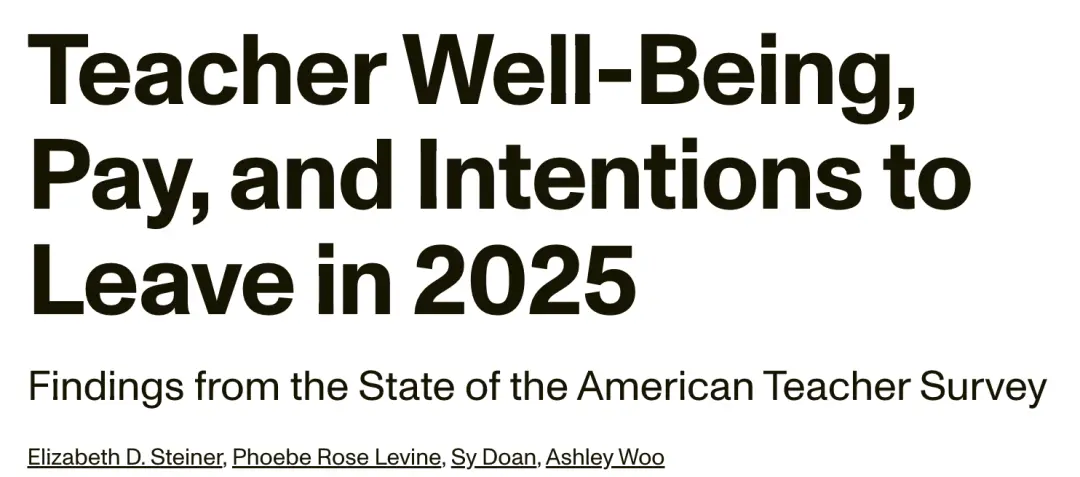
RAND's "State of American Teachers" 2025 Survey: Teachers work an average of 49 hours per week, a full 10 hours more than contract hours. (Source: RAND)
Preparing lessons, attending classes, correcting homework, filling out forms, and attending meetings mostly last until evenings and weekends.
In the past few years, teachers have used AI to generate teaching materials, but almost all have fallen into the same trap: they look beautiful, but they are boring to teach.
The grade level is not right, a key link in the curriculum has been skipped, or the teaching method is not consistent with the textbooks selected by the school.
As a result, all the time saved by AI was spent on inspection and rework.
Just as Forbes pointed out the paradox: alignment should have happened before the teacher got the materials, not after.
To put it bluntly, what the teacher wants is not that AI can "generate", but that "the generated things can be directly used."
The gap in the middle happens to be the most exhausting step.
Claude puts the 50 state curriculum standards
Stuffed into its brain
It is this step that Claude for Teachers wants to take.
It is connected to a system called Learning Commons and obtains the academic standards of the 50 states in the United States, as well as the more detailed ability points under each standard and the students' usual learning order.
What it can do for teachers is roughly three yuan.
The first step is to prepare lessons and align them.
Let it run a lesson, and what comes out is not a beautiful but dangling PPT, but a lesson plan that has been aligned with the curriculum standards of your state and set up in the order of learning.
Drew Bent, head of Anthropic Education, gave an example: if you ask it to teach "how to construct a linear function", it will first pull out the corresponding lesson marks, mark the mistakes that students are most likely to make in this area, and then build the lesson around these mistakes.
Once the teacher gets it, he no longer has to spend 20 minutes checking "whether this thing meets our curriculum standards."
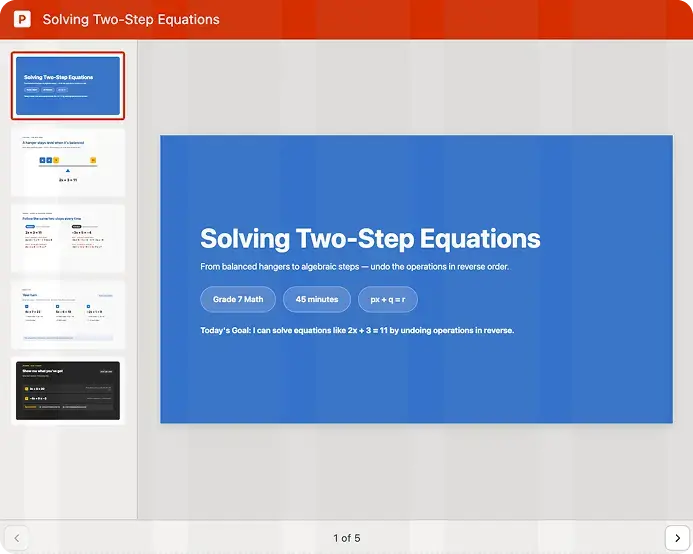
After connecting to Learning Commons, Claude automatically creates a lesson plan and student materials based on the state's curriculum standards and learning sequence. (Source: Anthropic official)
The second piece is differentiated stratification.
In the same class, students have different levels. The biggest headache for teachers is to prepare a suitable teaching plan for each person. If you ask Claude to change it according to different levels, it will come up with a set of hierarchical plans:
For those with a weak foundation, add "sentence starters" and scaffolding to make them accessible; for those who have room to learn, add more; for children whose native language is not English, lay a layer of language transition.
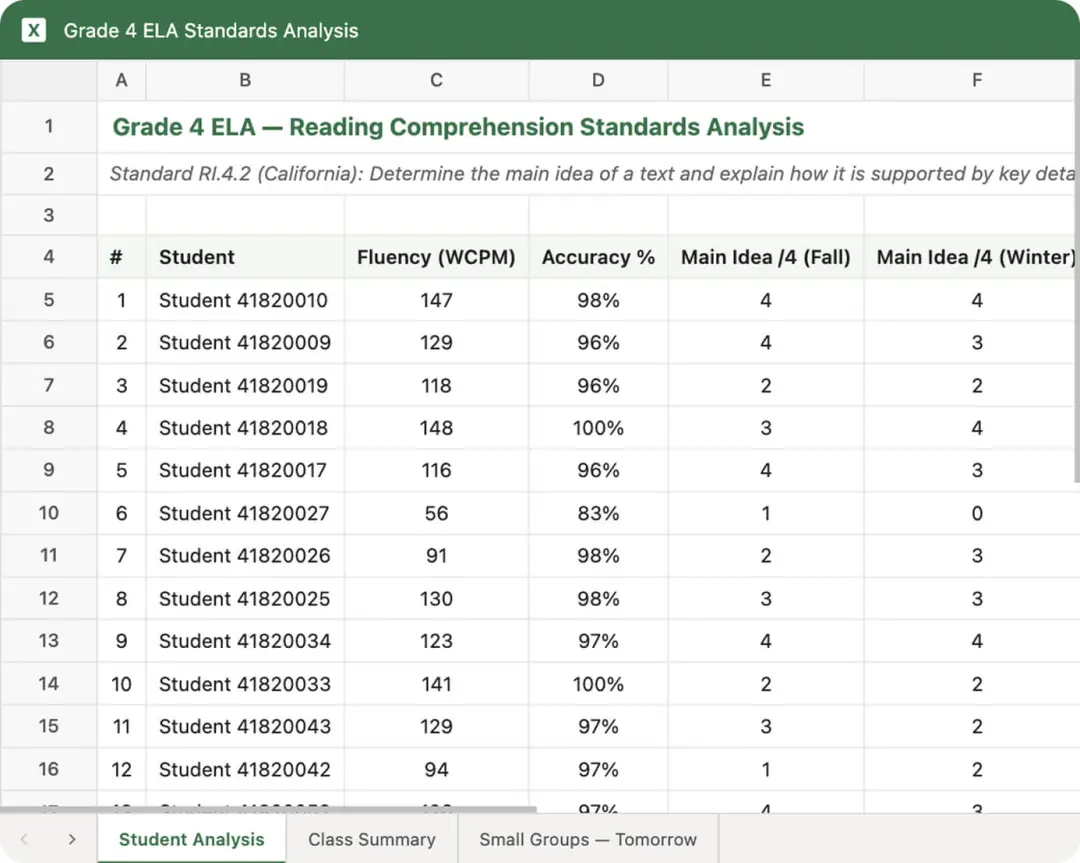
The same class is automatically stratified according to student level (Source: Anthropic official)
The third piece is data analysis.
Throw the roster, diagnostic results, attendance, and random notes to it, and it will spell out for you where each student is standing now: who is falling behind, and which knowledge point the whole class does not understand.
You have the final say whether and what data should be given, and whatever you hand over will not go into model training.
In addition to these three pieces, 9 K-12 ecological connectors are also connected:
ASSISTments produces math questions that are aligned with course standards and can be automatically scored. Canva turns teaching materials into designs that can be directly used in the classroom. There are also Brisk, Diffit, MagicSchool, TeachFX, etc.
The set of tools that the teacher was familiar with are now strung together in Claude.
More importantly, it also brings Claude Code and Cowork.
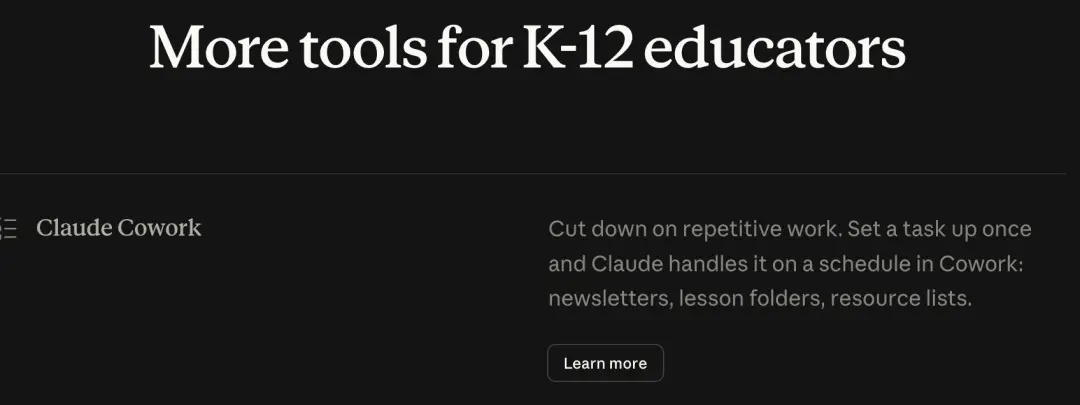
This means that it is no longer just "question and answer", but can push the work forward by itself, and even set it as a scheduled task to run every day.
The teacher hands over a repetitive task once, and it can run it for you every school day.
Students can't touch Claude
The teacher has been talking for a long time, what about the students?
In theory, students are the ones who ultimately benefit.
In traditional education, it is almost a luxury for a teacher who has to face dozens of people to truly teach students in accordance with their aptitude.
Claude can now develop personalized teaching plans for teachers, and teachers on Reddit have already used it to create tools for special education scenarios, such as helping their partner in special education organize an IEP (individualized education plan).
This sounds beautiful, but one thing must be pointed out: the students themselves cannot touch Claude.
Anthropic has a strict rule: Claude is only open to those over 18 years old. Therefore, the vast majority of K-12 students do not have accounts at all. Whether they can benefit or not depends entirely on how well the teacher handles it.
The official tone for this product is also very clear: Claude for Teachers is a tool for teachers. It does not replace teachers, nor is it directly fed to students.
Why so cautious? Because of the student-side AI, there has long been a quarrel.
Cheating, cognitive offloading (cognitive offloading, that is, the brain is too lazy to move, and everything is left to AI), whether generative AI should be used in early childhood education... each one is more controversial than the last.
This year, Norway simply issued a near-ban rule for students in grades 1 to 7: they are not allowed to touch generative AI during class.
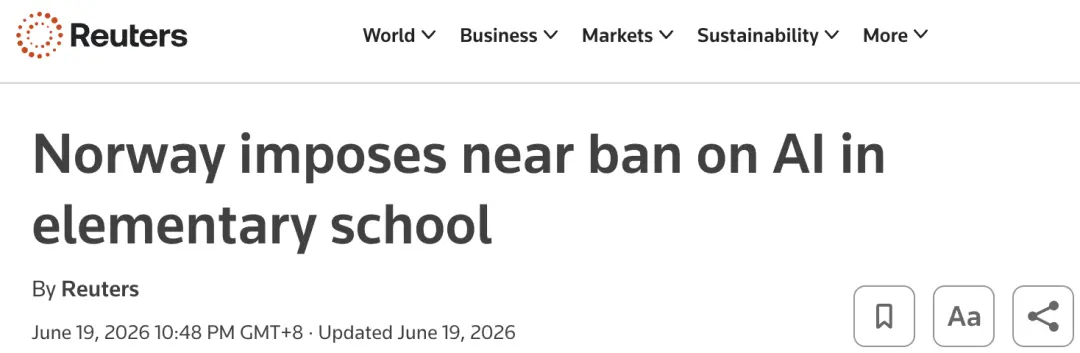
On June 19, Norwegian Prime Minister Storey announced that generative AI would be almost banned for students in grades 1 to 7. They are not allowed to touch it during class, and it will take effect in late August of the new school year.
Anthropic obviously wants to avoid this minefield: I don’t touch the students, I only arm the teachers.
Not replacing the teacher
It is to return the teacher to the students
Let me make one thing clear first:
What Claude takes over is repetitive tasks such as reviewing outgoing tests and adjusting tomorrow's lesson plans. It is not "marking all homework at a fixed time every day", and automatic grading only reaches the level of practice questions.
Anthropic's positioning for it is very clear: to reduce the burden on teachers, return the time they save to teaching, and provide real connections between people that cannot be automated.
This is not the first time Anthropic has done education.
From integrating Claude into the teaching system of American universities, rolling out student ambassadors and AI clubs, to today's primary and secondary school teachers, it has taken root step by step.
This time, the entire set of teaching skills is also open sourced, coupled with an AI literacy course for K-12 teachers.
So what does it picture? The answer is not complicated: teachers are the entrance to schools and school districts.
This style of play seems familiar.
Eight months ago, OpenAI released ChatGPT for Teachers: it is also free, it is also for American K-12 teachers, it is also free until 2027, and it also involves the American Federation of Teachers (AFT).
You can copy the style of play, but in education, what really determines success or failure is not which model is smarter, but trust.
Therefore, Anthropic plays its trust card very well: "data does not enter training", "complies with FERPA" and "special K-12 data processing terms". It also jointly builds a set of privacy Gold Standards with AFT, and union chairman Randi Weingarten personally stood up for it.
The other side of the coin is the lingering doubts in the community.
Some people are worried about student data privacy, some are worried about education being overly automated, and some are raising old scores: the children of Silicon Valley executives go to schools without technology products.
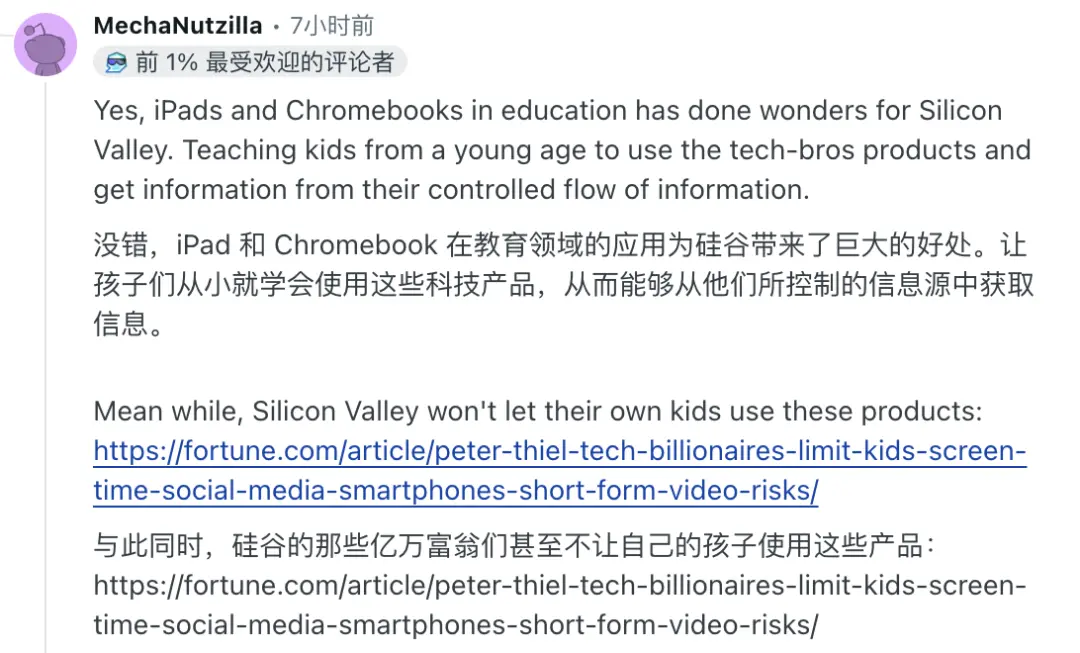
Some netizens also said that it would be wise for Norway to almost ban generative AI from grades 1 to 7.
Therefore, model capabilities are just the ticket. FERPA compliance, data isolation, and teacher union endorsement are the thresholds for true implementation.
But the story is not over yet, it leads to a bigger question:
When this generation of children grow up, AI is already as ubiquitous as the air. Can a child who has only been "taught with AI" by his teacher since he was a child but has never actually used AI himself, be truly prepared?
Claude for Teachers is not ready to answer this question yet.