Recently, a research team led by Harvard University's John A. Paulson School of Engineering and Applied Sciences made a breakthrough in the field of biotechnology: they successfully developed a water-based silicon chip that can synthesize DNA by precisely controlling enzymatic reactions through current. This result was published in the journal Nature Electronics on June 17, 2026, providing a new way to create safer and more environmentally friendly DNA.
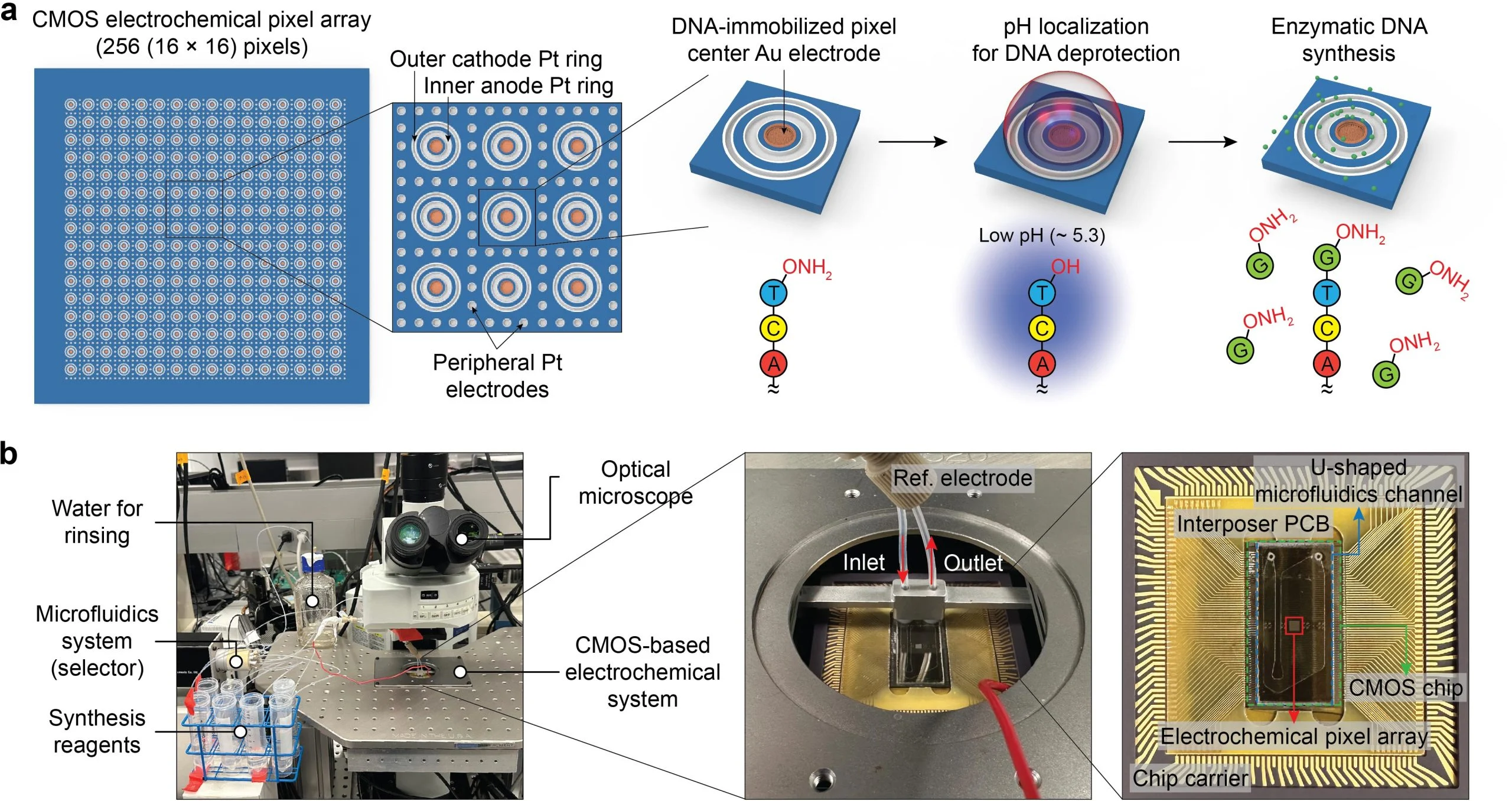
Silicon chips have long been at the heart of the computing revolution, but their applications have now expanded to cutting-edge areas such as neuron recording, DNA sequencing and even DNA manufacturing. Currently, the vast majority of synthetic DNA on the market uses phosphate amide chemistry. Although this method can generate DNA sequences in large-scale parallelism, its production process relies heavily on dangerous organic solvents and is often concentrated in large facilities. In contrast, the enzymatic synthesis process adopted by the Harvard University team this time is closer to the natural way that living organisms build DNA, and has a high degree of environmental protection advantages.
The silicon chip developed this time can simultaneously synthesize 64 different DNA sequences, each of which can be up to 39 nucleotides in length, setting a new benchmark record for parallel enzymatic DNA synthesis. The technology's working principle makes clever use of electric current: 64 DNA synthesis sites are integrated on the surface of the chip, each equipped with a pair of concentric ring electrodes. When it is necessary to add nucleotides, the chip injects current through the internal electrode to generate protons around the DNA chain to lower the pH value, thereby starting the enzymatic reaction; at the same time, the external electrode simultaneously consumes the diffusing protons to prevent the acidic environment from spreading to adjacent areas, ensuring precise control of the synthesis process.
Woo-Bin Jung, a member of the research team and currently an assistant professor at Pohang University of Science and Technology (POSTECH), said that this technology was inspired by electrode chips that were previously used to record neuron activity. By redesigning the surface electrodes, the researchers transformed their function from manipulating cells to directional control of molecular synthesis. In addition, the researchers also successfully encoded 169 bytes of text through the chip, demonstrating its application potential in the field of DNA data storage and laying the foundation for future large-scale, low-pollution DNA manufacturing.
Although the research encountered limitations in high-density array experiments on smaller sizes, the scientists found that this was mainly limited by the current deprotection chemical reaction mechanism rather than the electronic control capabilities of the chip itself. This discovery points the way for future research to develop more direct chemical techniques for acid-driven deprotection. This project brings together the research forces of Harvard University, the Broad Institute, DNA Script and other parties, and is expected to have a profound impact in the fields of synthetic biology, medical diagnosis and digital information storage in the future.