Researchers at the Japan Advanced Institute of Science and Technology (JAIST) recently developed a new soft robot gripper inspired by the trunk of an elephant. The device, called EleTac, is able to "sense" the objects it touches like a real living thing, bringing an innovative breakthrough in haptic technology for soft robots.
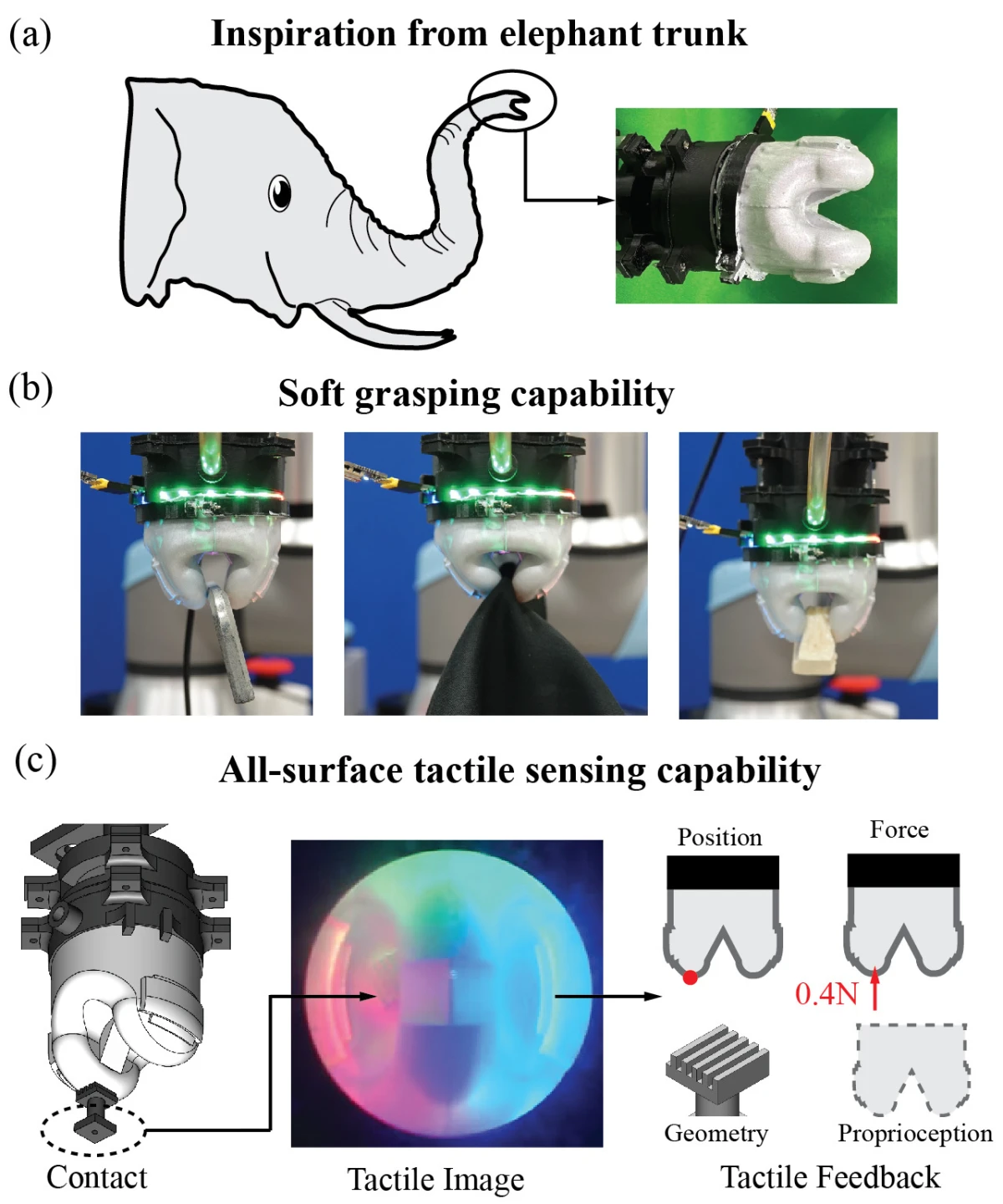
Traditional soft robot grippers usually rely on external cameras or additional sensors to detect and grasp objects. However, when the gripper completely wraps the object, the external camera often becomes blind and cannot see the real-time status of the contact point. In order to solve this pain point, the research team changed their thinking and instead of installing cumbersome external sensors on the gripper, turned the entire gripper itself into a large sensor.
The EleTac gripper is made from a soft, rubber-like material and features two flexible fingers. It doesn't use a built-in motor, but relies on vacuum pressure in a pneumatic tunnel to operate: as the air is pulled out, the soft walls bend inward, allowing the two fingers to slowly come together and gently pinch the object. Its core innovation is hidden inside the gripper - a tiny internal camera is integrated at the end of each finger, which can observe the deformation of its own "skin" in real time when it comes into contact with objects. In order to ensure that the image is clear and bright, the researchers also installed a lighting system composed of red, green and blue LED lights inside.
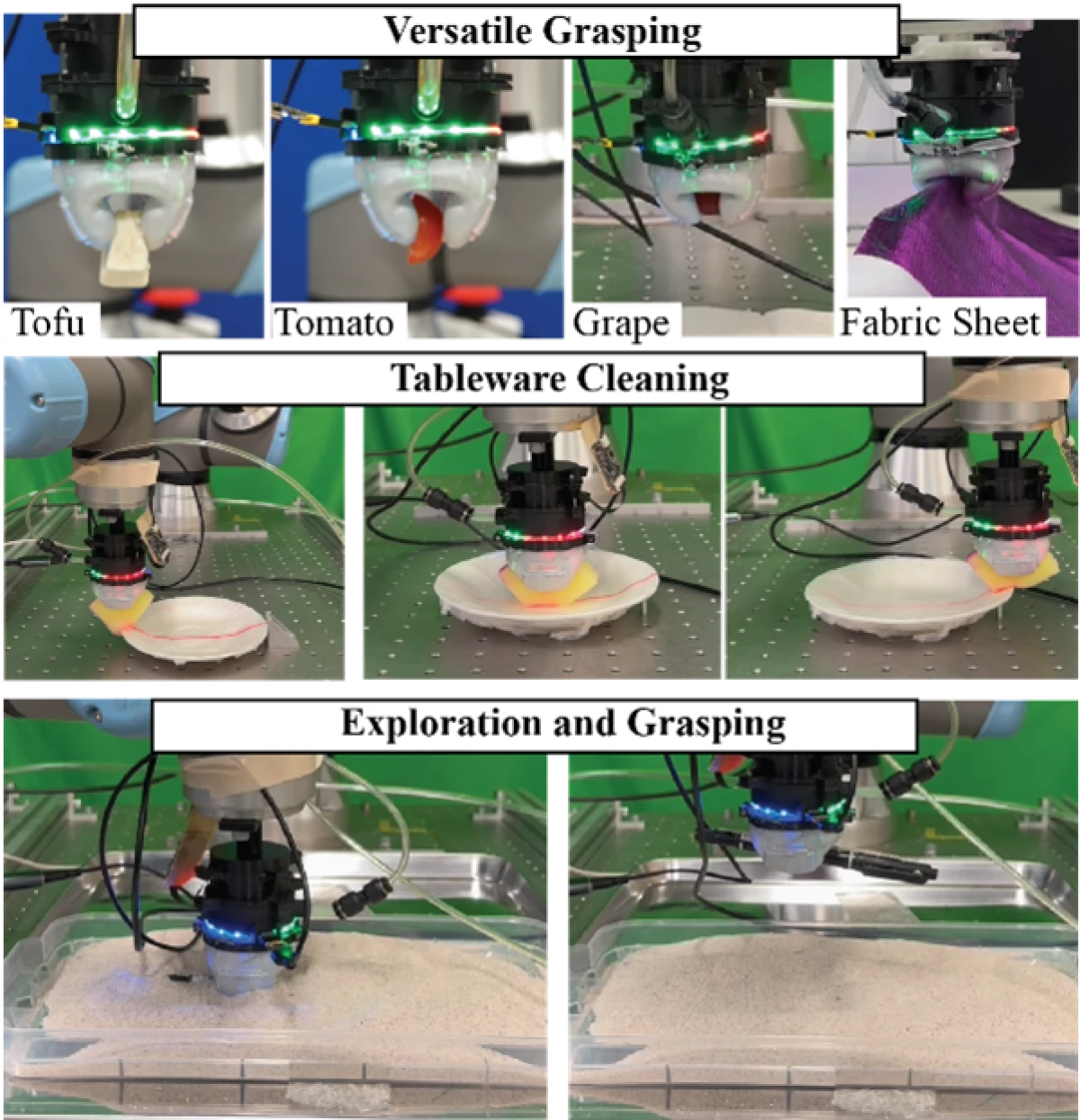
After taking hundreds of images of the gripper's deformation, the team used the data to train an artificial intelligence algorithm to accurately recognize the amount of force exerted, the shape of the object and the degree of bending of the fingers. In a series of experiments, the gripper successfully completed a number of extremely challenging tasks, including searching for and grabbing a completely buried ballpoint pen under a thin layer of sand. Since the external camera could not see the buried pen at all, the robot relied entirely on the "tactile" touch of the fingertips to sense the difference in texture between the sand and the pen, accurately locate and lift it. In addition, EleTac is used to hold a sponge in the hand to scrub dishes, and adjusts the grip strength in real time based on tactile feedback to complete the cleaning job securely.
The research team hopes that this technology, which combines grasping and tactile sensing, will help the next generation of robots to be more comfortable handling fragile items in the future, and to be capable of more complex and demanding daily tasks than washing dishes.