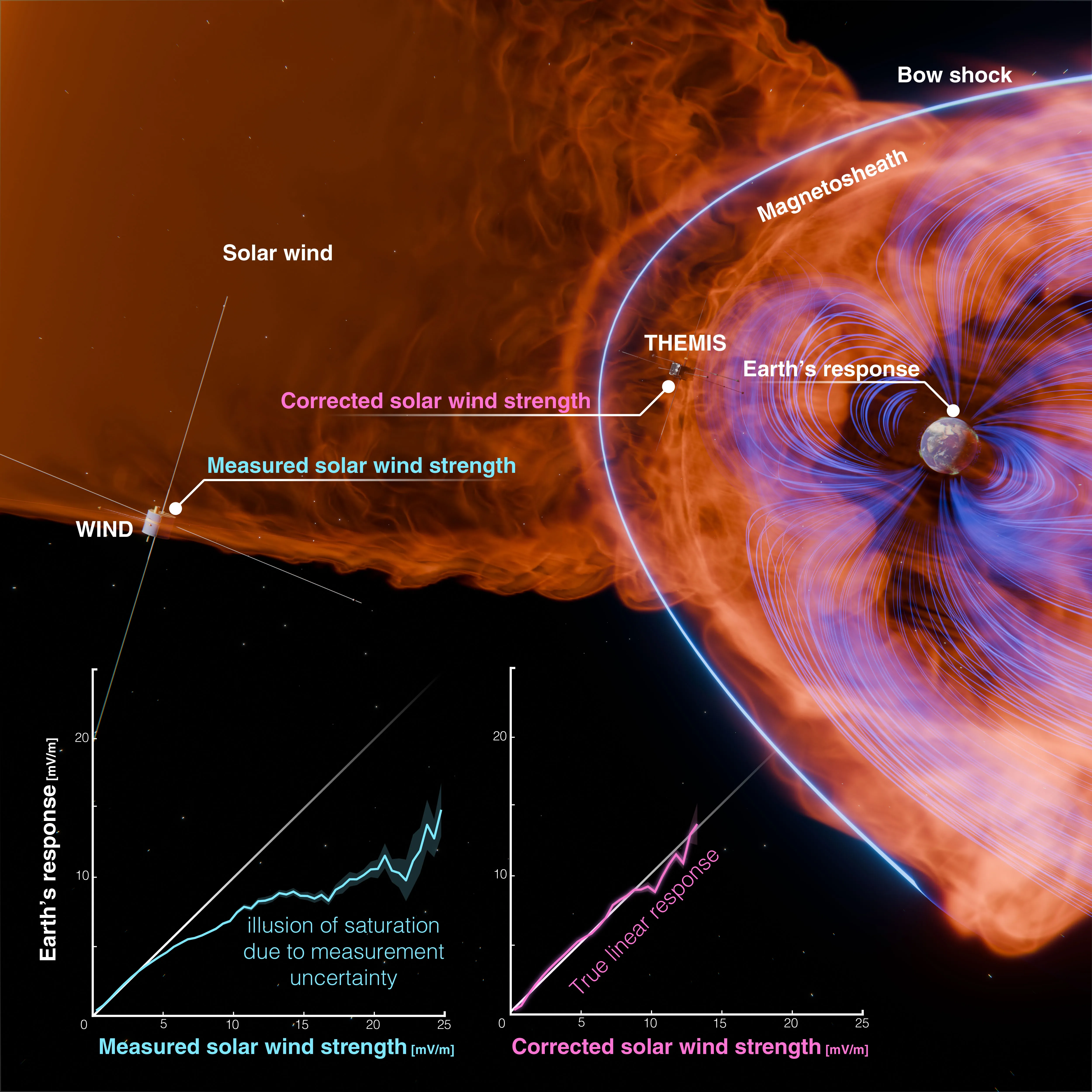
Recently, a research team led by scientists from the National Aeronautics and Space Administration (NASA) published an interesting new study in the journal Nature. The study pointed out that in the past, academic circles generally believed that there was a "saturation point" in the earth's response to extreme geomagnetic storms. This theory may only be caused by data bias and statistical illusion. This means that when extreme solar events are encountered in the future, the actual damage caused to the earth may be twice as severe as previously expected.
In its daily activities, the sun will eject plasma composed of high-energy charged particles into space from time to time. This is a coronal mass ejection. When these charged particles rush towards the earth at high speed, without the protection of the earth's magnetic field, they will cause a devastating blow to the satellites, power grids and various electronic infrastructures on which human beings depend. Looking back at history, the "Carrington Event" that broke out in 1859 was the strongest geomagnetic storm ever encountered by mankind. At that time, it paralyzed some telegraph office systems and caused fires. To better assess the risks facing our modern electronic society, researchers have long combined observations from ground-based magnetometers with solar wind data from distant probes.
However, in the past data accumulation process, scientists have found that the relationship between solar storm intensity and high-latitude geomagnetic activity shows a gradually slowing curve trend, as if there is some kind of ceiling or upper limit in geomagnetic activity. Previously, the scientific community has proposed various hypotheses for this "saturation effect", such as the oscillation of charged particles restricting particle motion, the magnetic field reconnection rate decreasing under certain conditions, or the plasma pressure dynamics constraining the current.
After re-examining the original data and correcting for relevant uncertainties, the latest research team led by NASA scientists found that this seemingly curved graph can actually be explained by a common statistical phenomenon - "reversion to the mean." The researchers note that this statistical bias is particularly evident when dealing with uncertain measurements of extreme values, and that previous data analyzes have not fully taken into account the high degree of uncertainty in the timing and intensity of solar wind events.
If these uncertainties are correctly factored into the calculations, the actual solar wind drive measurements should actually be less extreme, which means there is no so-called "defensive upper limit" for the Earth's magnetic field. The research team concluded that after correcting for data errors, the Earth's response to solar wind driving is actually completely linear, and the actual impact of extreme geomagnetic storms on the Earth may be twice as high as previously expected. This research not only refreshes mankind's understanding of the limits of space weather, but also sounds a warning to prevent extreme solar storms in the future.