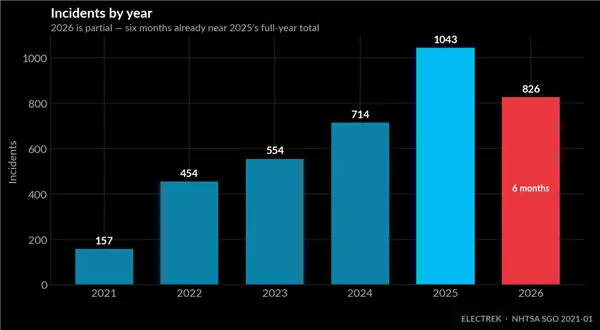
According to Electrek, Tesla’s latest accident report submitted to the U.S. National Highway Traffic Safety Administration (NHTSA) shows:In May 2026, its driving assistance system recorded a total of 207 accidents, setting a record for a single month. This number even exceeds the total number of accidents in 2021, which was 157.
NHTSA's Standing General Order (SGO) requires automakers to report if an advanced driver assistance system (ADAS) is activated within approximately 30 seconds before a collision and the accident reaches a severity threshold such as airbag deployment, vehicle towing, casualties, etc.
After merging NHTSA's latest exported data with complete archives since 2019 to remove duplicates, Tesla's cumulative L2 autonomous driving (Autopilot and FSD) accidents reached 3,763, accounting for approximately 85% of the total number of ADAS accident reports in the entire industry.
Moreover, the growth of accidents is accelerating rather than slowing down. In 2025, Tesla ADAS accidents exceeded 1,000 for the first time, reaching 1,043 for the whole year.
In the first half of 2026 alone, 826 cases were recorded. Comparing on the same basis (January to June), the data for the same period in the past five years were 180, 261, 269, 476 and 826 respectively, a year-on-year increase of 73%. At this rate, the number of accidents for the whole of this year will be roughly double that of last year.
The increase in the total number of accidents is certainly related to the expansion of the fleet and the increase in FSD mileage, but the key is that Tesla is the only organization that has the denominator data of mileage.
Tesla has never released independently audited Autopilot and FSD mileage data, and its quarterly "safety report" has even been criticized by its own AI trainers as misleading. Whether the accident rate per mile is declining is impossible to verify.
What is even more concerning is that Tesla deleted 99.9% of the accident descriptions in the 3,763 accident reports on the grounds that they involved trade secrets.
The accident severity field is overwhelmingly marked as unknown,The software version field was also blacked out, making it impossible to distinguish whether the accident occurred in Autopilot or FSD mode in public documents.
By comparison, General Motors, Ford, Honda and Toyota make almost no similar levels of redactions in their accident reports, with Tesla being the only major automaker to black out nearly every detail. Tesla has argued to regulators that the company would "suffer financial harm" if the data were made public.
It's worth noting that the latest data may be an underestimate due to reporting lags.When the latest export data was added, the final number of accidents in May was revised upward by 139 accidents.
In other words, 207 is the lower limit, not the upper limit, and NHTSA is currently conducting a separate investigation into Tesla's accident reporting methods.