Oxygen is a key element for maintaining life on earth. However, nowadays, whether it is the vast oceans, coastal waters, or rivers, lakes and streams on land, the dissolved oxygen content has shown a continuing downward trend. This not only directly threatens various aquatic organisms that rely on oxygen for survival, but also gradually destroys the key chemical balance in the water body. Researchers from the Scripps Institution of Oceanography at the University of California, San Diego and other institutions jointly issued a warning stating,This widespread lack of oxygen in water bodies is pushing the earth to an "unsafe" critical state, with far-reaching consequences that may even exceed the time span of human existence.
The research team systematically evaluated the interaction between water hypoxia and nine core systems in the "Planetary Boundaries" framework. This framework was first proposed in 2009 and aims to assess whether human activities have pushed the earth's environment away from a suitable state of stability and resilience by identifying the health of the earth's key systems. The nine boundaries currently included in the framework cover climate change, ocean acidification, biodiversity loss, atmospheric aerosol loading, stratospheric ozone depletion, changes in freshwater resources, land use changes, chemical pollution, and biogeochemical flows represented by the nitrogen cycle. In their latest research, scientists strongly call for the loss of dissolved oxygen in water bodies to be formally included in the framework as one of the important indicators for assessing the health of the earth.
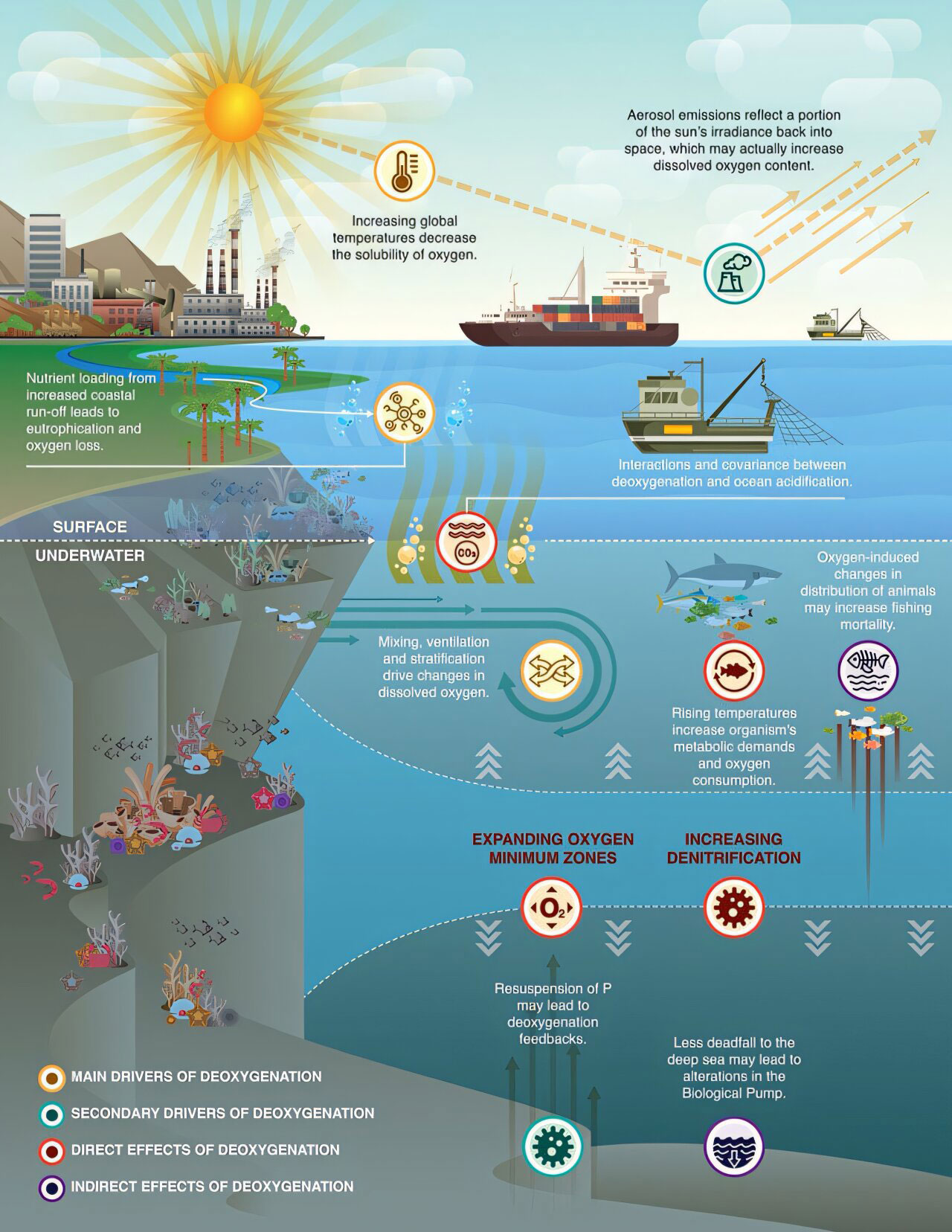
The study points out that hypoxia in water bodies is not an isolated environmental event. Climate warming caused by human activities, eutrophication pollution caused by excessive discharge of nutrients, and changes in water circulation that make it difficult to replenish oxygen in deep waters are the main factors driving water hypoxia. Not only does hypoxia interfere with biological and chemical processes that help regulate the Earth's climate, it also poses a severe challenge to the survival of large aquatic life, from tiny microorganisms to fish, sharks, and more. Even marine mammals that breathe air directly at the surface of the water suffer indirect impacts from habitat changes caused by lack of oxygen, prey loss, and destabilization of entire food webs.
The idea for this study began at the 2019 United Nations Climate Change Conference (COP25) in Madrid. The researchers hope that by incorporating water hypoxia into the early warning mechanism, policymakers and academia will be encouraged to treat it as equally important as major crises such as climate change and respond in a coordinated manner. Scientists emphasize that the overall stability of the earth system is inseparable from a healthy aquatic ecosystem, and maintaining the normal operation of the aquatic ecosystem must be based on sufficient dissolved oxygen. Controlling and alleviating hypoxia in water bodies is not only a core part of protecting global biodiversity, but also an indispensable and solid barrier to cope with the climate crisis and maintain the stability of the global environment.