
Abstract:
After tracking consumer AI applications for three full years, well-known venture capital a16z has just released the seventh edition of
"Top 100 AI Consumer Applications"
List. What is sad is that this traffic-based list has been completely solidified: only 11 new products are on the list in this issue, a record low.
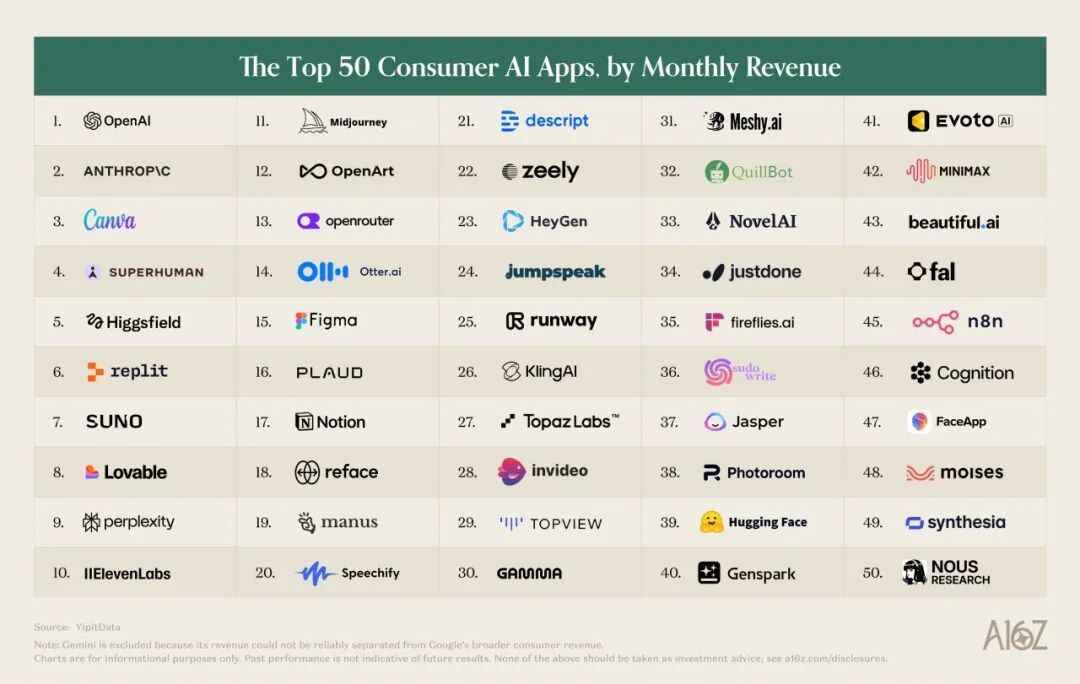
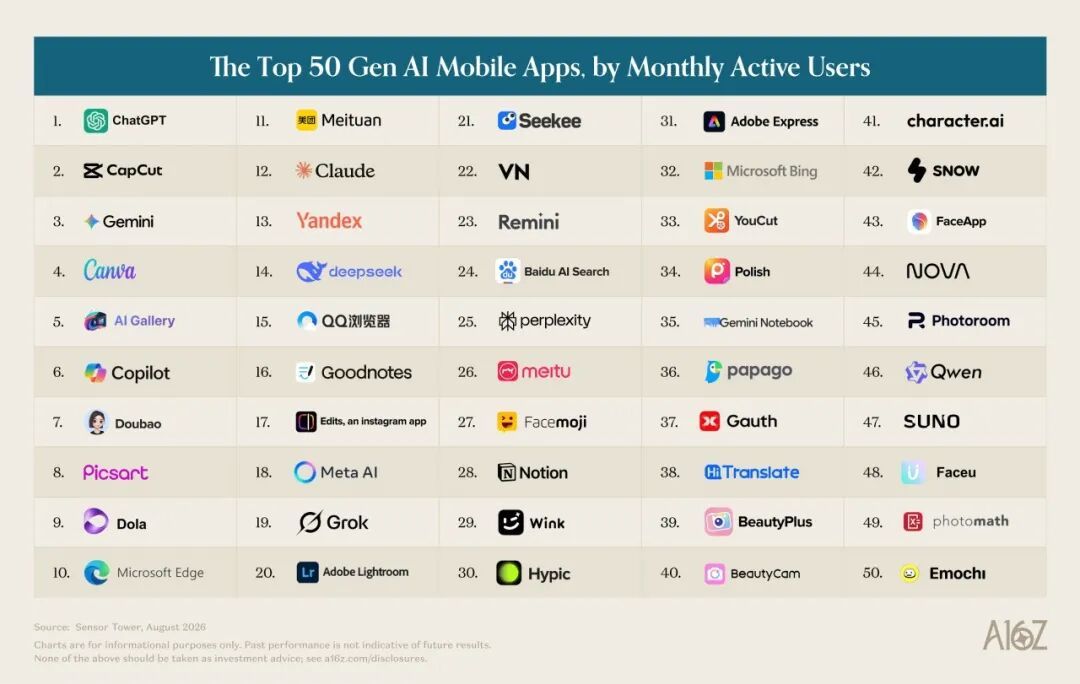
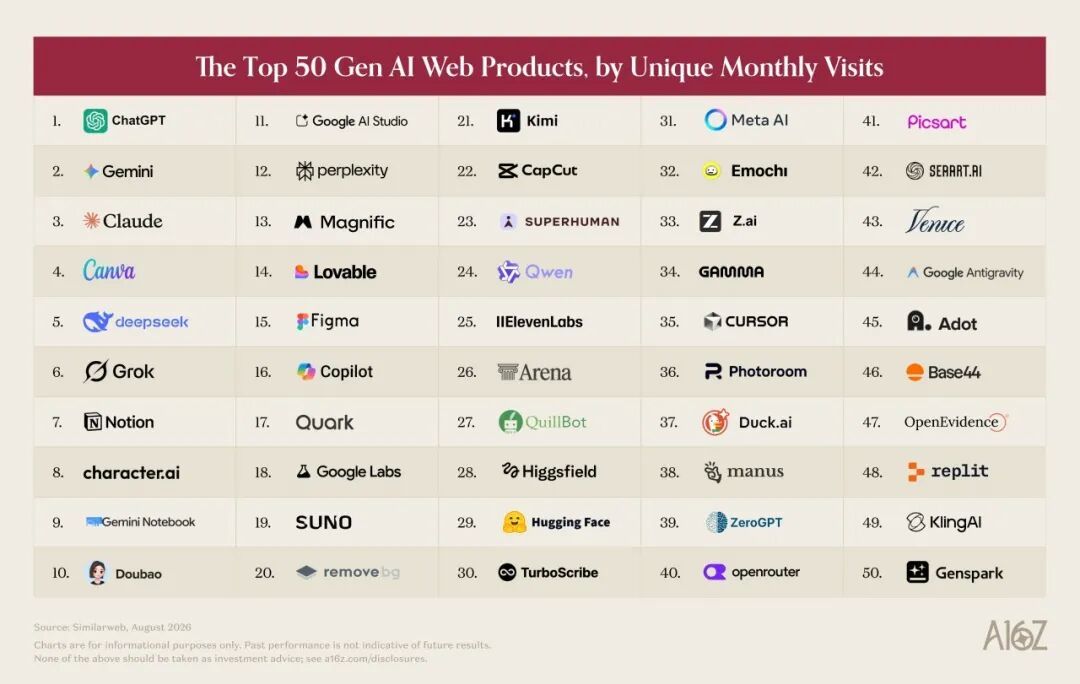
It’s not that the strongest AI model has lost its appeal, but that the “traffic” indicator itself has become somewhat distorted. More and more people are beginning to quietly use AI on the desktop or in traditional Internet software, and these behaviors will not enter the statistical caliber of traditional web traffic at all.
In order to see the truth clearly, a16z introduced real consumption data of US consumer credit cards based on YipitData for the first time. This list, piled with real money, reveals an extremely counter-intuitive and even cruel reality in the current AI industry:
AI has attracted a large number of users, but only a few are willing to continue paying. The revenue of manufacturers is increasingly focused on professional users who use it for work. In order to break this deadlock, AI manufacturers have also begun to look for new sources of revenue besides subscriptions, and an exploration around "who will pay for AI" has begun.
With $903 a month, who is supporting the AI empire?
AI is widely used, but surprisingly shallow.
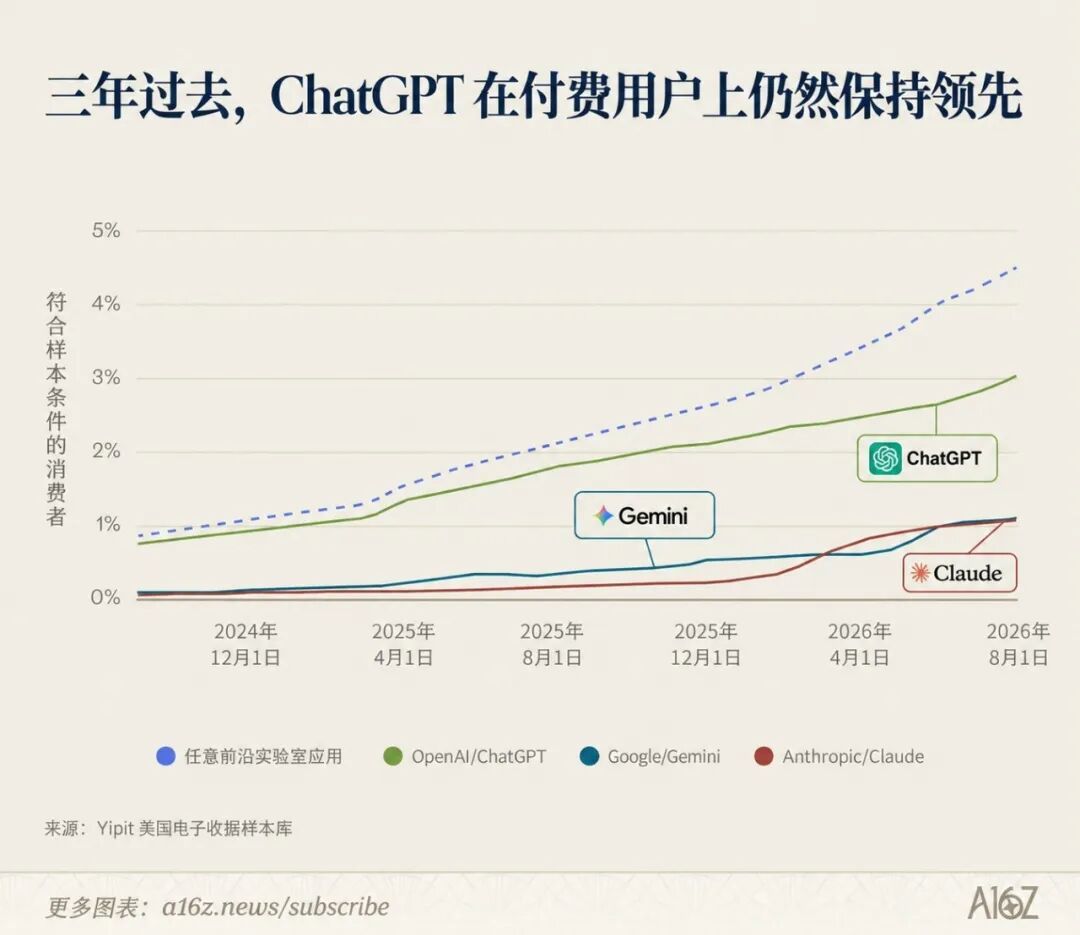
While nearly half of Americans claim to have used AI, only 25% use it on a daily basis. What’s even more worrying is that as of August this year, only 4.5% of consumers actually paid to subscribe to ChatGPT, Gemini or Claude.
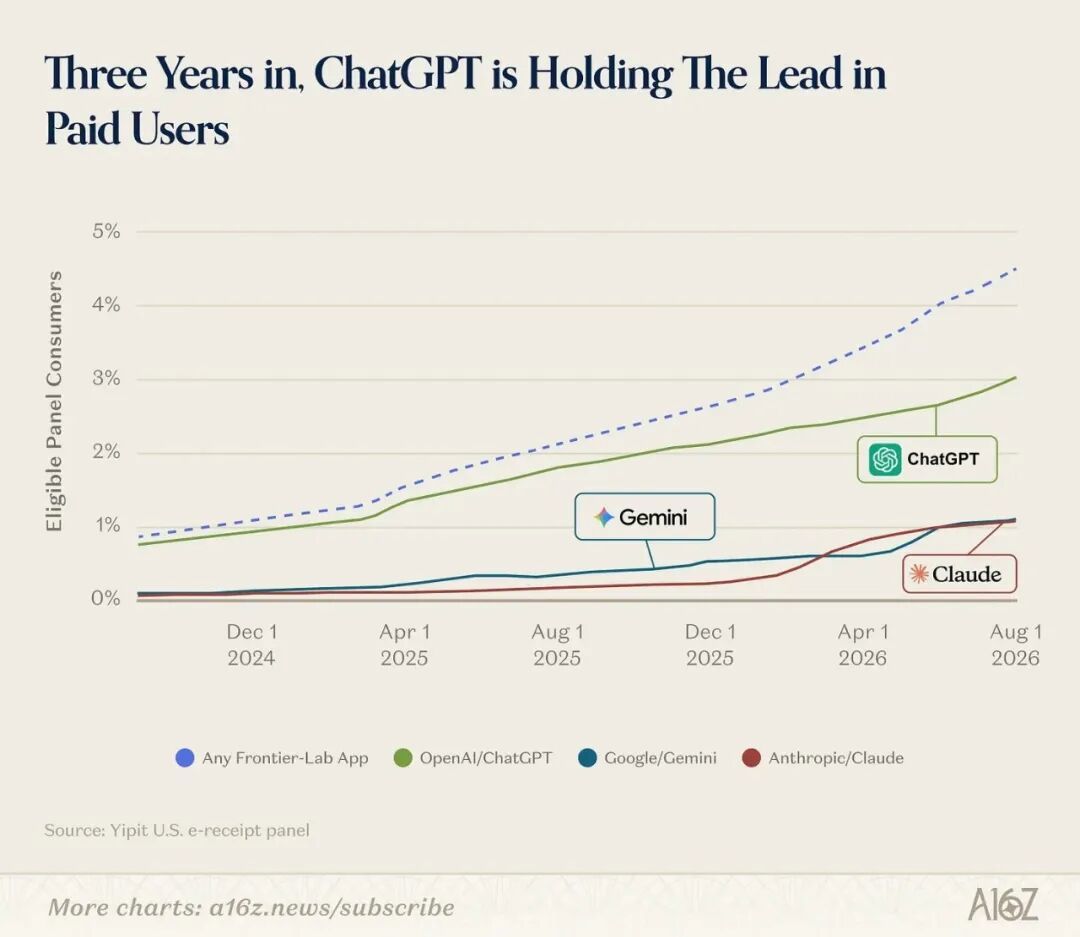
So, who do those AI unicorns with valuations of tens of billions or hundreds of billions of dollars rely on to support themselves?
The answer is the 1% of "super money players" at the top of the pyramid.
Data from a16z shows that the AI consumption market shows an extreme power law distribution:
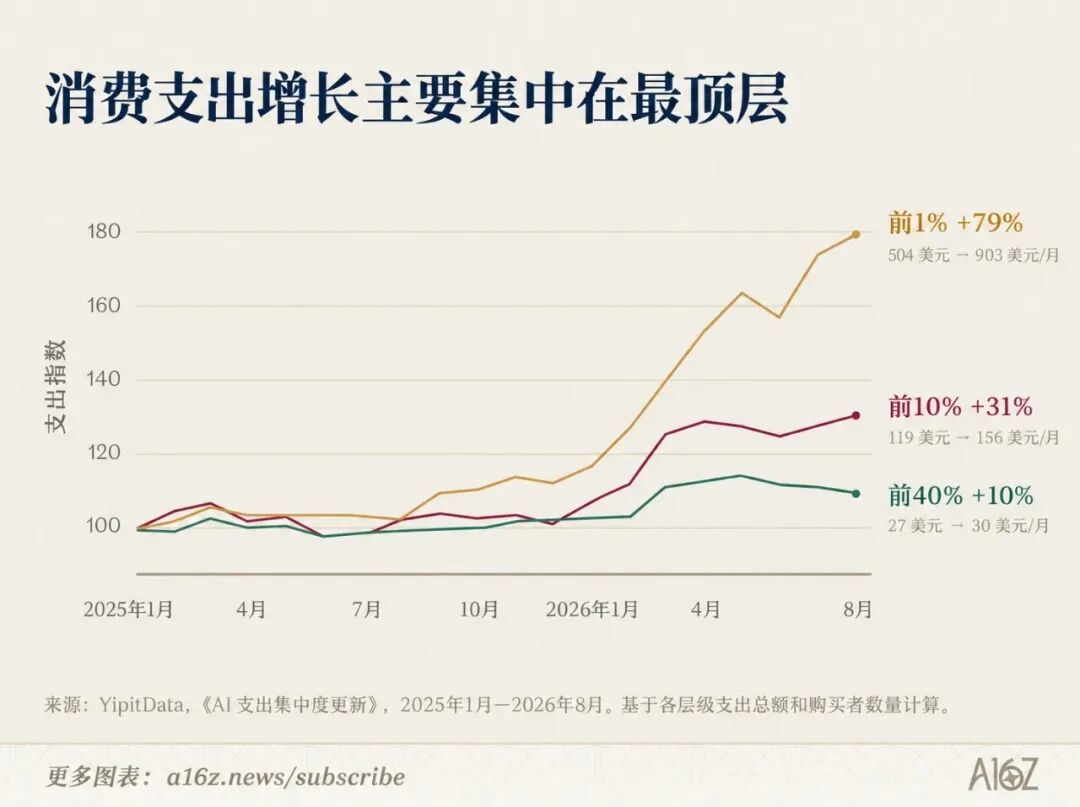
The top 1% of paying users contribute 19.5% of the revenue of the consumer AI market, even exceeding the total expenditure of the bottom 50% of users (16.6%)
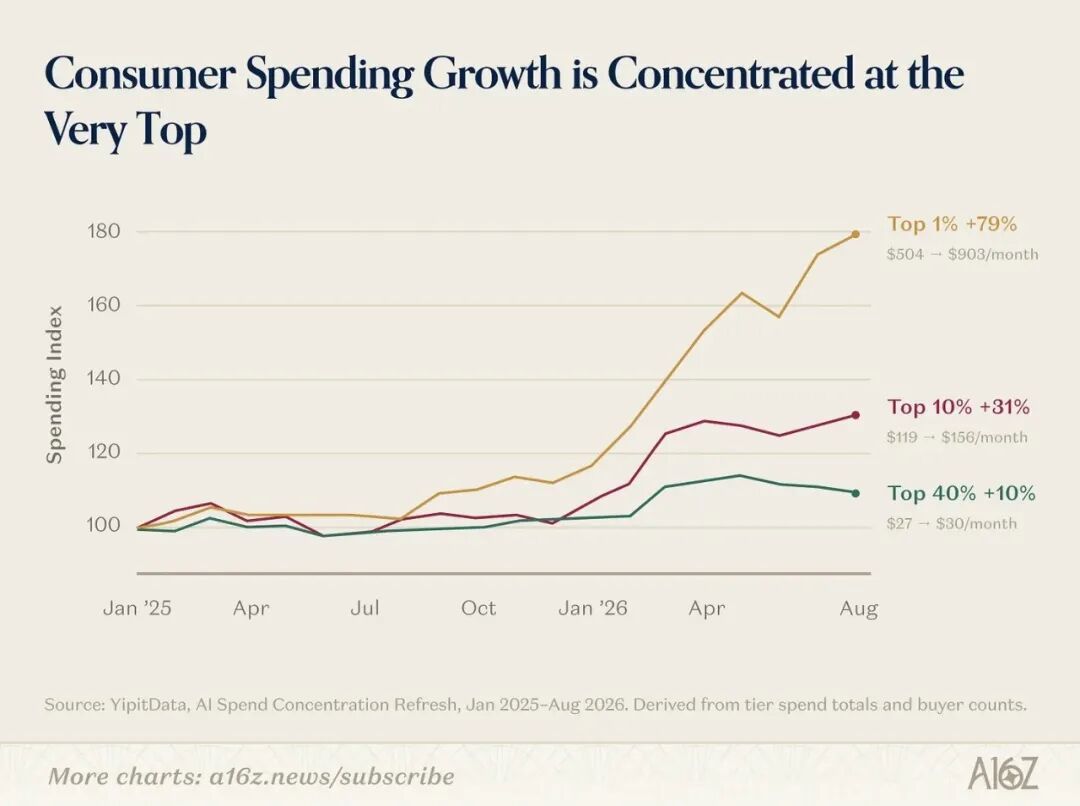
.These pyramid paying users spend a staggering US$903 (approximately RMB 6,054) on AI tools every month, and their consumption has soared by 80% in the past 18 months.
By comparison, the average median paying user spends just $25 per month, and their budget is barely growing.
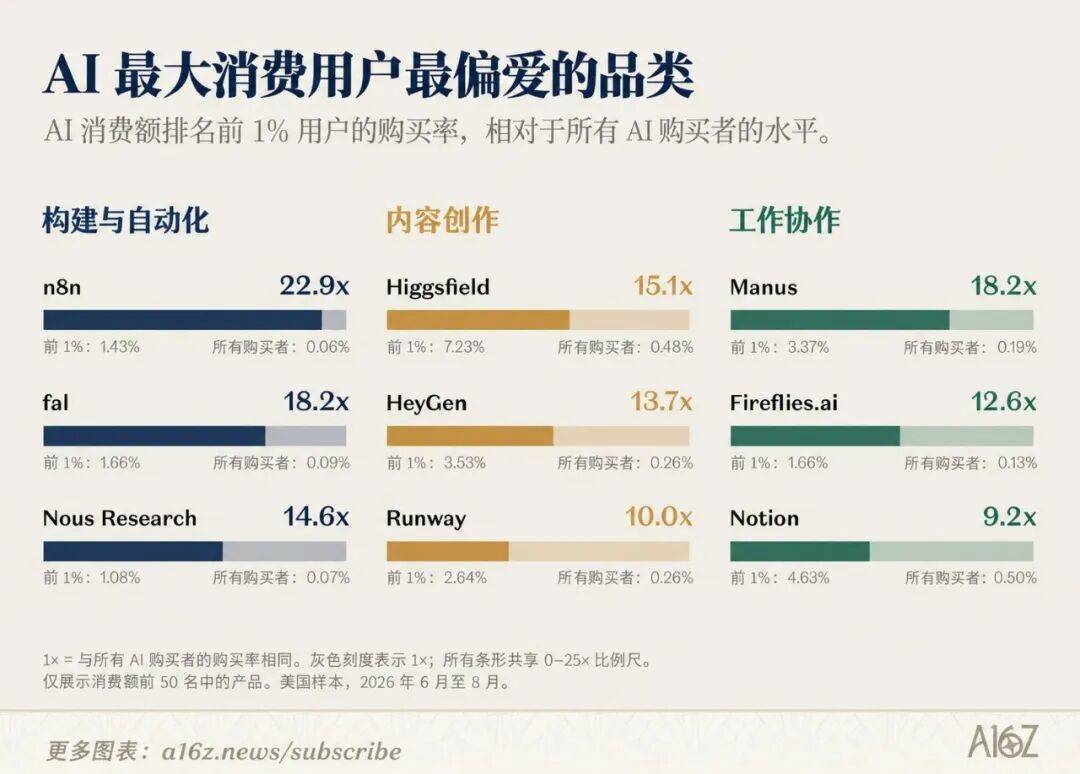
While these super players are frantically purchasing automation tools such as n8n and Manus, they are also spending heavily on creative productivity platforms such as Higgsfield, Figma, and HeyGen.
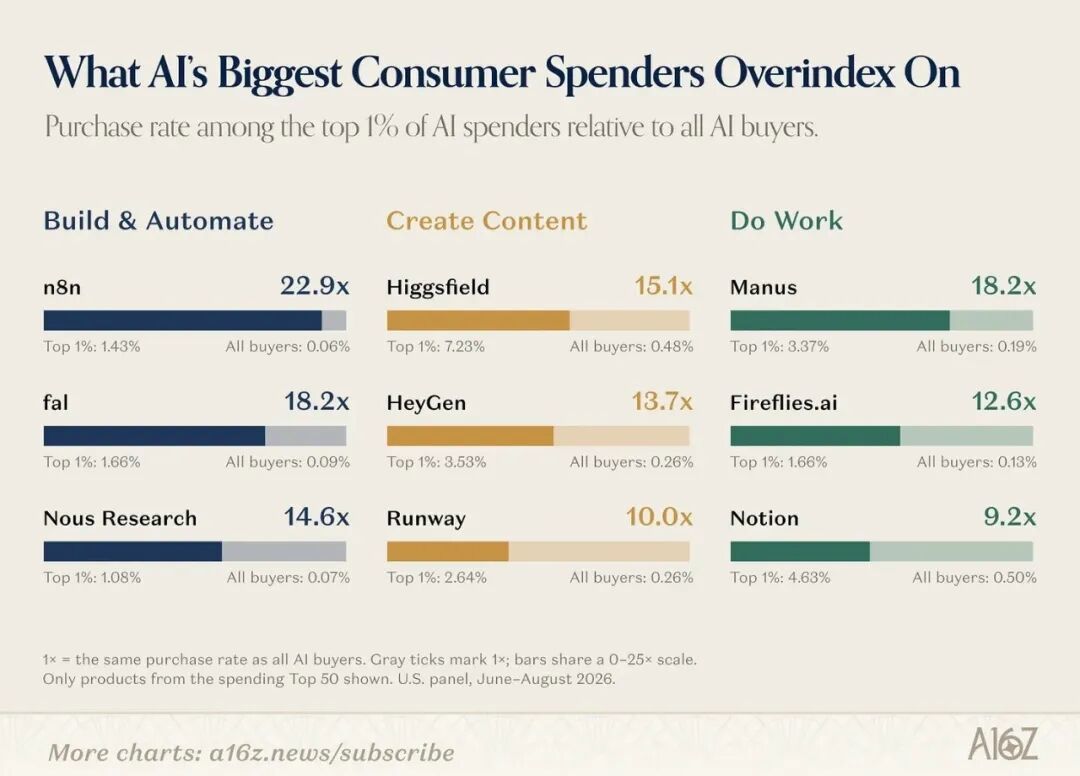
This also explains why there is a huge disconnect between the "traffic list" and the "revenue list": 29 of the top 50 AI suppliers ranked by real consumption do not appear on the traffic list at all.
In the three major lists of web traffic, mobile monthly activity and real revenue calculated by a16z, only 7 companies can be on the list at the same time: except for the two big brothers ChatGPT and Claude, the others are only the modeling company Suno, AI native applications Perplexity, Photoroom, and the old giants Canva and Notion.
The vast majority of star products that rely on free traffic cannot be squeezed into the real consumption table.
After releasing 127 products in half a year, Claude counterattacked with “purification”
Besides super users, the mass market is still the Shura field of the Big Three.
In order to compete for users, Anthropic, Google and OpenAI frantically released 127 new products in just six months.
There is no doubt that ChatGPT is still the absolute king.
Whether it is on the web or on the mobile side, its traffic has a crushing advantage over Gemini and Claude (the monthly activity on the mobile side is even 14 times that of Claude); in terms of the number of paid subscribers, ChatGPT is a full three times higher than the latter two.
In July this year, with the release of the GPT-5.6 family (Sol, Terra, Luna) and ChatGPT Work, its growth engine roared again.
But the most noteworthy variable is Claude's sudden emergence.
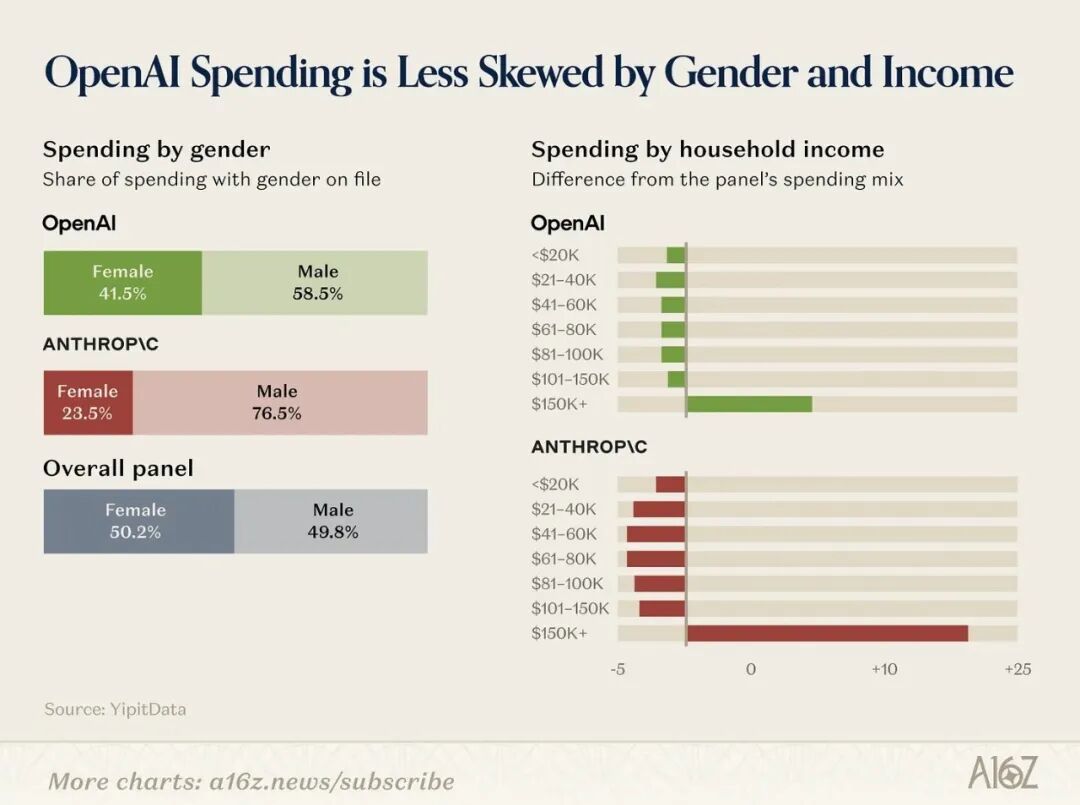
In the first edition of the list in September 2023, Claude did not even find this person; now it has not only greatly increased its traffic, but also briefly surpassed Gemini, who was born with a silver spoon, in the number of paying users in the United States earlier this year.
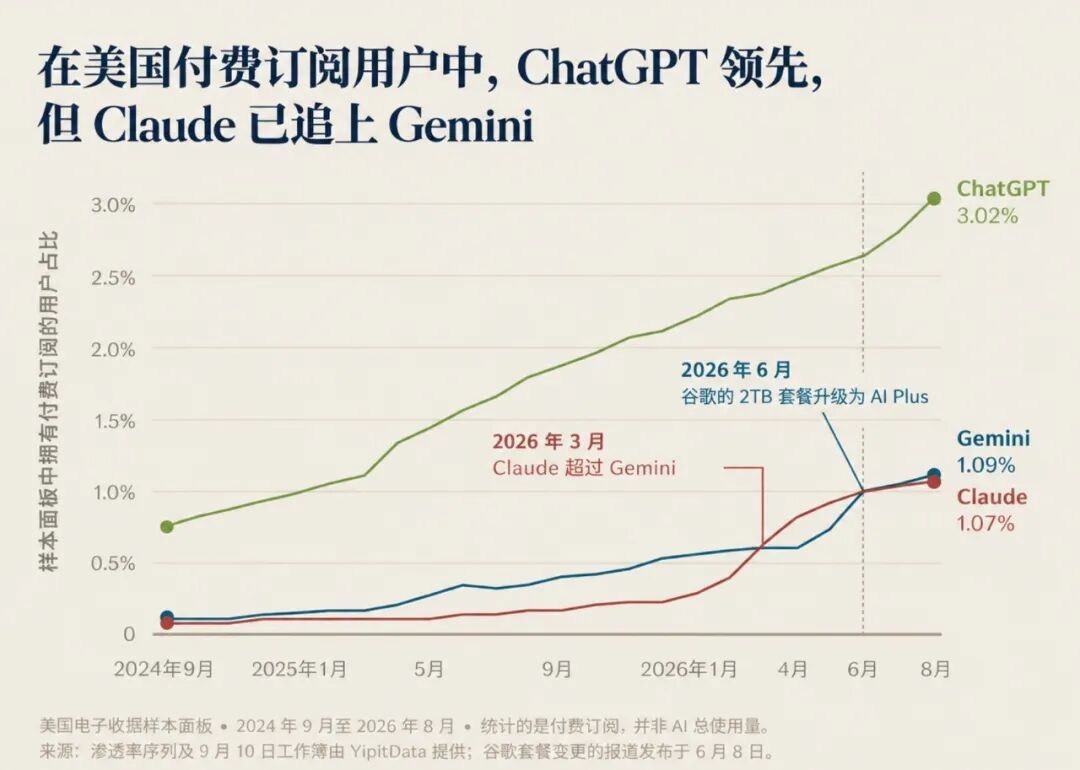
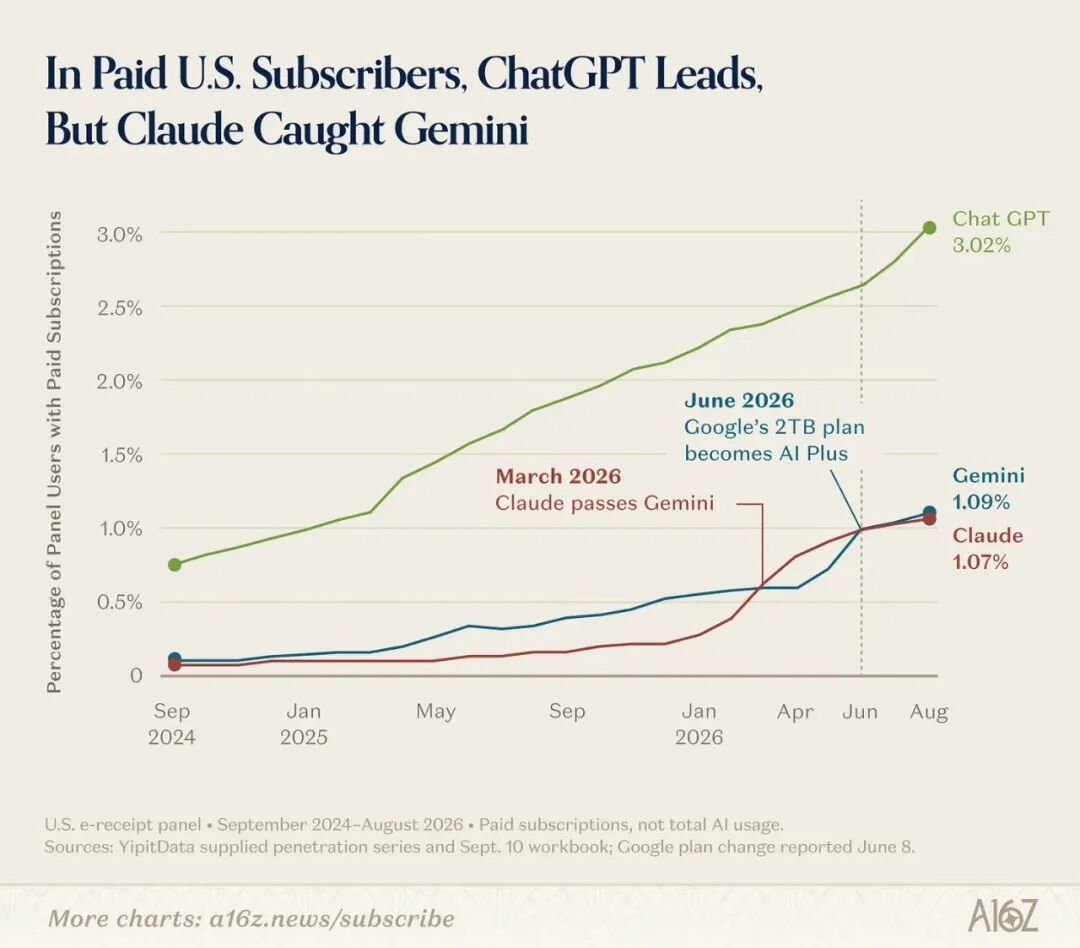
Ultimately, Anthropic's style of play is all about one big miracle.
While ChatGPT tried to do it all (launching tools for personal finance, job hunting, and even health) and Google pounced on creative models (Lyria 3 Pro, Gemini Omni), Claude focused almost entirely on prosumers (Claude Design, Code Review).
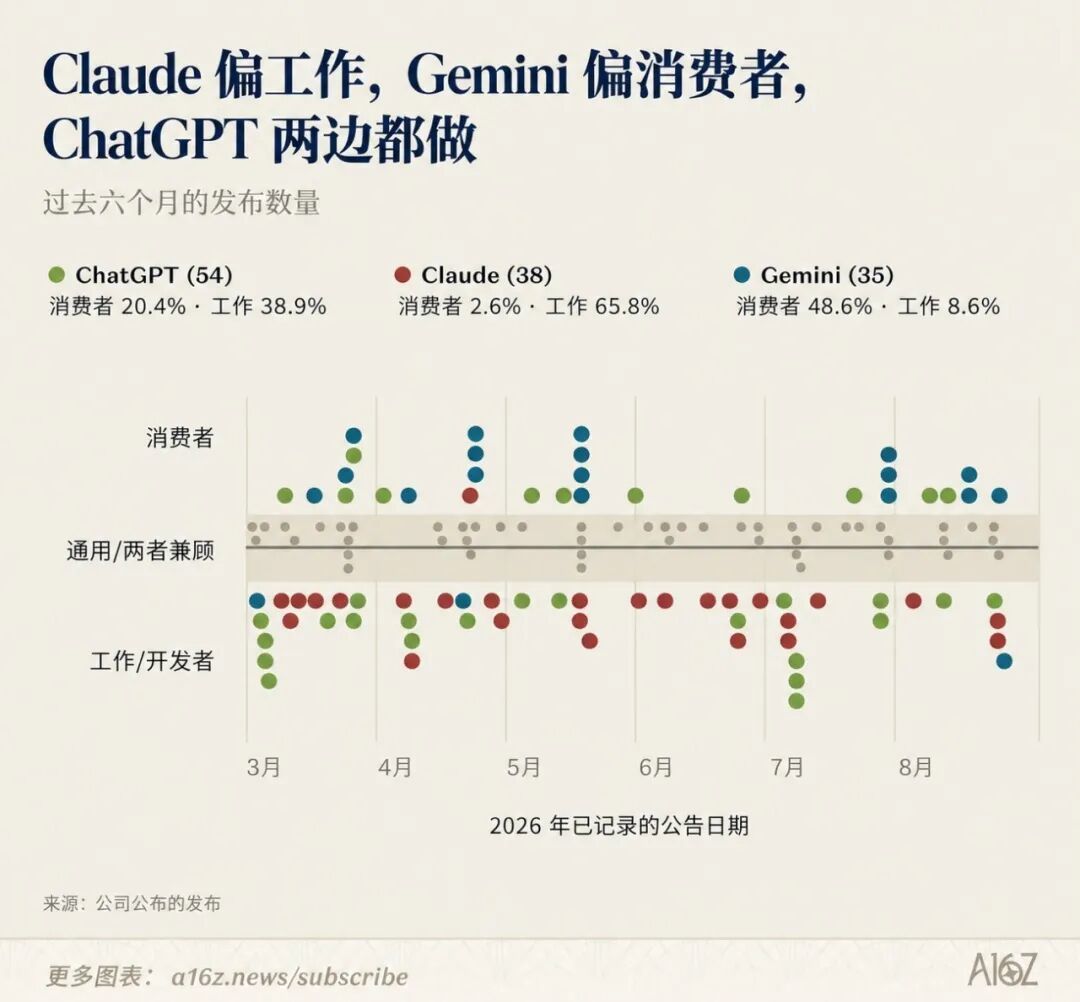
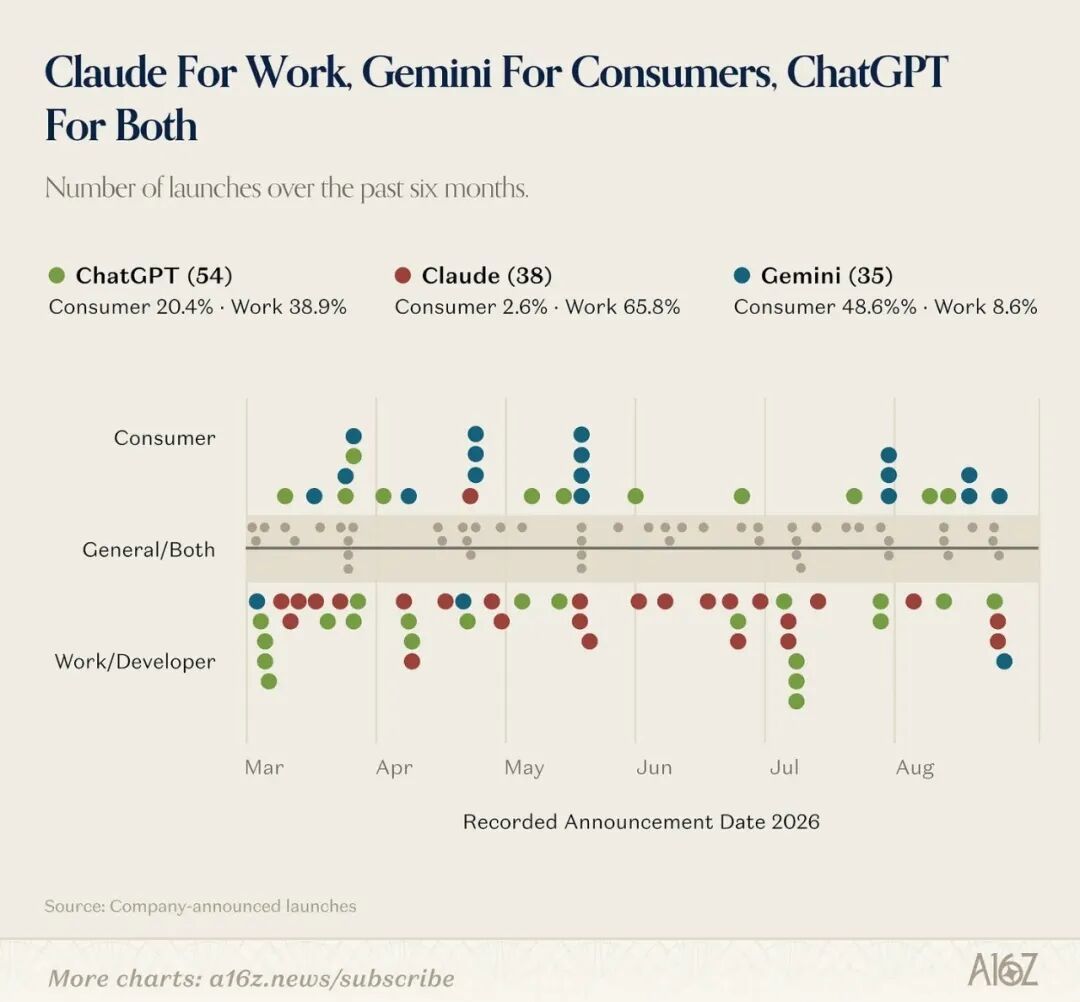
In addition, Anthropic has made it clear that it will never touch advertising. With its excellent model, subscriptions from C-end users are becoming an important source of revenue.
In Claude’s highest-end personal subscription plan of up to US$100/month, 7.3% of paying users paid for it; for comparison, the conversion rates of Google and ChatGPT on the same-priced packages were only 1.3% and 1.1% respectively.
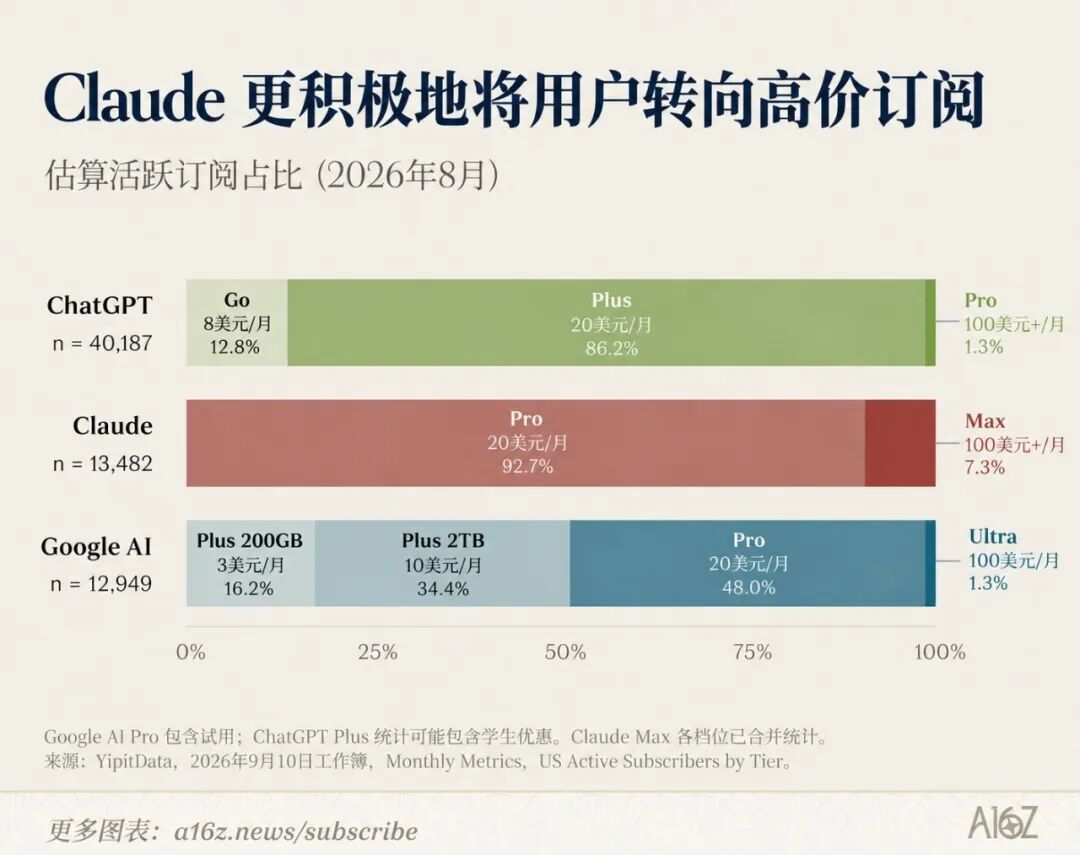
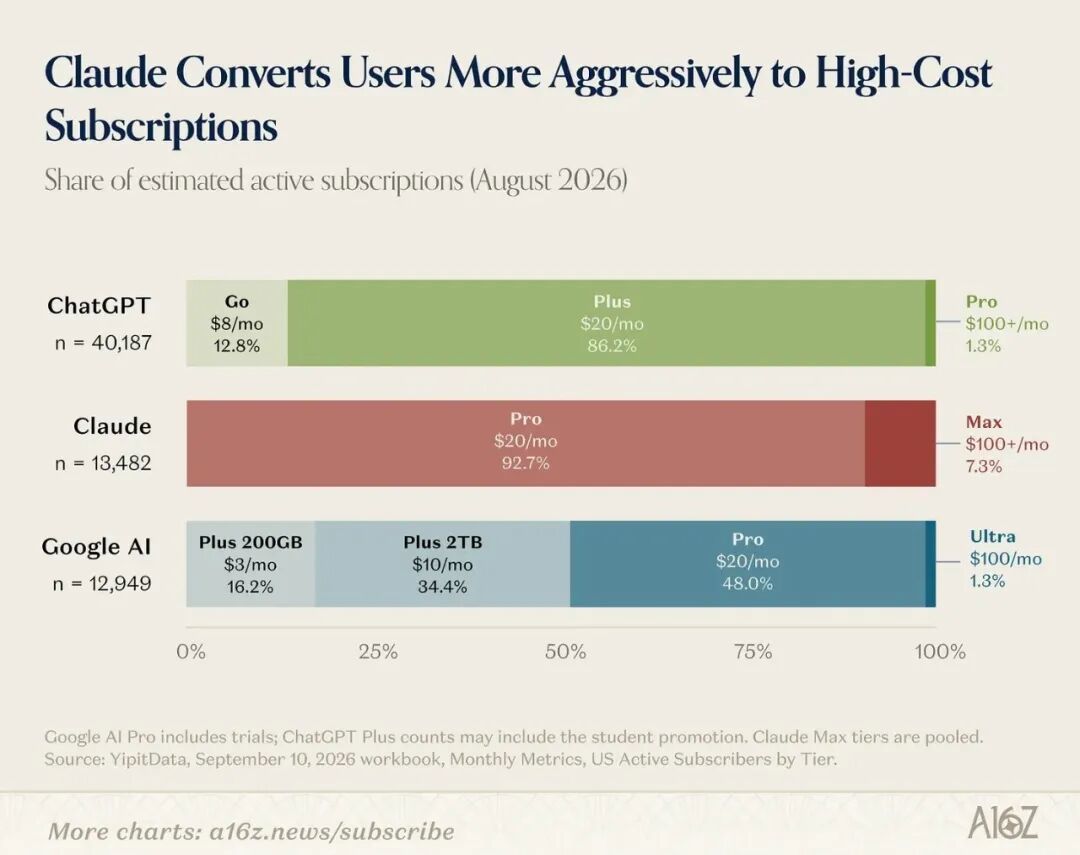
In addition, data shows that only 8% of ChatGPT subscribers also subscribe to Claude.
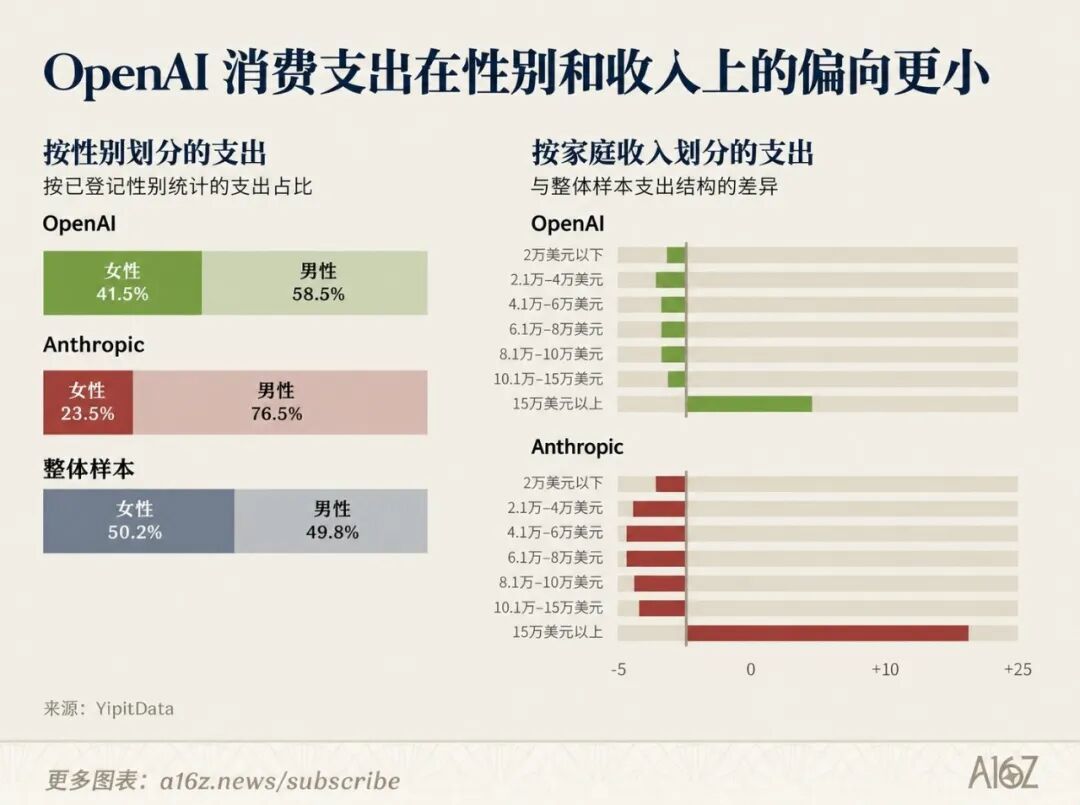
How can startups escape the meat grinder of big companies?
When the traffic is sucked up by ChatGPT, and when traditional SaaS giants such as Superhuman and Canva seamlessly embed AI into existing workflows, the living space left for startups is being infinitely compressed.
But there is no way to survive in the shadow of giants. To this end, a16z has summarized four experiences:
First, master the exclusive differentiated model.
No matter how powerful the general large model is, it cannot achieve the ultimate in a specific vertical field. Suno (19th in traffic, 7th in revenue) and ElevenLabs are the best proof. For creators, a unique visual style, sound texture, or proprietary training data are all worth paying for.
Secondly, since you can't beat them, join everyone.
The popular code editor Cursor (soared to #35) supports calling models from multiple labs. For users, being able to freely switch to the most convenient model according to specific tasks is far more enjoyable than being bound to the ecosystem of a certain large manufacturer.
Furthermore, get into the "hidden corners" that giants don't want to touch.
Compliance policies and privacy concerns are precisely the moats for startups: OpenEvidence, which focuses on medical privacy, has penetrated 50 to 60% of the U.S. doctor community; and those NSFW (adult content) AI applications that were deliberately excluded from this list actually account for more than 20% of the traffic list.
The market where giants dare not sink for the sake of reputation is a breeding ground for barbaric growth.
Finally, since the software entrance is occupied by Google Docs and ChatGPT, let’s seize the physical entrance. For example, AI recording hardware Plaud ranked 16th on the consumer spending list thanks to its “device + subscription” model.
The giants have also taken notice. Meta put Muse into smart glasses and even developed AI electronic pets; OpenAI’s acquisition of io Products has even more ambition to make hardware written on its face.
However, whether giants or startups, today’s consumer AI essentially faces an unavoidable problem: the business model is too single.
On the one hand, in the pre-AI era, the underlying logic of the Internet was that "the wool comes from the sheep": we watch content for free at the expense of ads. But in the AI era, the computing power cost of large models is astonishingly high, and AI manufacturers simply cannot afford to spend money in exchange for free traffic.
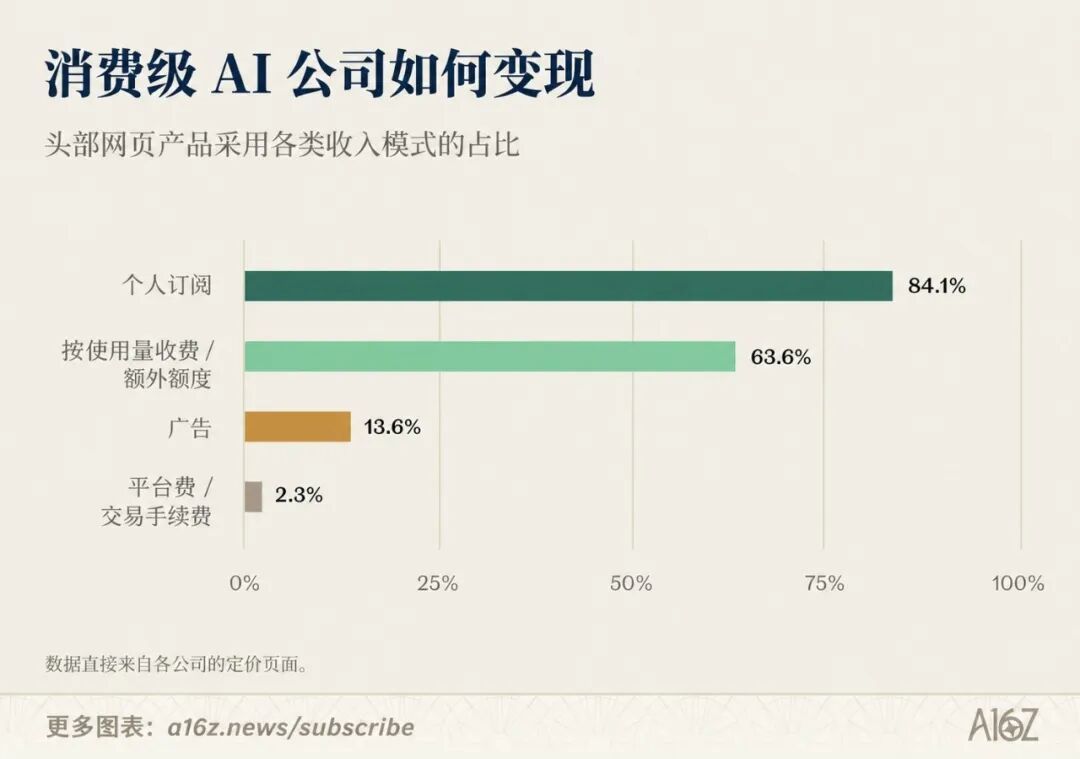
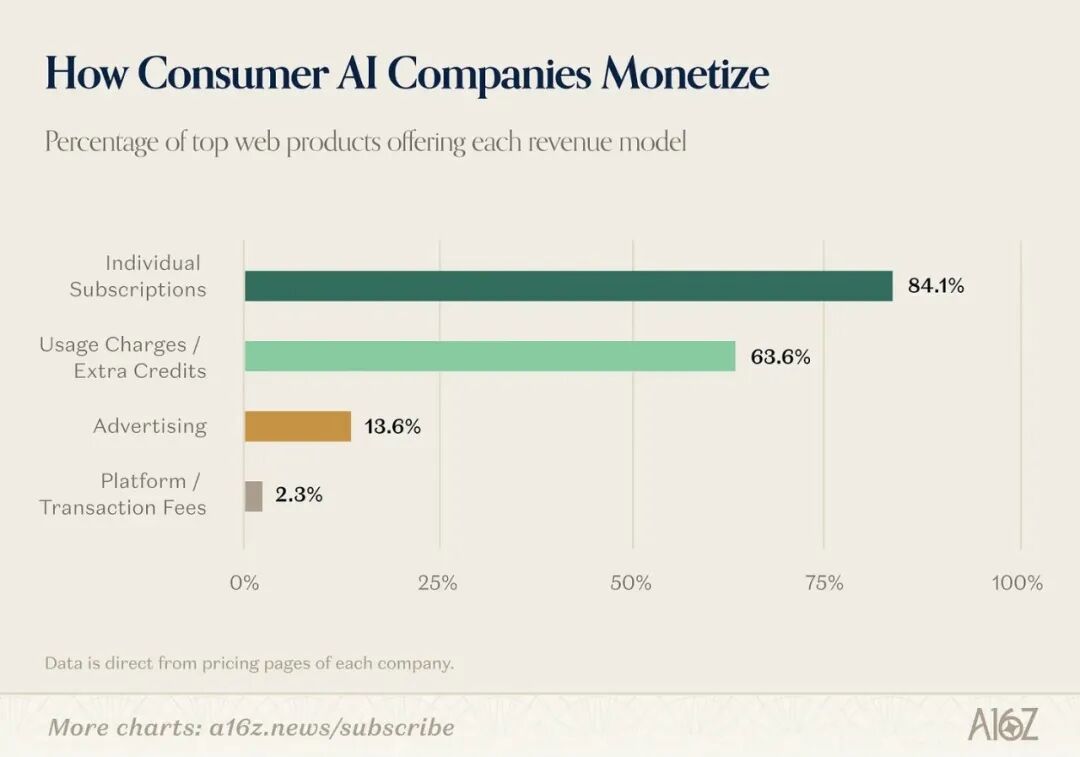
Among the 44 AI native products counted by a16z, 84% make money by selling subscriptions and 63% by selling computing power quotas.
On the other hand, AI Agents (intelligent agents) with real execution capabilities are detonating the next business model revolution.
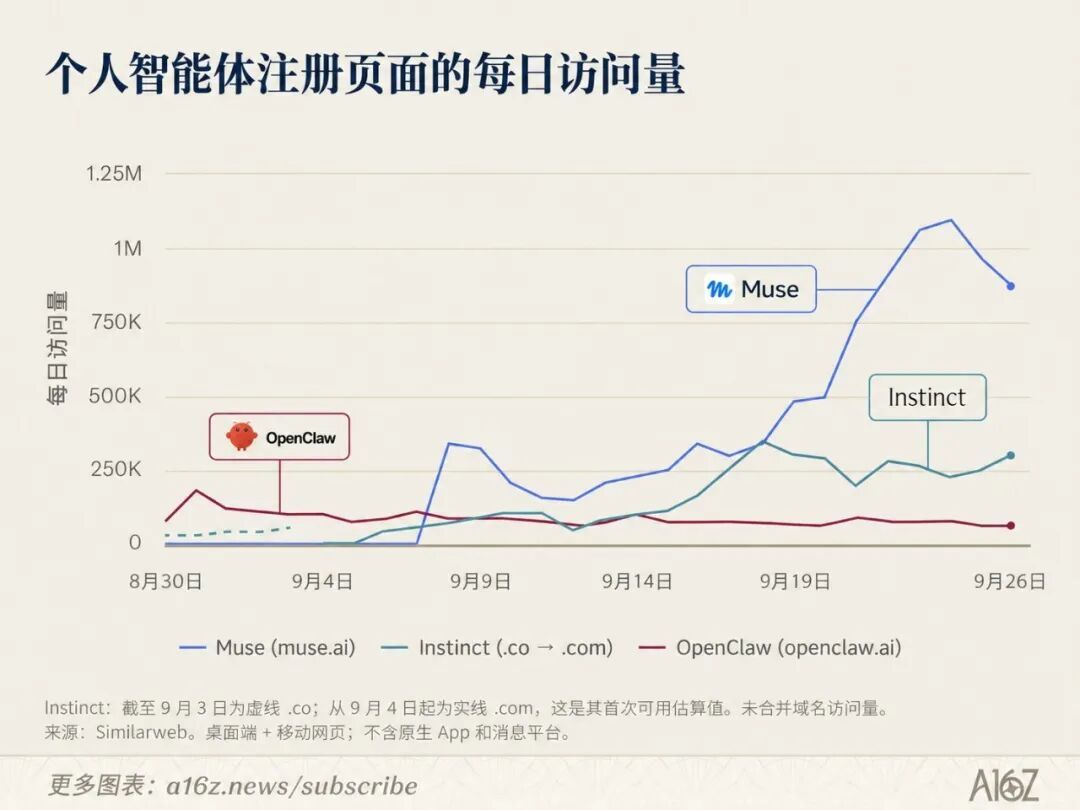
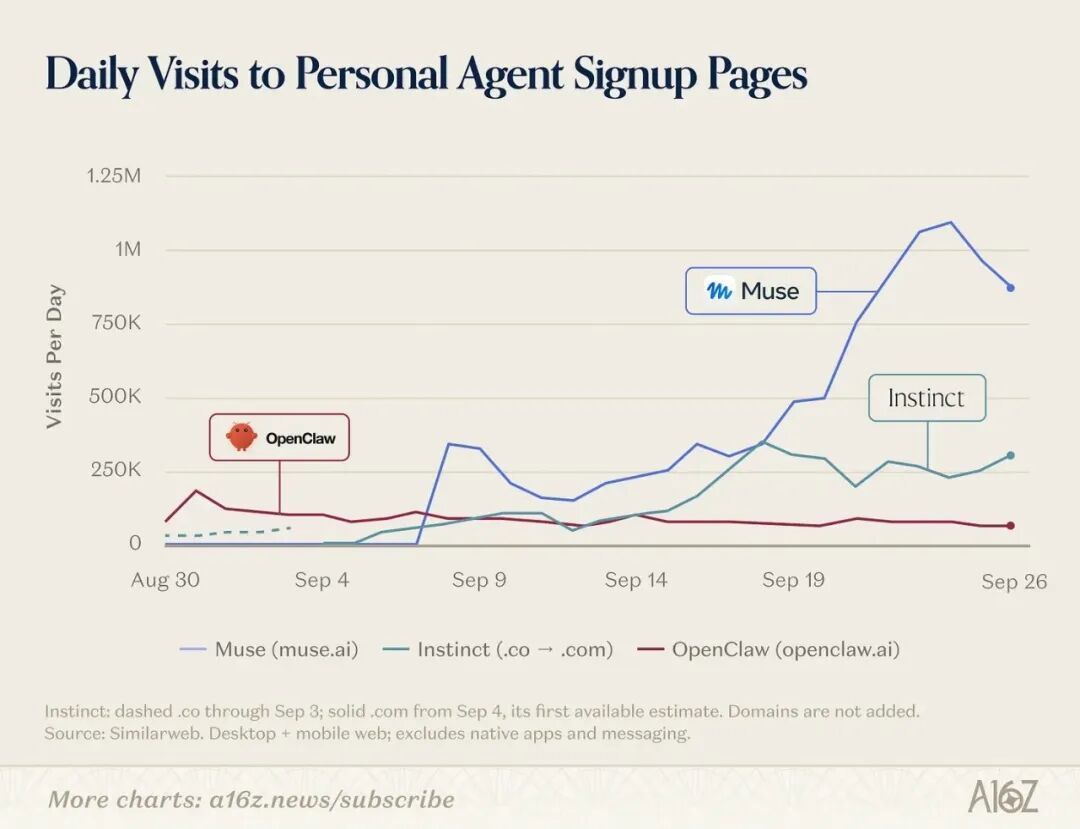
Half a year ago, everyone was still complaining that Agent was difficult to use; today, personal agent products such as Muse and Grok Bot have millions of active users.
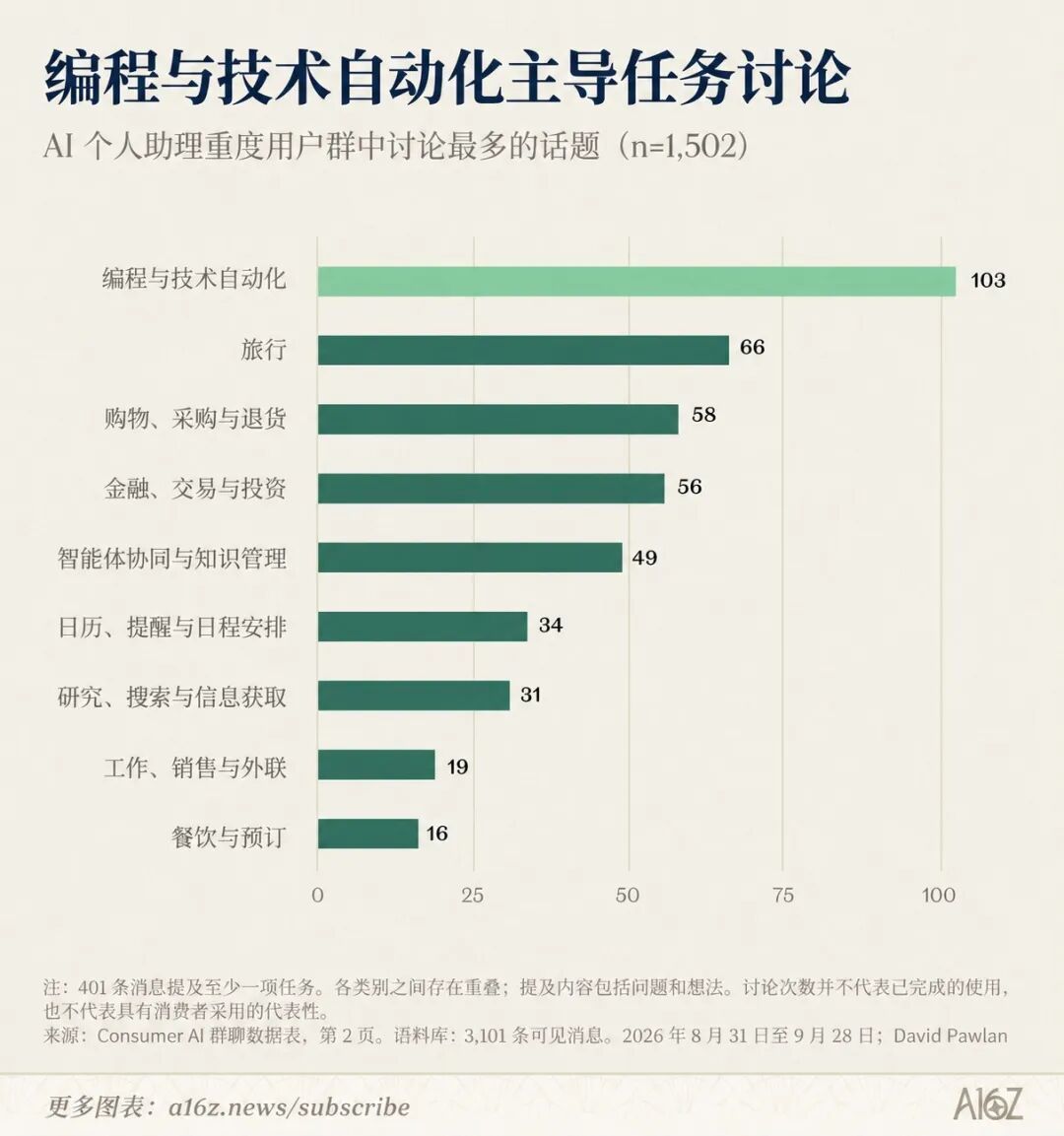
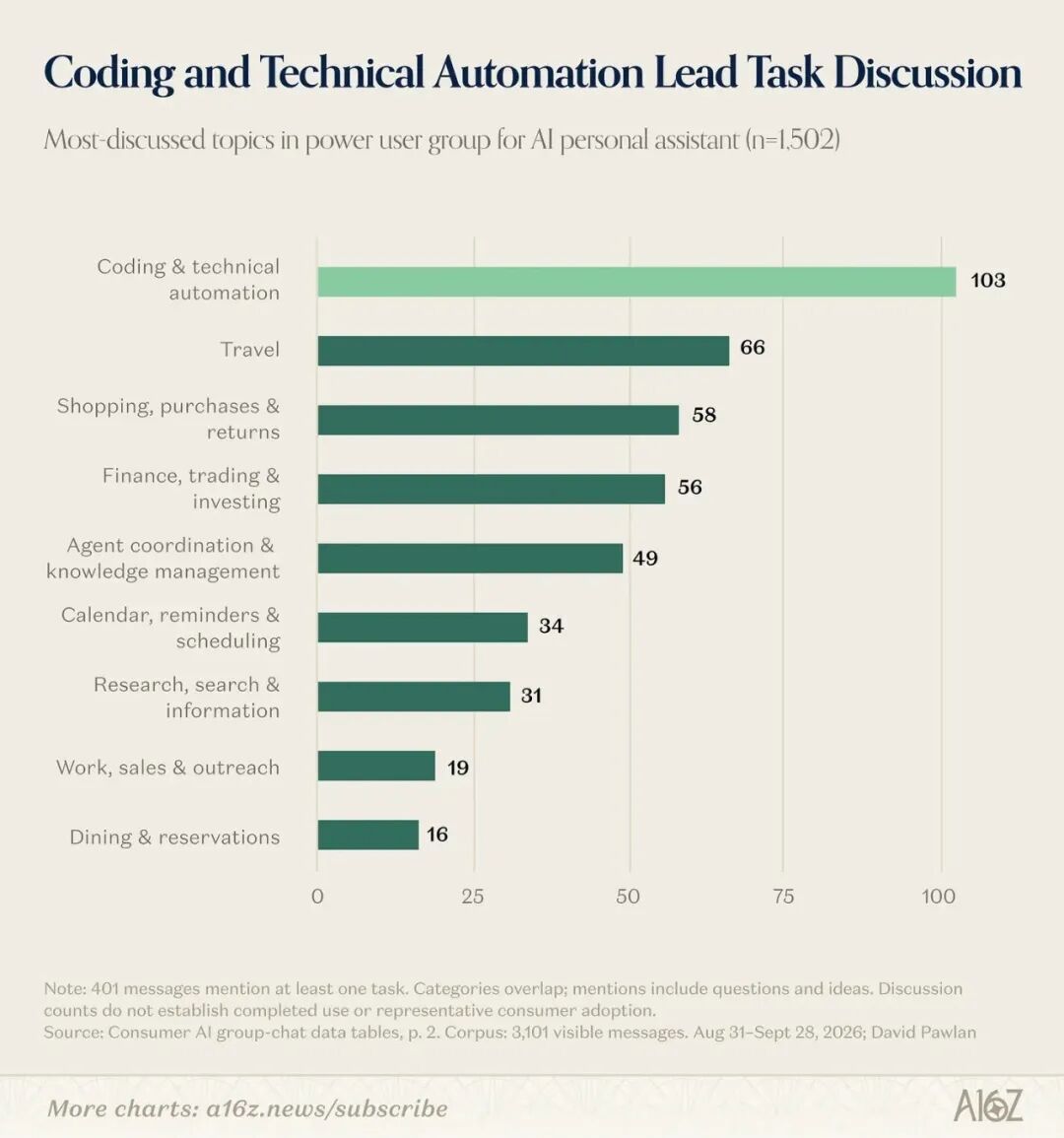
According to AssistantBenchmark data, the most commonly discussed application scenarios for Agents are programming and technical automation.
More importantly, once the AI masters the transaction entry, it no longer has to charge users the painful $20 subscription fee. It can charge merchants a “take rate” or affiliate marketing fee just like traditional Internet platforms.
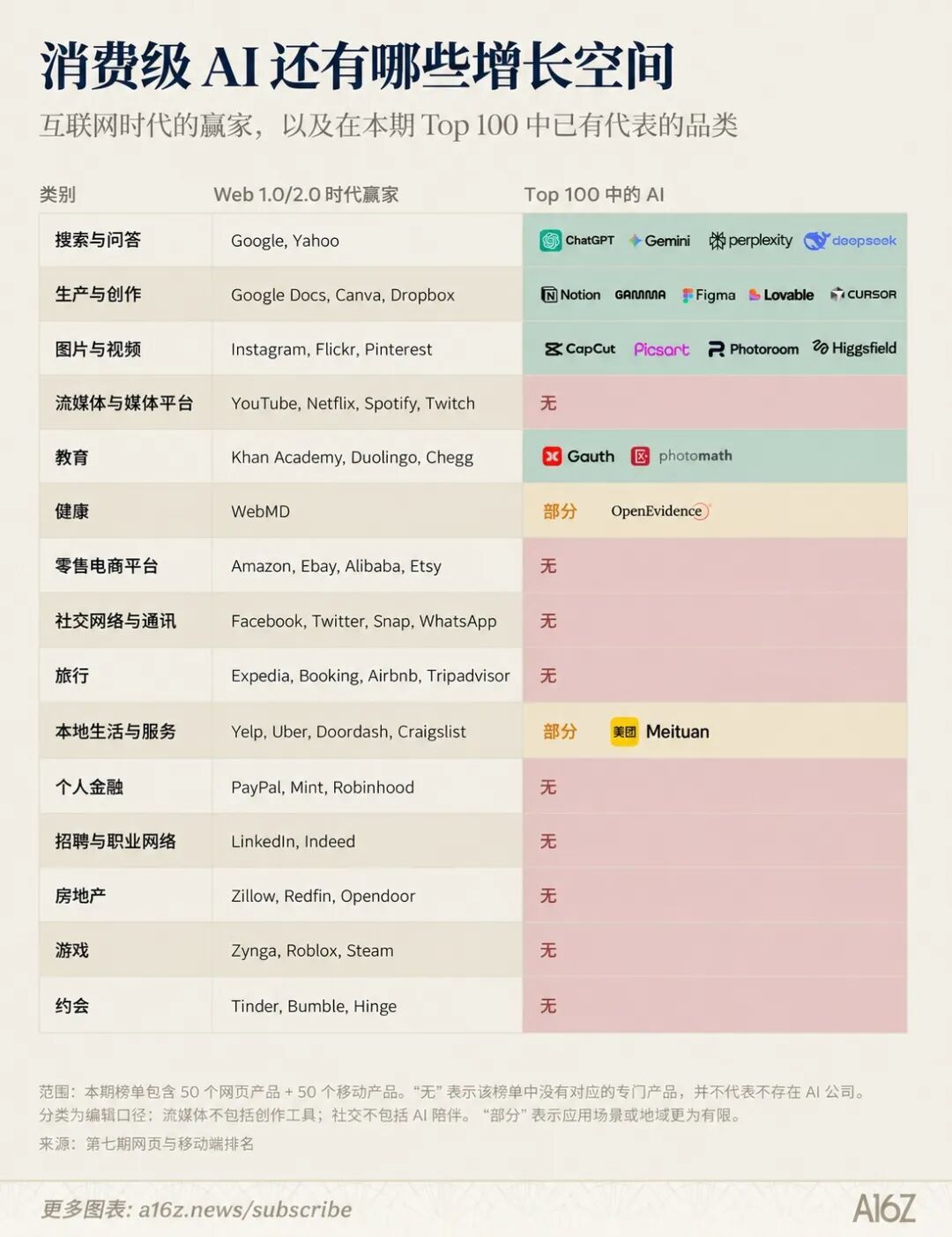
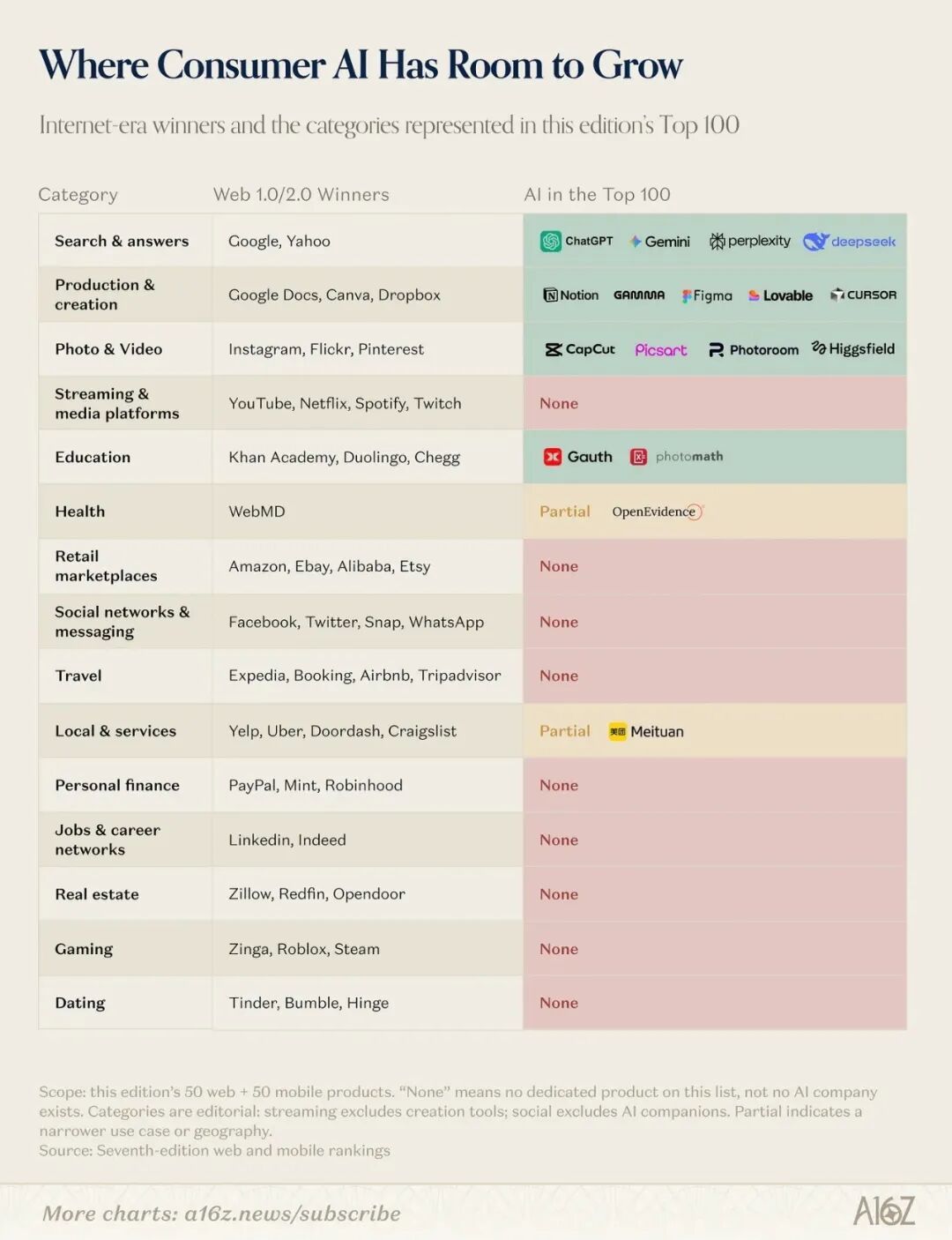
In short, the first half of consumer AI is a carnival for the 1% of super players. Everyone is immersed in the magic of Prompt and is willing to pay for the high computing power.
But if AI wants to become the mobile Internet of the next era, it must complete a difficult transformation: from a SaaS tool that "collects monthly rent from users" to an infrastructure that "extracts water from transactions", or rediscovers the classic advertising model of the Internet.
As a16z said at the end of the report, subscriptions will still be the home of professional tools. But only when the advertising and transaction commission models really work, and when ordinary people no longer need to carefully calculate the tokens consumed for each conversation, will the magic of AI truly come to everyone's daily life.
And this day may come sooner than we think.
Comments