
Abstract:
After the National Day holiday officially started, many owners of new energy vehicles traveling by car complained that queuing up in high-speed service areas to charge is still the most painful part of the entire travel process. On the first day of the National Day holiday, it was not just the traffic on the main expressway that was stuck on the road, there were also long queues at the energy replenishment areas in various service areas. Whether it was DC charging piles or the passages of battery swapping stations, there were trams queuing up everywhere waiting to replenish energy.
Some pure electric car owners complained on social platforms that charging was far more difficult than expected. They went to four service areas without charging. There were dozens of car numbers lined up in front of the charging piles in each service area. After picking up the number, they got the number 169. Standing in the queue, they felt that their good mood for traveling was gone. There is also feedback from car owners that many high-speed charging stations have issued temporary rules during the holidays. All vehicles must leave the site when charged to 80%. The machine automatically sets a current limit in the background, making it impossible to continue to fully charge.
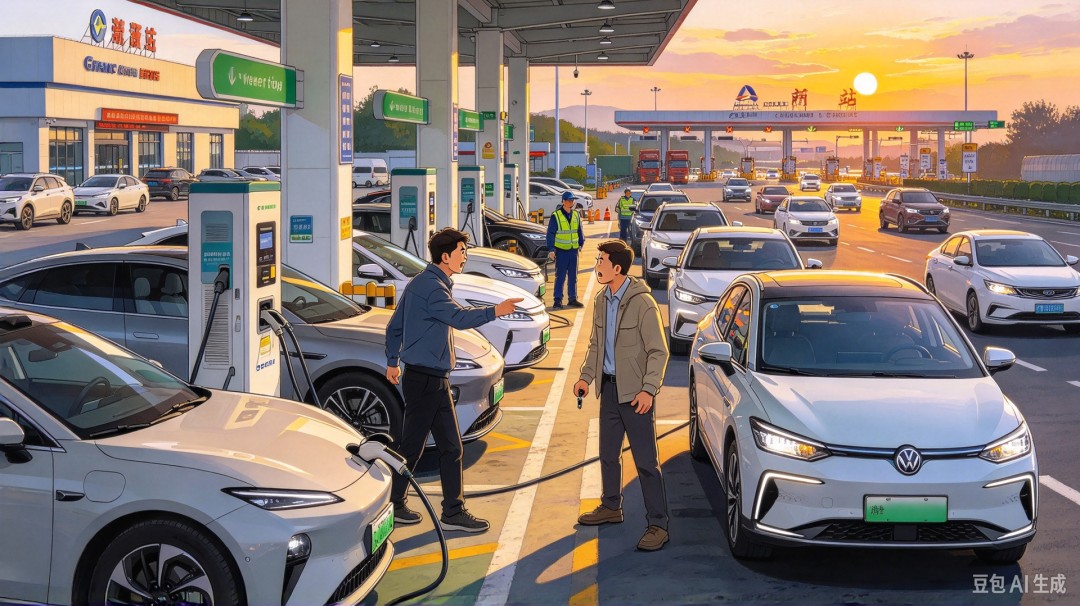
Many pure electric car owners who have queued for an hour or two and have yet to recharge complain that 8 of the 10 charging piles in the high-speed service area are occupied by hybrid and extended-range models. These models have gas in the tank and do not have to worry about battery life. However, many car owners are reluctant to use gas after turning on the power, and also queue up at high-speed charging piles to recharge. Already tight charging resources are further squeezed, and the waiting time of pure electric car owners is extended.
Many owners of extended-range vehicles also came forward to express different views. They said that the power battery capacity of their models is much smaller than that of pure electric models. It takes a short time to fully charge and will not occupy the charging pile for a long time. If there are long queues at high-speed charging piles during holidays, they can directly switch to fuel mode and drive to their home to recharge. They will not have to squeeze on the highway to grab charging piles.
According to travel data predictions from the National Smart Internet of Vehicles Platform, the peak of high-speed charging during the National Day holiday has arrived on October 1, with the peak charging hours on that day concentrated between 7:00 and 20:00. Next, October 5th and 6th are the core periods for concentrated return trips across the country. The number of charging vehicles on highways will remain at a high level. The charging peaks of the two days correspond to 11:00 to 21:00 on October 5 and 10:00 to 22:00 on October 6 respectively.
Liu Hao, a senior automotive industry practitioner, pointed out that in order to completely solve the pain point of high-speed charging queues during holidays, the first thing to do is to optimize the layout of energy replenishment infrastructure. Along popular highways with large traffic volumes, the number of charging piles in service areas must be directly doubled; at the same time, public charging stations must be added to a large area in the surrounding urban areas of high-speed entrances and exits to actively divert the concentrated energy replenishment pressure on highway sections.
Secondly, charging pile resources in high-speed service areas can be tried to be dynamically managed by partition. Extended-range or hybrid models can be guided to separate exclusive charging areas, or such vehicles without endurance anxiety can be guided first to get off the highway to surrounding urban areas to recharge; mainstream navigation APPs can synchronize the real-time charging queue number and waiting time information in each service area, allowing car owners to adjust their charging plans in advance. Popular service areas can also deploy mobile charging vehicles and temporary emergency charging piles in advance to supplement energy during peak travel hours.
Many car owners who have experienced queuing for charging said that after these optimization measures are implemented, they can significantly reduce the anxiety of recharging energy during long-distance travel of new energy vehicles during holidays. They will no longer have to spend most of their time on self-driving trips waiting in line for charging. Ultimately, the long-distance travel experience of new energy vehicles will catch up with the convenience of traditional fuel vehicles.
Comments