
Abstract:
Huang Renxun admitted it. On November 8, Nvidia released a letter he wrote to all employees. Huang, 63, admitted in the letter that he had been unfaithful to his wife and wrote, "I owe my family and all of you an apology." Immediately afterwards, Nvidia's board of directors announced the launch of an independent investigation that day. There was no name in the letter, but everyone knew it was Alice Huang, a former executive at the Singaporean company Megaspeed.
The intersection between the two people has actually been traced for a long time.
In June 2024, someone posted a photo on LinkedIn. Alice Huang and Lao Huang were drinking whiskey in a bar in Taipei. At the same table were executives from suppliers such as Gigabyte. According to the recollection of a person present quoted by foreign media, Alice Huang once said in front of everyone that she could invite Huang over, but Huang actually came.
In an interview with Bloomberg last month, Huang also said that their interactions were related to Megaspeed's business and were "completely normal."
So at the end of the day, what everyone talked about the most was Lao Huang’s private life and the stock price of NVIDIA (NVDA).
But few people ask, why can the executives of a Singaporean company that few people have heard of invite the CEO of the world's most valuable company to have a drink?

Megaspeed was founded in 2023, and few people outside the circle had heard of it until last month;
But what you may not know is that it is Nvidia’s largest partner in Southeast Asia.
From June 2024 to February 2026, its affiliates in Malaysia bought at least $4.8 billion in AI equipment containing Nvidia chips, according to trade records cited by the New York Times.
These equipment are installed in computer rooms in Malaysia and Indonesia, and the computing power is rented out. According to reports from the New York Times and other media, one of the major customers is Alibaba.
Anyone with a discerning eye can see that this business has taken advantage of a crack in US export controls.
The U.S. controls only the transit of chips, not the online rental of computing power. As long as the GPU stays in Johor, Malaysia, and engineers in Hangzhou submit training tasks online, it will not be considered an export according to current U.S. rules. The industry calls this "external training and internal promotion", where you train overseas and do reasoning when you return home.
The chips have not left the country, but the computing power has gone overseas.
If Megaspeed only does this, it will at best be a second-hand computing power landlord standing on the gray line. But it’s an on-site inspection in late 2024 that has the U.S. Commerce Department on edge. Investigators walked into its computer room in Malaysia and saw a batch of Nvidia servers still sealed in boxes.
The chip sealed in the Megaspeed box
What companies that rent computing power are most afraid of is having their cards idle.
GPUs depreciate every day, and new models are replaced every year. If the card is not plugged in, it will be lost every day. So when investigators saw the intact local server in Malaysia, they became suspicious:
This batch of goods may not have been intended to be used here.
A year later, Bloomberg revealed more details in a report. Customs records in Malaysia and Indonesia show that Megaspeed imported about 136,000 Nvidia chips, more than half of which were the latest generation Blackwell, and most of them arrived more than half a year ago.
But Nvidia sent people to its computer room, and only a few thousand Blackwells could be counted on site.
Nvidia’s explanation at the time was that the uninstalled chips were all stored in the warehouse, and every chip was accounted for, and it was not found that any of them had been transferred to China. The Nvidia spokesperson also said that Megaspeed operates a "small commercial cloud" and, like many similar companies around the world, is within the scope of U.S. rules.
At the same time, Megaspeed itself issued a statement denying any involvement in illegal shipments.
It’s just that the origin of this company is not “small” at all. According to foreign media, its predecessor was the Singapore subsidiary of Chinese gaming company 7road (7road, 0797.HK). It was split out five months after the United States introduced a ban on Chinese chips in October 2022. It was first transferred to the name of a British Virgin Islands company controlled by Alice Huang, and in November 2023 it was sold to Swiftdata, a shell company of Singaporean businessman Tan Yong Pong.
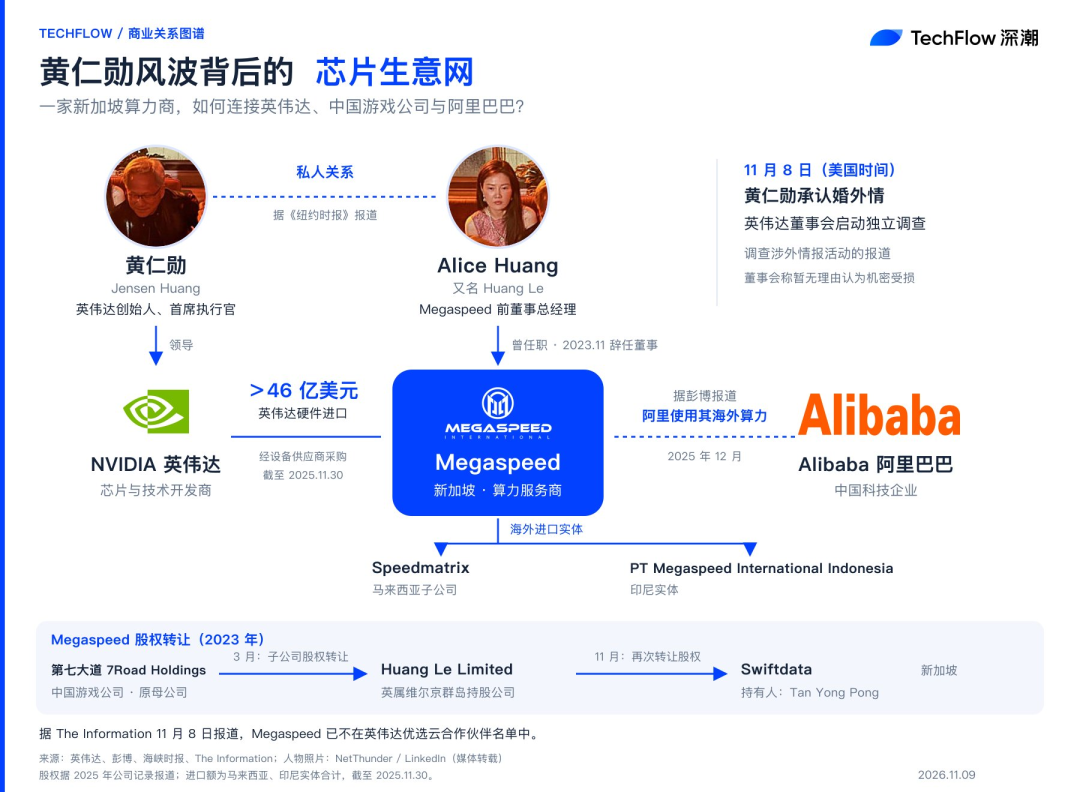
Four days after ownership changed hands, it became Nvidia's cloud partner.
A company that has just changed its boss can obtain this status so quickly, which shows that in the eyes of Nvidia, it is a major customer worthy of attention. But if you look at its background by the standards of a normal computing power company, it almost doesn’t match up.
The first thing that makes no sense is money. At the end of that year, the company had just $5.7 million in cash on its books, and within two years it was importing Nvidia equipment worth more than 800 times the cash on its books.
Computing power leasing is an asset-heavy business. It is normal to rely on financing and customer prepayments to buy cards. But who filled such a big hole is still unclear to the outside world.
The origin of the goods can be traced, but the results are more likely to make things difficult for the Americans. Megaspeed bought the card and placed the order with Aivres, an affiliate of Inspur in the United States.
Inspur is one of the largest server manufacturers in China. It was previously on the U.S. entity list, but its affiliates in the U.S. can still get Nvidia products. In other words, from the time these chips left the factory to the time they entered the computer room, several companies they dealt with were all related to China, but none of them were on the U.S. blacklist.
Meanwhile, Megaspeed itself doesn't appear to be running such a big business.
A reporter from the New York Times visited its office on-site and found that there were only two employees in Singapore, and they knew nothing about the business when asked; the office in Malaysia was very small, and there was not a single engineer in sight.
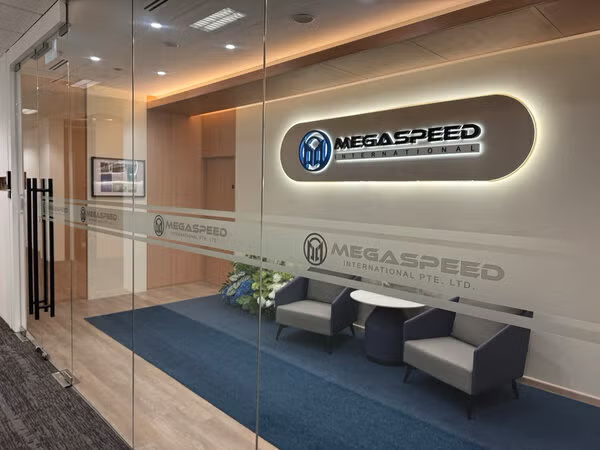
The official website states that the computer rooms are in Malaysia and Indonesia, but according to a 2024 financing material provided by Bloomberg, it also introduced a data center located in a "specific area" to potential investors, but the specific country was not mentioned.
Perhaps the real value of Megaspeed is this structure.
A company with almost no employees has managed to build a multi-billion dollar computing power business. The customers may be in China, the machines are in Malaysia, and the equity is in Singapore and the British Virgin Islands. Every link is beyond the reach of US chip export controls.
Computing power goes overseas, uncontrollable remote flow
Between the ever-increasing physical embargo and the huge demand for computing power, capital and technology are always looking for the most effective flow path.
From an implementation level, the U.S. Department of Commerce controls where a chip is shipped from and to whom it is sold. As for who the chip is installed in the computer room, the computing power is rented to through the network, which is in a shadow zone of export control.
So Megaspeed may be far more than just one company following this path.
According to foreign media reports, INF Tech rented 2,300 Blackwells through a computer room in Indonesia; Tencent signed a contract of approximately US$1.2 billion with Japan's Datasection, corresponding to 15,000 Blackwells; this summer there was news that Dark Side of the Moon used GB300 through facilities in Thailand...
These transaction orders do not cross the line, the chips have not left the country, and the people who use the chips do not own the chips.
In fact, the United States has also seen this gap. In January this year, the U.S. House of Representatives passed the Remote Access Security Act by a vote of 369 to 22, intending to count the remote use of controlled chips as an export, but the bill is still pending in the Senate.
According to The Information, the Ministry of Commerce is also drafting rules for remote computing power, which have not yet been announced.
For domestic AI companies that rely on "external training and internal recommendation" to make up for the computing power gap, this road is still feasible for the time being, but it is getting more and more expensive and increasingly uncertain. Huang's scandal has thrust Megaspeed into the spotlight. Every secondary landlord in Southeast Asia that provides computing power to Chinese customers will probably have to re-evaluate their customer lists.
This reminds me that a while ago everyone was still talking about
Token going overseas, and domestic models sold cheap Tokens all over the world. But few people have thought that part of the computing power used to train these models may have been rented back from overseas.
Before Lao Huang’s gossip, Megaspeed’s own expansion did not stop.
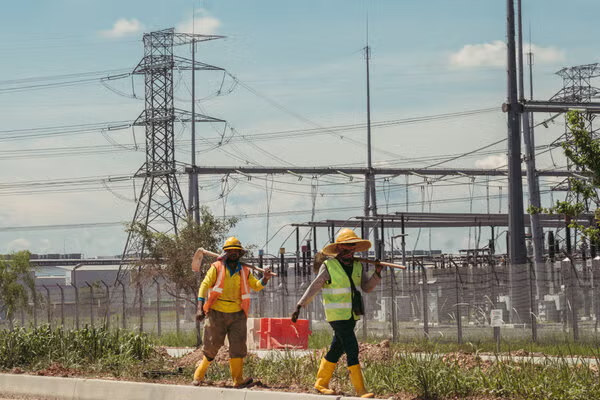
It has suspended the purchase of Nvidia hardware since July 2025, but according to the New York Times, its large data center in Johor is still stepping up construction, with newly built AI computer rooms sandwiched among oil palm plantations. The report also mentioned that it already has the key chips needed for the expansion.
Questions that apology letters cannot answer
Looking back at the apology letter, what Huang recognized was actually the best part of the whole thing.
Extramarital affairs are a matter of personal morality, and they hurt the family and his personal image. An Nvidia spokesperson was more direct, saying today's news won't slow Nvidia down.
There is a difference between a person admitting that something went wrong in his personal life and a company admitting that something may be wrong with a major customer. The former is Lao Huang's own business, and the latter is Nvidia's business.
Customers like Megaspeed are precisely the part of Nvidia’s growth that has rarely been put on the table in the past two years. Huang himself said that Nvidia’s share of the Chinese market has dropped from 95% to 0. The most advanced cards cannot be sold directly into China, but Chinese companies have always had demand for computing power. They just changed their addresses, and may continue to place orders from computer rooms in Southeast Asia.
If this scandal is ultimately characterized as Nvidia being penetrated, it will not only be Megaspeed that needs to be tightened, but the entire "Southeast Asian computer room plus Chinese customers" channel. For Nvidia, all the orders flowing through this channel are real orders.
The chip can be locked within national borders, and the computing power can be exported along a network cable.
In the computing power business in the AI era, the border no longer exists at customs.
Lao Huang admitted his mistake in the letter. As for the business on this channel, it is not a question that a letter of apology can answer.
Comments