
Abstract:
A new way to power AI computing power has emerged: using electric vehicle charging stations. This is exactly the idea that charging pile start-up Xeal is advancing. The company plans to raise approximately US$2 billion in debt financing in the next 18 months to support the implementation of the project. New York-based Xeal operates a network of thousands of charging piles, most of which are located in high-end apartments, high-end retail malls and office buildings in about 500 cities in the United States and Canada.
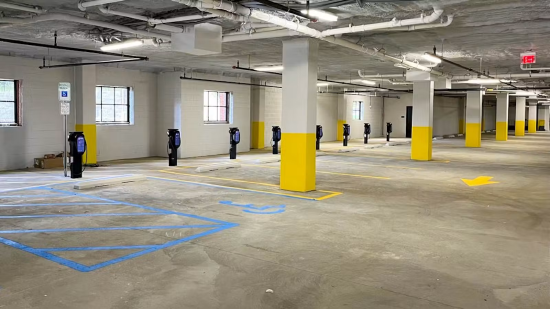
Xeal places NVIDIA computer racks in metal containers and deploys them near its charging piles.
Xeal CEO Nihil Bharadwaj said that although the contract signed with the power company allows charging piles to charge electric vehicles around the clock, the average utilization rate of its charging stations is less than 10%. This means that Xeal holds massive idle power resources, enough to continuously power approximately 130,000 households or 110,000 NVIDIA AI chips.
To this end, the company has launched a new business: supplying idle power to AI chips. In December of this year, Xeal will place Nvidia AI server racks next to charging piles in parking lots in Chicago, Houston, and Dallas; the racks will be placed in custom-made protective metal containers, which are equivalent to the size of a parking space. The power supply line supporting the charging pile can directly supply power to the rack, and each container is equipped with approximately 48 NVIDIA AI chips.
Bharadwaj said that Xeal has received customer orders for 100 such computing power containers, but refused to disclose the name of the customer. He said that in the next 18 months, the company aims to raise approximately US$2 billion to produce and launch 1,000 containers; each container is placed with a set of GPU racks, which can provide a total of approximately 50,000 GPUs and a total power supply capacity of 60 megawatts.
Xeal has previously completed two rounds of equity financing, raising a total of US$54 million. The latest round is a US$40 million Series B financing in 2022. Bharadwaj said Xeal plans to apply for low-interest asset-backed loans and project financing, totaling US$2 billion, to support business expansion. He believes that the company has the conditions to obtain this funding: it has built a huge network of charging piles with only US$54 million in venture capital funding.
Xeal’s plan reflects that even companies far away from the AI industry are trying their best to seize the huge power demand dividend brought by the explosion of AI data centers.
However, as our colleagues reported, the difficulty of financing for some AI project developers is rising. Even if the first batch of GPU containers runs smoothly, Xeal may not be able to obtain the target financing as expected.
Xeal’s core advantage is ready access to the grid. AI data center developers often have to wait several years to complete grid access. Many companies turn to gas turbines and nuclear power, but such solutions also face long approval and construction cycles. The battery can only be used as a backup power source and cannot support the continuous operation of a complete data center for a long time. It needs to be recharged after a few hours of charging.
Bharadwaj said: "It only takes us a few weeks to launch reasoning and computing services, instead of waiting for several years. Funds are the fuel to help us build a sustainable computing infrastructure."
Bhardwaj co-founded Xeal in 2019. The company sells charging piles to property owners; if the electric vehicles are used frequently, owners can typically recoup their investment in five years.
However, due to a variety of factors (including car purchase costs), U.S. electric vehicle sales fell short of expectations, causing the average idle rate of Xeal charging piles to be as high as 92%. Many property owners are therefore reluctant to add new charging piles. Bharadwaj said: "There has always been a chicken-and-egg dilemma here. Real estate customers will say: I don't know if there are electric car owners in the community, and I am not sure whether to install more charging piles."
The AI computing boom has changed this account. Bharadwaj will contact building owners who use Xeal chargers, pay them space rent, and be allowed to place a GPU container in the garage. He introduced to the owners: "It used to be 5 years to pay back, but now it only takes 2 and a half years; you don't need capital expenditures, and you don't have to bear operating costs, all the electricity bills are borne by us."
He said that the demand for computing power is extremely strong, which is enough to support the investment in new charging piles. Xeal's existing sites have a total power capacity of 200 megawatts and are expanding at a rate of 10 megawatts per quarter.
“Now we can promote charging pile projects across the United States without the need for federal subsidies or power company incentive policies. Relying on the established infrastructure and computing power business to generate income, the entire industry can achieve self-sufficiency.”
Comments