
Abstract:
Since the beginning of this year, capital inflows into the technology sector have continued, and economic growth expectations boosted by AI investment and popularization are providing solid support for the US dollar.
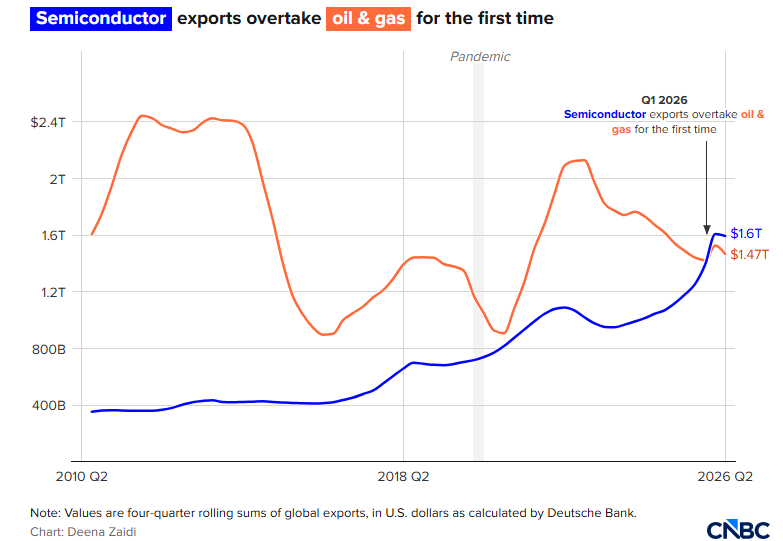
At the same time, Deutsche Bank's analysis based on International Trade Center (ITC) data shows that, driven by the artificial intelligence craze sweeping the world, the total global exports of semiconductors have surpassed oil and natural gas for the first time.
Although the arrival of this historic milestone is quite embarrassing-current investors are re-examining the prospect of huge expenditures in the field of artificial intelligence and continue to sell chip concept stocks. But in any case, global trade is indeed gradually ushering in a new era of "chip dollars".
“For decades, the global financial community has been talking about ‘petrodollars’. Perhaps from now on, we should turn our attention to ‘chip dollars,’” Jim Reid, head of global macro and thematic research at Deutsche Bank, said bluntly in a research report earlier this month.
The report uses a rolling sum of four quarters to calculate that global semiconductor exports surpassed oil and gas resources for the first time in the first quarter of 2026, reaching approximately US$1.61 trillion, while oil and natural gas exports during the same period were US$1.53 trillion.
Entering the second quarter, this lead further expanded: total semiconductor exports reached approximately US$1.60 trillion, while oil and gas exports dropped to approximately US$1.47 trillion.
After the outbreak of the Iran war, energy transportation in the Strait of Hormuz was blocked, which directly accelerated the gap between the two. According to statistics from the U.S. Energy Information Administration, the average daily crude oil transit volume in the strait has plummeted, plummeting nearly 77% from 21.6 million barrels in the fourth quarter of 2025 to a mere 4.9 million barrels in the second quarter of 2026.
Despite the violent turmoil in the capital market in recent years, driven by the global data center construction frenzy, the market's thirst for semiconductors seems to be insatiable, thus continuing to drive up the global trade volume of this increasingly scarce AI underlying infrastructure.
Redburn, a research institution under the Rothschild Group, emphasized in a recent research report that in order to build a sufficient AI computing power base, the scale of orders currently flowing into GPU and computing power centers has reached hundreds of billions of dollars.
“Computing power will become a new commodity that will drive this era of change on a global scale,” said Cara Thomson, an analyst at the agency.
Is the impact of change as great as petrodollars?
Analysts point out that the jump in the weight of semiconductors in global trade may have far-reaching macroeconomic impacts that are no less than the shock waves caused by the explosion of oil trade in the 1970s.
Historically, oil exporting countries usually inject most of their trade surplus back into the financial system to purchase fixed-income assets such as U.S. Treasury bonds. This not only helps support the U.S. fiscal deficit to a large extent, but also lays a solid foundation for global sovereign debt demand.
Deutsche Bank's Reid further analyzed that given that Asia's semiconductor trade surplus countries are more deeply bound to U.S. technology giants, the huge funds accumulated in chip exports are expected to flow back into U.S. technology stocks, start-ups and data center construction projects, thus feeding back and supporting the entire AI super investment cycle.
Reid believes that this fundamental reshaping of the global trade landscape may also completely overturn the underlying pattern of global capital flows.
“Therefore, welcome to the new era of ‘chip dollars’,” he pointed out.
This may be accompanied by stronger growth potential, more market excitement points, more severe asset fluctuations, and structurally higher long-term yields on corporate bonds and sovereign bonds.
Comments