
Abstract:
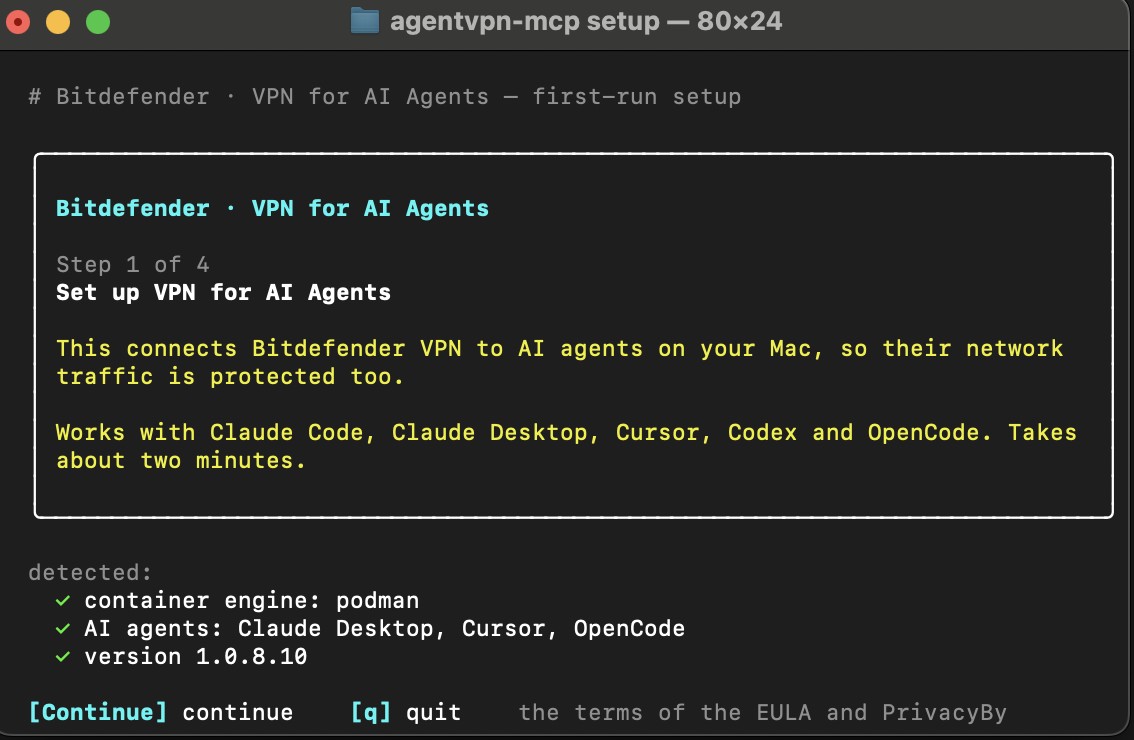
The veteran anti-virus software Bitdefender recently launched a dedicated VPN service for AI agents, trying to solve the problems of exposing the user's real IP when the agent is connected to the Internet, and residual network status between different tasks. This product provides services for AI agents through the MCP model context protocol, and in principle does not support use by real users.
Use independent connections for different tasks:
According to Bitdefender's introduction, after the user submits a task to the agent, the service will establish an independent and temporary isolation environment for the prompt word, and then forward relevant requests through an encrypted tunnel to avoid directly exposing the user's real IP address. The temporary environment will be destroyed immediately after the task ends, and any cache, cookies or other session state will also be cleared.
This mechanism helps reduce data residue between tasks and can also be used to view web content from different regions or test localized pages. Therefore, for some developers who need to develop websites or services, this VPN can also be used as a connectivity test for different endpoints around the world.
Only take over AI agent traffic, not user traffic:
Traditional VPN tools (those without global offloading) will directly take over the traffic of the entire device after configuration, that is, no matter what operations the user performs, the connection will be through the VPN exit. Sometimes this will lead to changes in connection speed and localization issues when accessing content.
Bitdefender's VPN can only be called by AI agents, such as Claude Desktop, Codex, OpenCode and Cursor, etc., which can be configured with the MCP protocol. Traffic sent by the AI agent will be forwarded from the MCP tool, so the browser or other applications on the computer still use the normal local network exit.
It is not an anonymous tool and does not cover all risks:
Bitdefender emphasized that this service is mainly used to change the network exit and isolation method of requests. It does not hide the prompt words submitted by users to the model service provider, nor does it provide comprehensive security protection for AI agents. Account logins, requested content, etc. will still be identified by the model and the target website, so it cannot be regarded as a completely anonymized solution.
Currently, this VPN tool only supports macOS systems. It is free during the test period and does not limit traffic. If developers are highly motivated, it is estimated that a Windows version and a paid subscription plan will be launched in the future.
Download test:
https://ai.bitdefender.com/vpn-for-agents
Comments