
Abstract:
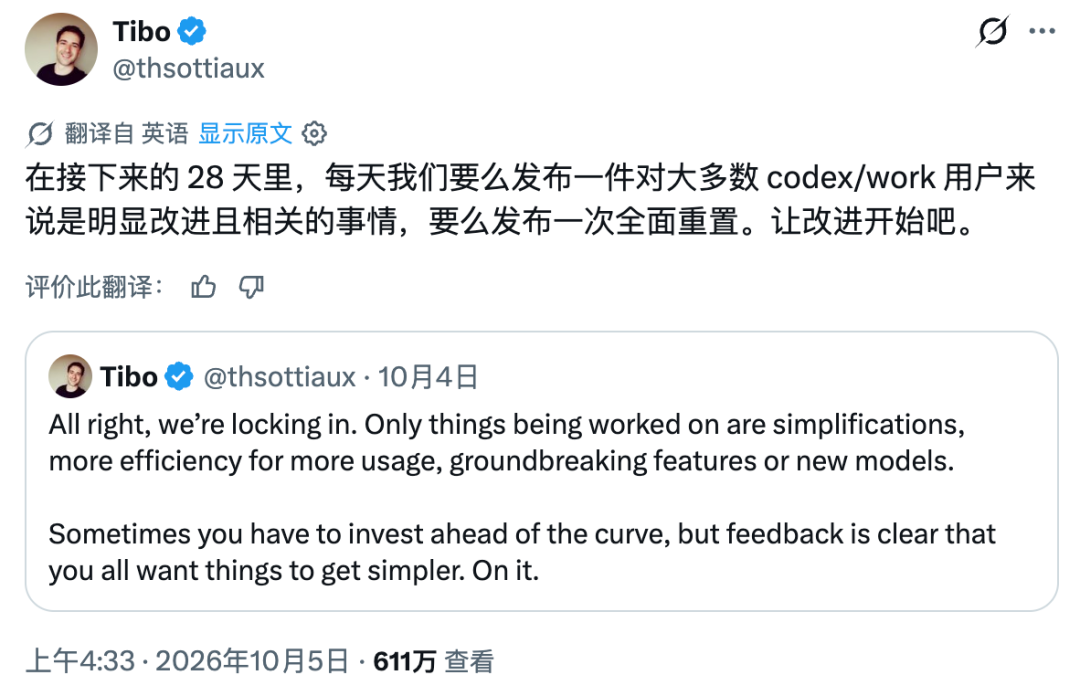
There are very few AI manufacturers that firmly believe that the products they release can "exchange quantity for quality", and OpenAI is one of them. Just like the previous 12-day press conference, yesterday, OpenAI Codex head Thibault Sottiaux (also known as Tibo) announced a 28-day commitment:
Every day thereafter, the team will either release an update that is of obvious value to the majority of Codex or ChatGPT Work users, or perform a complete quota reset.
The event came to Day 1, and the answer OpenAI handed over was speed up
. Using GPT-6 Astra and GPT-6.1 Sol with a subscription will increase default speeds by approximately 50% without users having to adjust settings.On the same day, OpenAI also announced two changes in completely different directions.
Part of the text output of ChatGPT and Codex will begin to add invisible watermarks, and ChatGPT's advertising business is preparing to introduce a more intuitive image display format.
Taken together, these updates tell a lot about OpenAI’s current situation. It needs to make paying users feel that the subscription is more valuable, and it also needs to explain to regulators where the AI content comes from. At the same time, it needs to make the growing number of users a business that advertisers are willing to pay for.
Besides the model, the daily affairs faced by the AI platform are getting closer and closer to the Internet we are familiar with.
Updated every day, users look forward to a list of available improvements
Tibo's promise has a limit worth noting. The improvements released every day need to be relevant to the majority of Codex or Work users, and the effect must be obvious enough.
In other words, a small feature hidden in the corner can hardly meet users' expectations for this promise. For people who use AI for work every day, waiting time, convenience of operation, and whether the credit limit is sufficient will directly affect whether they are willing to continue paying.
The speedup on Day 1 just responds to this demand.
As Tibo explains, the default speed optimizations for GPT-6 Astra and GPT-6.1 Sol cover OpenAI’s subscription products, as well as partners that support Sign in with ChatGPT, including OpenCode, Pi, Amp, and Devin.
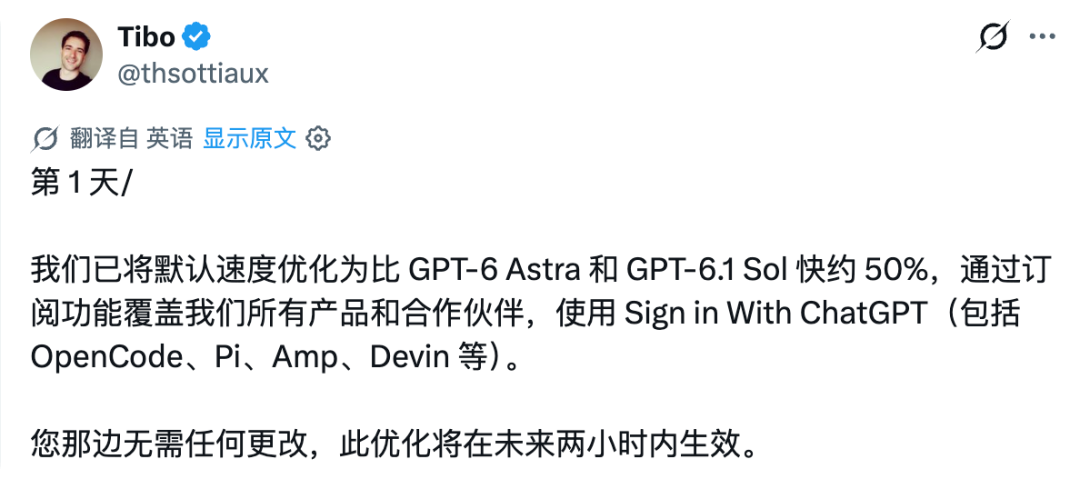
Users' ability to use subscriptions in these tools through ChatGPT accounts is also within the scope of this adjustment. He said the changes would gradually be felt by users within two hours of the announcement.
Subsequently, Tibo gave a more specific number, increasing the generation speed from 30 tokens per second to 50 tokens per second.
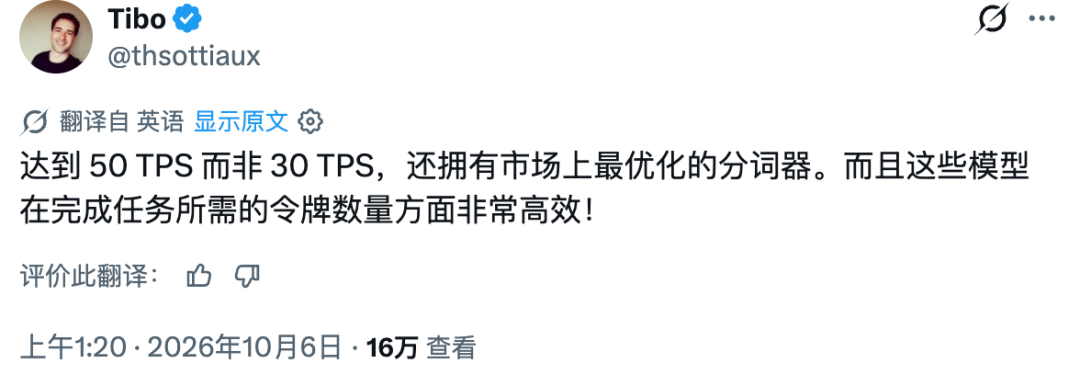
For work that requires continuous interaction with the model, speeding up is still of practical significance. Writing code requires repeatedly reading files, modifying, testing, and correcting errors. Organizing data may also require multiple searches and generation. After a single wait is shortened, the accumulated experience difference will be more obvious.
However, compared to increasing the speed, perhaps resetting the limit is more practical
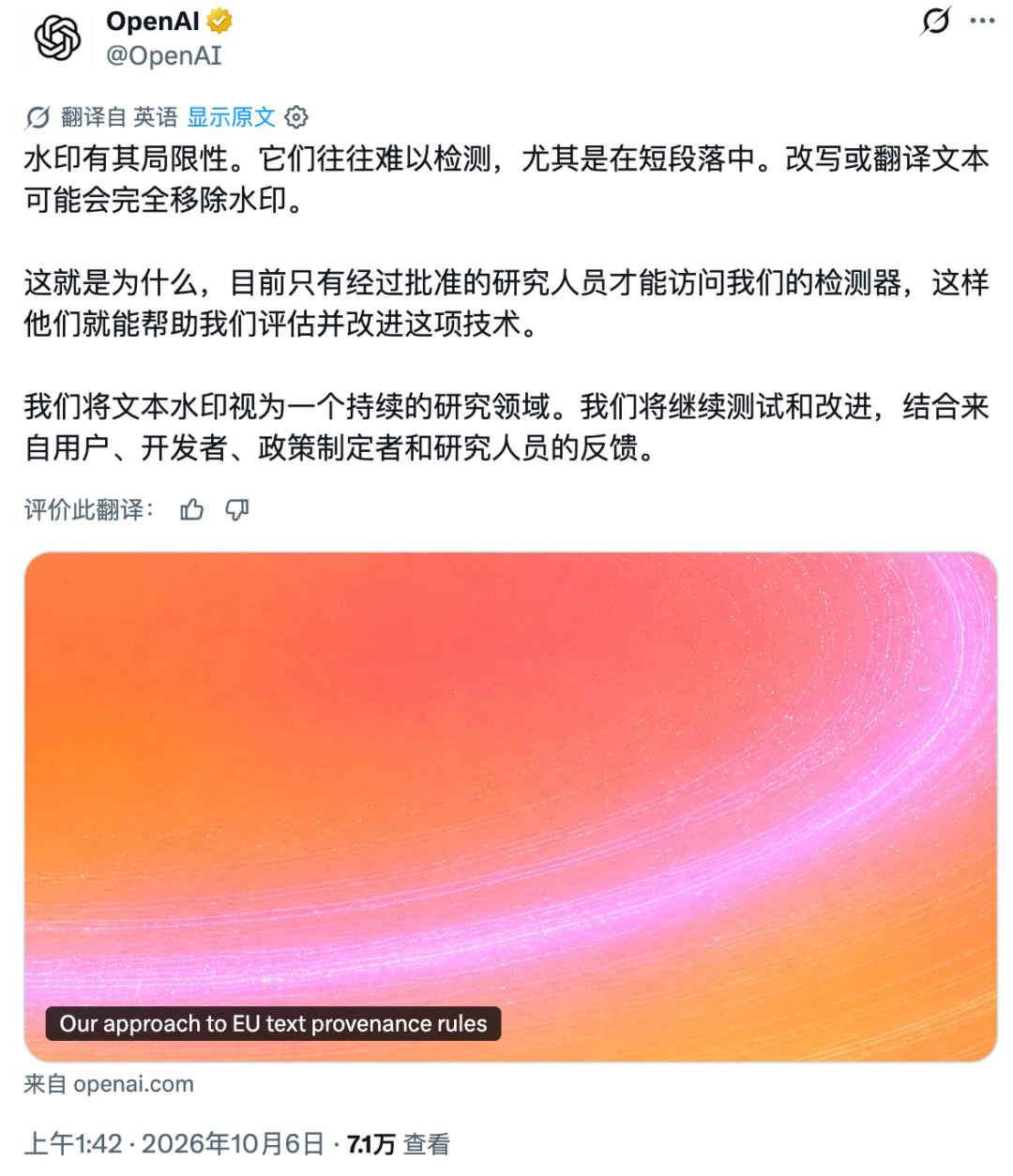
, we also look forward to seeing it several times in these 28 days.When leaving a watermark on text, you must also acknowledge the limitations of watermarks
Speed-up makes it easier for users to use AI, and text watermarks answer another question. When the generated content enters emails, articles, reports and public discussions, can outsiders still recognize its relationship with AI?
Also today, OpenAI announced its plan to deal with EU text source rules. According to its announcement, the EU’s AI Act requires generative AI providers to make generated text identifiable in a machine-readable manner.
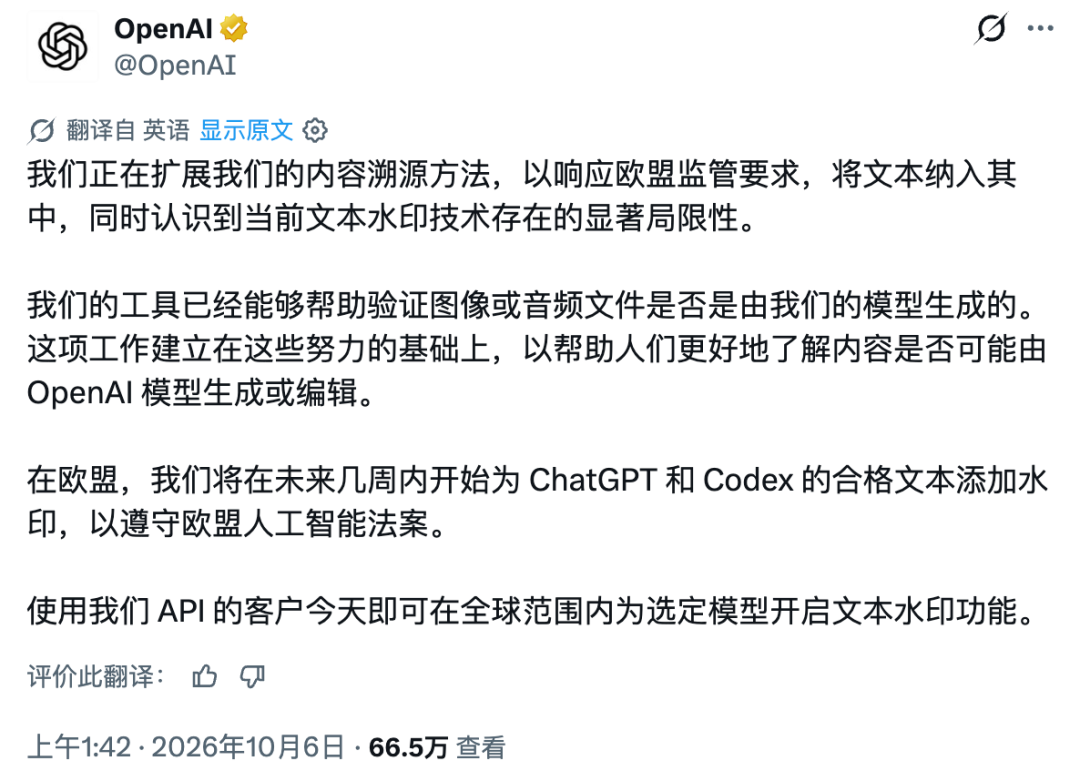
Global API customers can proactively turn on text watermarks for some models starting from that day, but the default state remains off.
In the next few weeks, OpenAI will add invisible watermarks to eligible ChatGPT and Codex text output in the EU, covering various packages, but it will not be set as a global default feature in the initial launch stage.
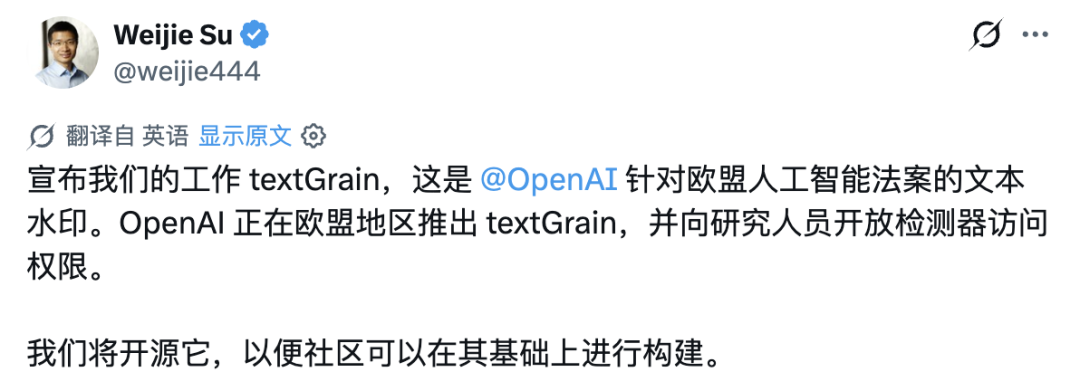
OpenAI calls this technology textGrain. It adds invisible statistical signals when the model selects words, and the detection tool then looks for these signals to determine whether a piece of text contains an OpenAI watermark. OpenAI also plans to make the technology open source.
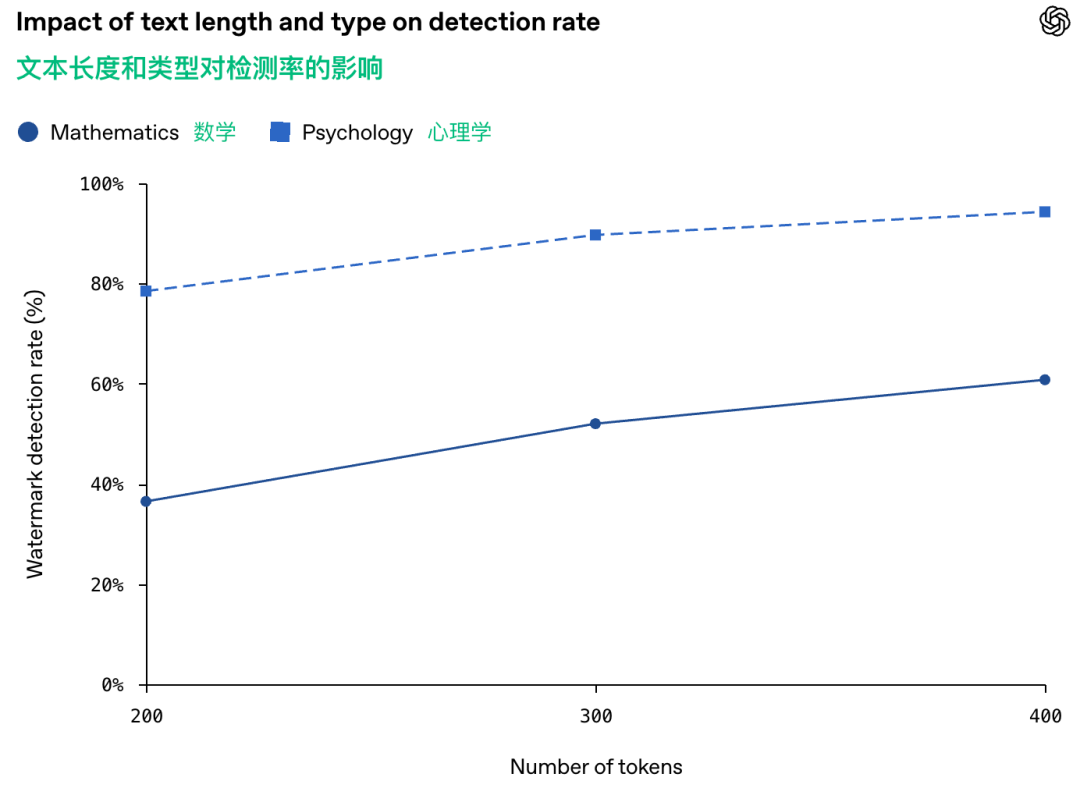
The difficulty is that the text is too easy to change, and the expression options available to the model vary depending on the content.
Under test conditions with a target false positive rate of 1%, for psychology and other content, the detection tool can recognize about 80% of 200-token watermark text. When the length is increased to 400 tokens, the recognition rate is about 95%. The expression space of mathematical content is smaller, and the detection performance is significantly lower.
Editing can also weaken the signal. In another set of 400-token text tests, replacing 10% of the words with synonyms reduced the detection rate from about 92% to 66%; after replacing 25%, the detection rate was only 17%.
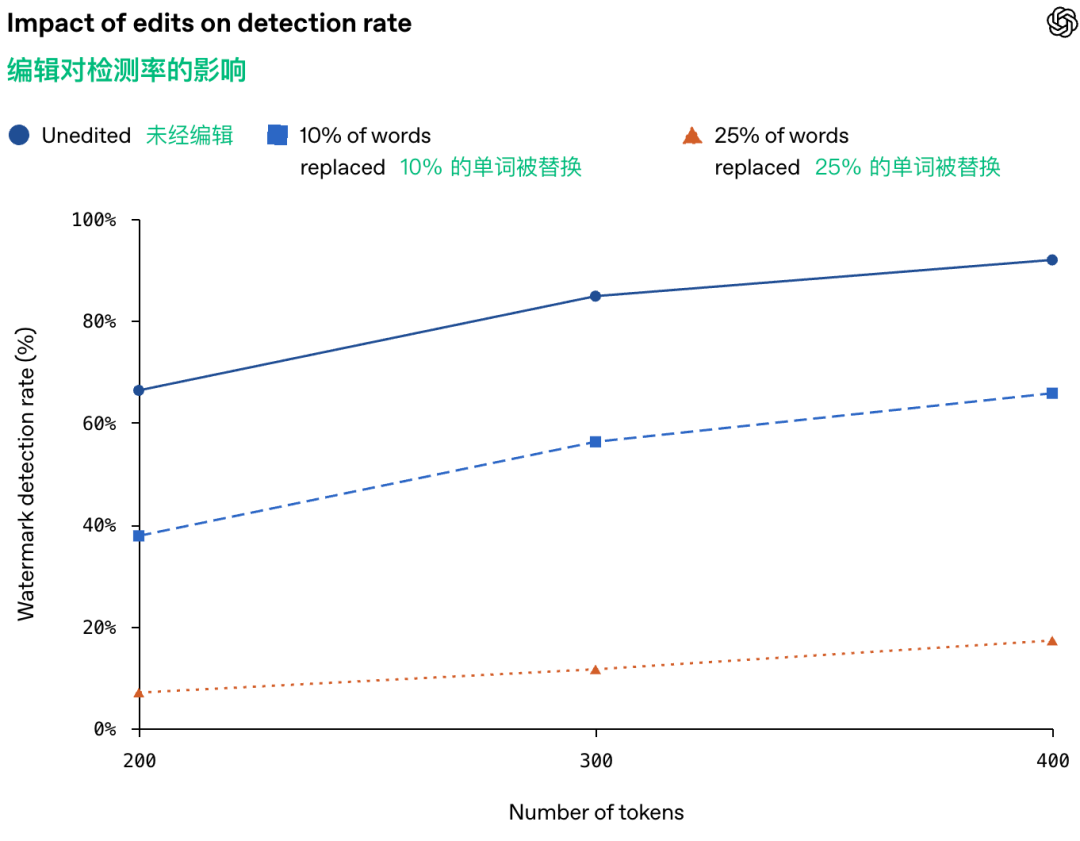
Several sets of numbers show that text watermarks can provide clues, but there is still a long way to go before we can reliably judge the creation process of an article. OpenAI also said that in the benchmark tests it used to evaluate Astra, it did not observe meaningful performance differences before and after adding watermarks, but these tests still do not cover all real-world writing scenarios.
The more critical boundary is that watermarks cannot measure human contributions.
A person completes the article by himself, then lets AI adjust the expression, or lets AI generate the full text, which may involve the model's processing of text. The detection of a watermark cannot indicate how much judgment, editing, and creativity the author has invested, nor can it be used to determine copyright, responsibility, or the authenticity of the content.
The watermark will also not be associated with a specific user, account, prompt word or conversation. In turn, no watermark is detected and there is no way to prove that the text was written by a human independently. The text is too short, has been edited or translated, and comes from a model that does not support watermarks, which may make the signal unrecognizable.
Because false positives and false negatives still exist, OpenAI will only open applications for detection tools to approved researchers and professional institutions for the time being, and will not fully open it to the public when it goes online.
When ChatGPT reaches 1.2 billion people every week, ads start to take on a familiar look
Compared with watermarks, visual advertisements make it easier for ordinary users to feel product changes.
OpenAI stated in an announcement on the same day that ChatGPT reaches 1.2 billion people every week. For a platform of this size, commercial revenue beyond subscriptions has become part of product development.
The new advertising format announced this time will show product inspiration, usage or related experiences through pictures. The first beta is scheduled to launch in the U.S. later this month,
working with an initial group of advertisers to showcase images generated by ChatGPT.
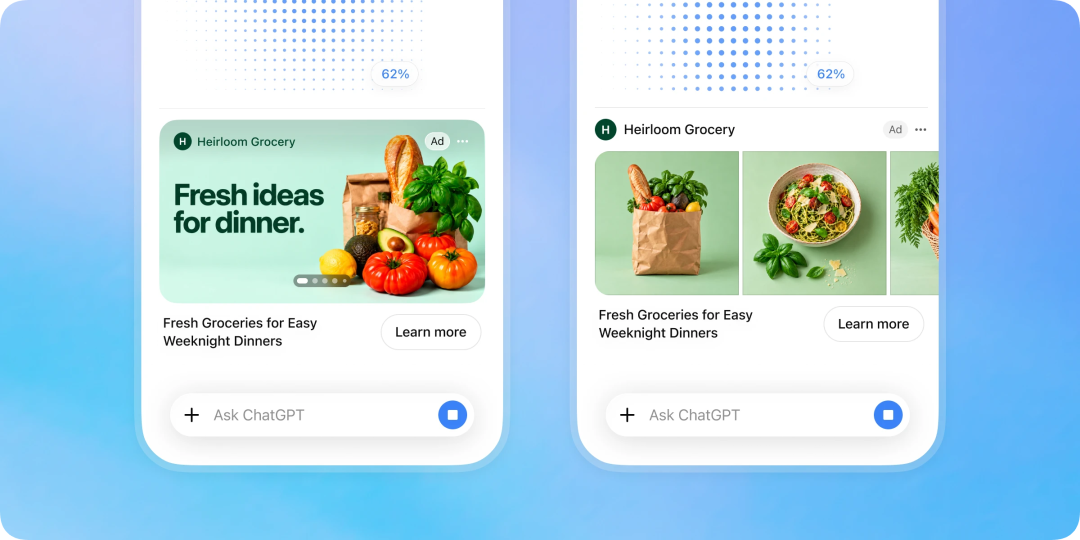
Per OpenAI's instructions, ads are clearly labeled and kept separate from the image being generated, and they do not affect the answers provided by ChatGPT.
Choose image generation as the test scenario, which has its business logic.
When users are imagining room layouts, activity plans or lifestyles, pictures can make the usage scenarios of the products more intuitive and make it easier for the brand to enter the user's consideration range. Of course, whether it can bring a good enough experience remains to be determined by testing.
OpenAI has also expanded its advertising performance measurement tools and cooperated with platforms such as Hightouch, Tealium, and LiveRamp to facilitate advertisers to transfer conversion data from existing systems back to ChatGPT Ads, and to introduce more attribution and performance evaluation partners.
For advertisers, the real question that needs to be answered is whether users made purchases after seeing the ads, and how many of these purchases would have occurred in the first place.
OpenAI announced early results from several groups of partners.
DV Rockerbox claims that WeightWatchers' attributed customer acquisition cost on ChatGPT Ads is 15.3% lower than its integrated paid search benchmark; WorkMagic claims that 67% of incremental purchases for wellness brand Dose come from new customers; and Triple Whale claims that 93% of Portland Leather's visitors from ChatGPT Ads are new visitors.
In addition, new rules are also required for where ads are displayed. OpenAI said it will evaluate whether the conversation is suitable for displaying ads, avoid serving in emotionally fragile, sensitive or otherwise inappropriate contexts, and explore brand fit assessments with DoubleVerify and Integral Ad Science.

According to the announcement, these partners will evaluate relevant protection mechanisms in a controlled test environment and will not access the private conversations of real users.
While ads on traditional websites typically surround page content, ChatGPT ads appear next to a constantly changing conversation. The better the platform can understand what users currently want to do, the more specific the business opportunities will be; similarly, users will be more concerned about how the suggestions they receive are affected.
OpenAI promises that advertising will not affect answers, and we will wait and see in the future.
The 28-day update commitment has just begun, and what will be delivered each day is still worth paying attention to. However, several changes on the first day have made the scope of the competition clearer. OpenAI must simultaneously operate the efficiency of paying users, the transparency of generated content, and the commercial return of advertisers.
As AI platforms become more mature, there is an increasing need to answer a familiar question. When it is both an assistant to help you make decisions and a place for businesses to compete for your attention, why should users continue to trust it?
Comments