
Abstract:
AI and data centers seem to be completely high-tech. But in the United States, there seems to be a "countercurrent". For example, this year, the city of Monterey Park in Los Angeles County, California, originally planned to build a very large data center with a peak power consumption of about 50 megawatts. However, this "high-tech project" was blocked by local residents. Moreover, with an approval rate of 88.34%, local voters made Monterey Park the “first city in the United States to ban the construction of data centers by citizens’ vote.”

City of Monterey Park
Not only will we not build it now, but we will never build a data center in the future.
Faced with the rapid advancement of the AI era, in a country that claims to be the world’s AI hegemon, why are people so disgusted with data centers?

In today's international landscape, whoever has large-scale, low-cost computing power clusters has the ticket to the next round of technological dividends.
Looking at specific cities, in the AI era, data centers are one of the most important infrastructures.
If a city builds a large data center, it may drive an entire industrial chain from chips to power grids to AI applications.
Therefore, the layout of data centers is not only related to the local economy, but also a reflection of a country’s technological sovereignty and energy strategic capabilities.
Therefore, many regions regard the construction of data centers as an important indicator of urban construction.
But in the United States, ordinary people have a general resistance to data centers, and Monterey Park is by no means an isolated case.
Even, it's not the most intense one.
For example, in the city of Festus, Missouri, a $6 billion data center project failed to come to fruition due to voter resistance. During this period, four congressmen who supported the project were directly dismissed.
In Prince William County, Virginia, Blackstone Group originally planned to build a 100-billion-level data center campus, but it was delayed due to a three-year lawsuit from local residents and civil organizations.
Behind these extreme cases, the data reveals the widespread opposition among the American people.
In May 2026, poll data released by Gallup showed that 71% of Americans opposed the construction of local AI data centers, of which 48% were "strongly opposed."
For comparison, even nuclear power plants, which have always been controversial, only had an opposition rate of 53%.
In other words, in the eyes of many Americans, AI data centers are already more objectionable than nuclear reactors.

In the first three months of this year, at least 75 data center projects in the United States, with a total investment value of approximately US$130 billion, were halted, delayed or canceled.
In the summer, in just over a month, three states in the United States turned on the red light one after another, and the intensity increased:
On July 14, New York State suspended for one year the issuance of environmental approvals for large data centers with more than 50 megawatts.
On August 3, Texas froze the advancement of new data centers in the grid connection process, requiring an audit of the actual controller, funding source, and electricity and water use plan of each project before deciding whether to release it.
On August 18, Pennsylvania required data center developers to provide their own electricity, pay their own electricity bills, and obtain the consent of the local community. If any of the requirements are not met, the permit will not be obtained.
The data center, which was originally the underlying infrastructure of cutting-edge technology, seemed to have become a scourge and disease overnight, and was beaten by everyone.
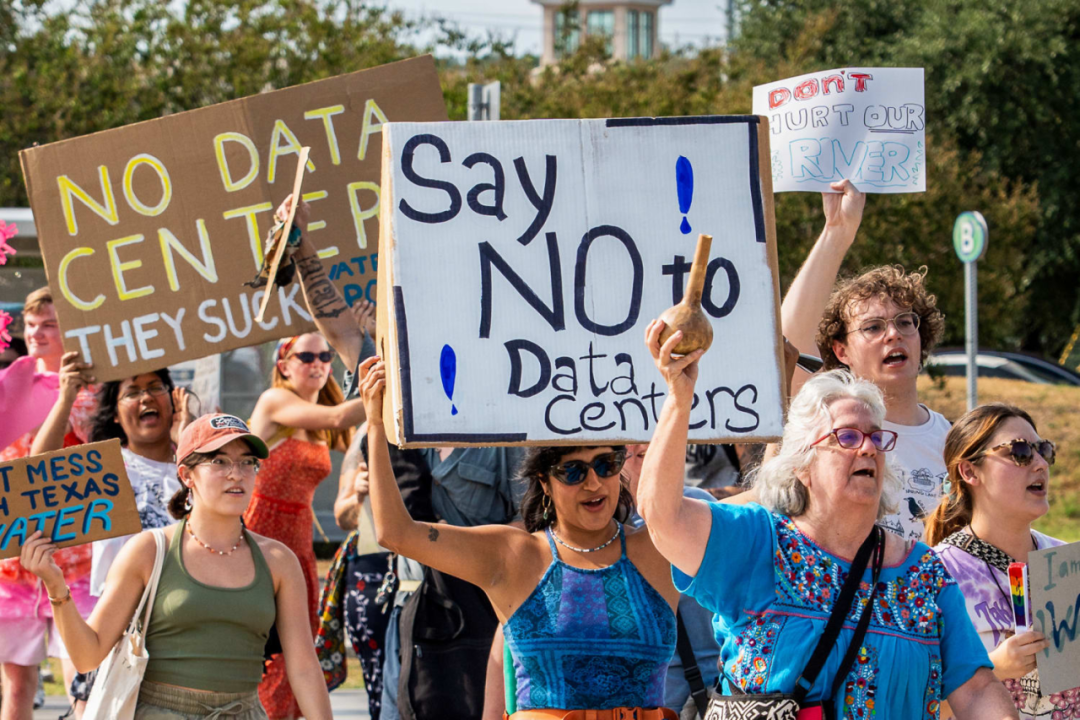
American people protest against the construction of artificial intelligence data centers

Why are U.S. residents boycotting data centers?
What are the goals of holding so many massive protests?
This is actually a very "firewood, rice, oil and salt" thing.
First, it’s electricity.
Data centers are "power tigers" and will directly drive up local electricity demand.
So, if these data centers are taken over, the local power grid company will have to upgrade substations and lay new lines.
In the United States, a country with a market-oriented electricity market, as demand increases, the cost of new infrastructure will be directly passed on to electricity prices.
Since 2021, U.S. electricity prices have increased overall by about 40%.
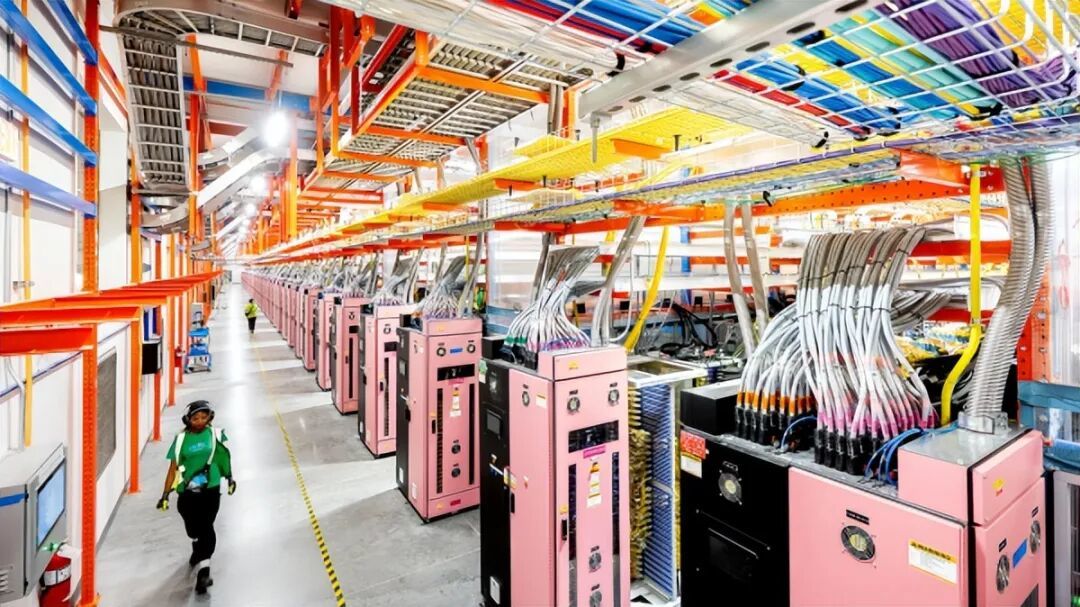
AI super cluster developed by Amazon and Anthropic
Over time, ordinary people can predict:
Completion of data center = increase in electricity prices.
This speculation has also been confirmed by the U.S. Department of Energy: data center electricity consumption in 2023 will account for approximately 4.4% of U.S. electricity consumption. By 2028, this proportion may rise to 6.7% to 12%.
Just imagine, a family in the United States originally had an electricity bill of about US$1,500 a year, but when the data center came in, it almost doubled.
For example, in Texas, because of its independent power grid and the blessing of natural gas, electricity prices have always been relatively low, making it a popular area for many companies to build data centers.
As a result, the demand for applications to build data centers in the Electric Reliability Council of Texas (ERCOT) grid connection queue this year has reached approximately 474 gigawatts, more than five times the historical peak power load in Texas.
A considerable part of these construction needs are trying to "occupy seats" rather than making a decision to settle in Texas.
So the Texas government can only raise the threshold again and again, otherwise the power infrastructure alone will not be implemented for a while, and the rising electricity prices will be difficult to suppress.
Second, it’s water.
A lukewarm piece of knowledge is that data centers require large amounts of water to cool their equipment.
For example, a large data center, based on the upper limit of 5 million gallons, is equivalent to approximately 18,900 tons of water per day, which is equivalent to the daily water consumption of a small or medium-sized town.
More importantly, in order to ensure power supply, many data centers will be equipped with power plants, so they must choose places with cheap land and small populations. Many of these also have water shortages. Once the data center is built, the local water distribution pressure will be even greater.
For example, in Newton County, Georgia, residents were told that water bills are expected to rise by 33% in the next two years.
A large part of the reason for the price increase is the huge water consumption due to the construction of data centers nearby.

The elderly who have to go to the town to drink water directly because they are neighbors of the data center
Once the data center is launched, both electricity and water bills will increase.
Why should residents pay for the water and electricity provided by technology giants?
Third, it’s noise.
In order to ensure that thousands of GPUs operate at full speed, most data centers are equipped with powerful cooling systems. Industrial cooling fans roar at low frequencies 24 hours a day, which can cause continuous noise pollution in the surrounding area.
Therefore, some research shows that residences within 3 kilometers of the data center may face the risk of depreciation.
We talked about the 50-megawatt ultra-large data center project in Monterey Park City. It is only about 150 meters away from residential areas. If local residents do not join forces to resist, they may have to endure noise pollution for a long time.
In other words, data centers will not only compete with residents for land, but will even disrupt the normal lives of residents several kilometers around.
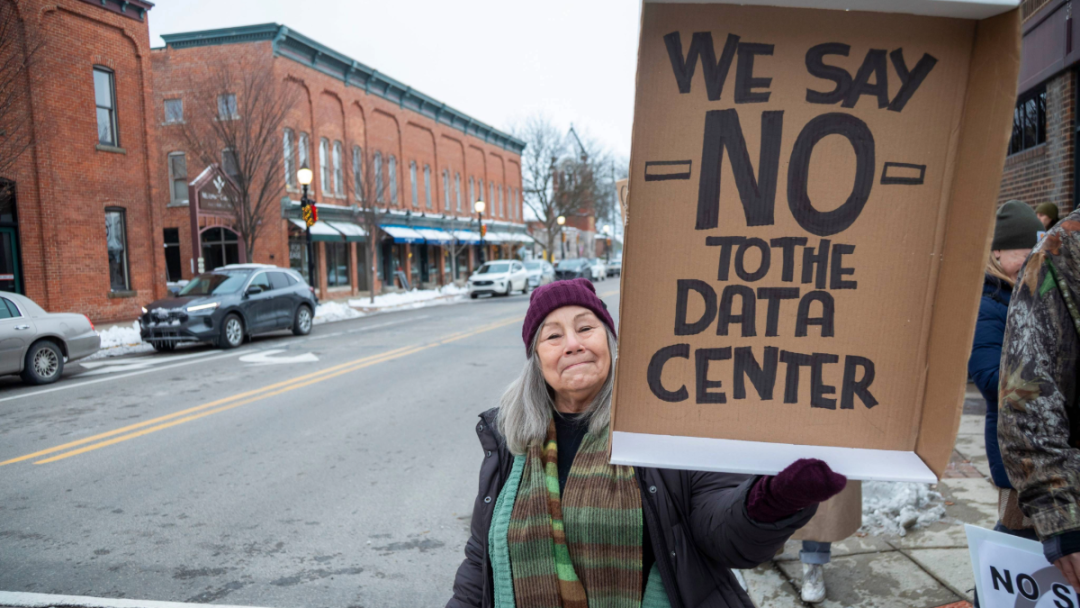
Rural Michigan residents rally to protest the $7 billion Stargate data center planned for construction in farmland in southeastern Michigan
Developers of residential properties are not stupid either.
As long as residents do not resist, the new building will not be built.
But this will obviously result in loss of interests for many parties - residents have no new houses to live in, the municipal government lacks new projects, and local finances receive less money.
There seems to be no better way than proposing to "send off guests" to the data center.
Fourth is employment.
The developer's mouth is a liar.
This is the same in the field of AI data centers.
Faced with public protests against data center projects, the most common rhetoric used by developers is: We can solve employment problems.
But the Virginia Legislative Audit and Review Commission gave figures in its official report for 2024:
A typical 250,000-square-foot data center has only about 50 permanent full-time positions, nearly half of which are outsourced personnel; the real number of people is during the construction period, when about 1,500 workers work on site for 12 to 18 months.
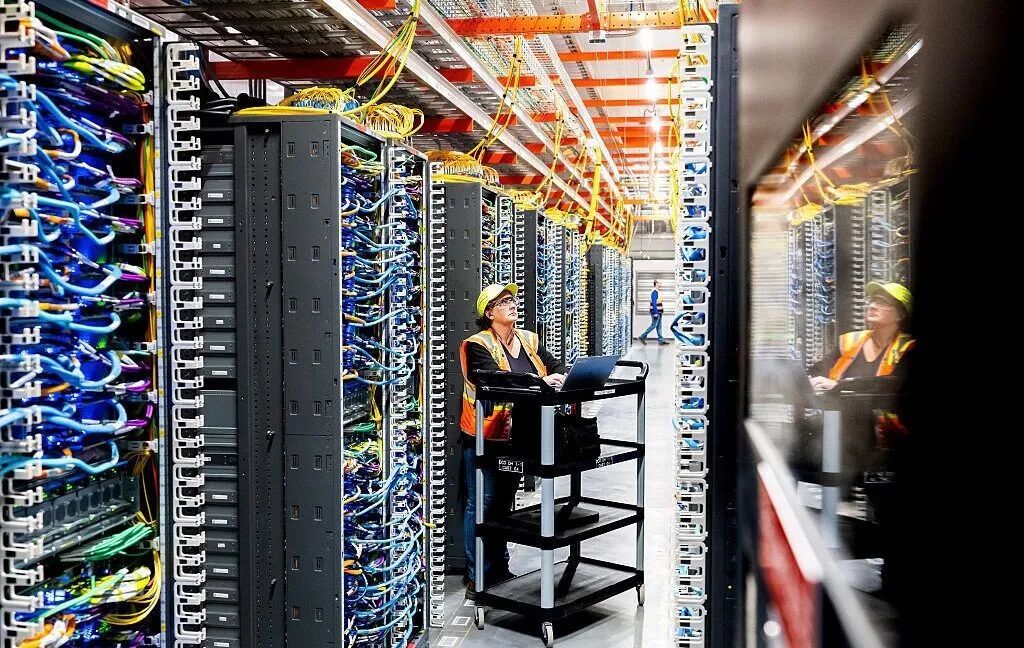
In the end, the result that residents will see is likely to be: a data center is built, the developer hires a small number of foreign technicians, but leaves the local area with skyrocketing electricity bills, water bills, and noise.

However, these are just appearances, and they are deeper hidden in the underlying logic of the operation of the American country.
Take the U.S. power system as an example.
The United States is indeed a hardcore developed economy, but its power system is really ridiculously broken.
The continental United States does not have a unified supergrid like many countries, but is made up of three asynchronous grids: the Eastern Interconnection Grid, the Western Interconnection Grid, and the Texas Island Grid.
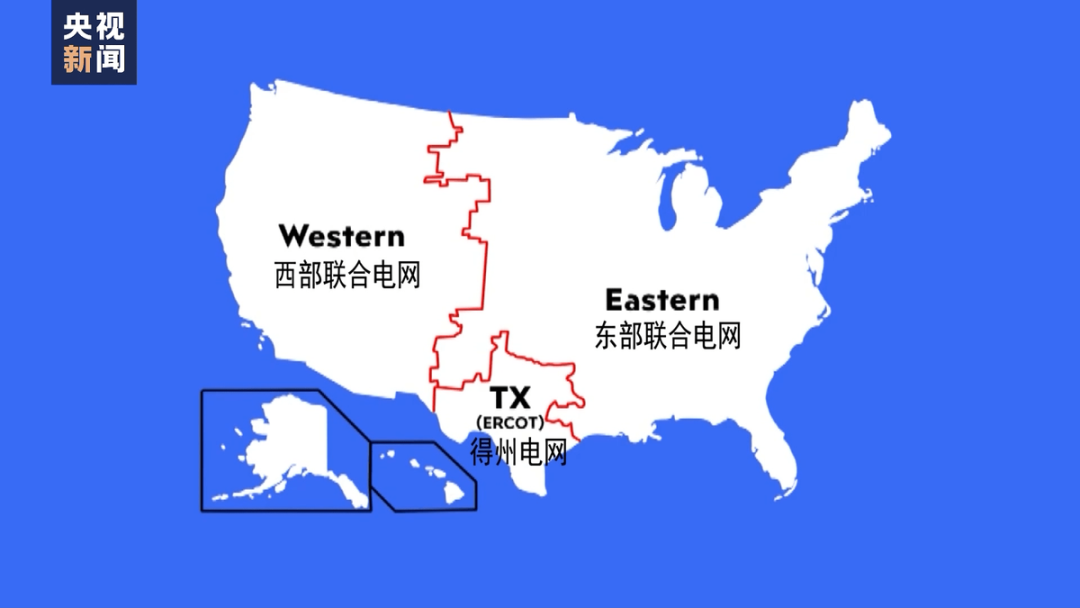
The power grid system in the United States is mainly divided into three major regions: the Eastern United Power Grid, the Western United Power Grid, and the independent Texas Power Grid
The three major power grids have little intercommunication and operate independently.
Because if you want to build a cross-state high-voltage transmission line, you need layer upon layer of approvals, involving every transit state.
A series of processes must go through the Public Utilities Commission, relevant departments, environmental groups, land owners...
Under this framework, each state is willing to go its own way. As long as taxation, employment, and supervision are all easily controlled within their own jurisdictions, they can make stable profits, save time, have less trouble, and have high returns.
This has resulted in a vertical monopoly among 7 independent operators in the United States and constant competition among 3,000 power companies.
Books have different texts and cars have different tracks. How can the world be unified?
But the brokenness of the U.S. power grid was not created in a day, and it is not that easy to change.
As early as 1935, during the Great Depression, the United States promulgated the "Public Utility Holding Company Act". The federal government managed interstate electricity wholesale, and states were responsible for retail sales and services.
But when it comes to the power grid, whoever is in charge of distribution and pricing is the boss.
With legal retail rights, states have focused on providing electricity for their own homes, not to mention unifying the power grid.
It takes an average of more than ten years from planning to completion of interstate lines, let alone the mutual aid model of long-distance power transmission and high-voltage power transmission.
Data centers need to be built, citizens’ rights and interests must also be protected, and the party that can gain commercial benefits must make concessions.
In February this year, Trump proposed the "Ratepayer Protection Pledge" for the first time in his State of the Union address, advocating that the cost of upgrading new power transmission infrastructure in data centers should be borne by the enterprises themselves, rather than American consumers.
In this regard, the technology giants seem to have given up and decided to develop their own electricity.
Google acquired the renewable energy company Intersect Power for approximately US$4.75 billion. It not only bought its power generation capacity, but also its power grid access rights and land reserves.
Microsoft restarted the Three Mile Island Nuclear Power Plant, and one of the reactors will be modified to exclusively power Microsoft data centers.
Meta has signed a nuclear power purchase agreement for more than 2,600 megawatts, enough to power a medium-sized city.
Amazon signed a long-term power purchase agreement with power company Talen Energy to lock in the supply of nuclear power of up to 1,920 megawatts.
And these are just part of the AI manufacturers’ efforts to make money.
This means that,
in the future, AI manufacturers may also be large power companies.
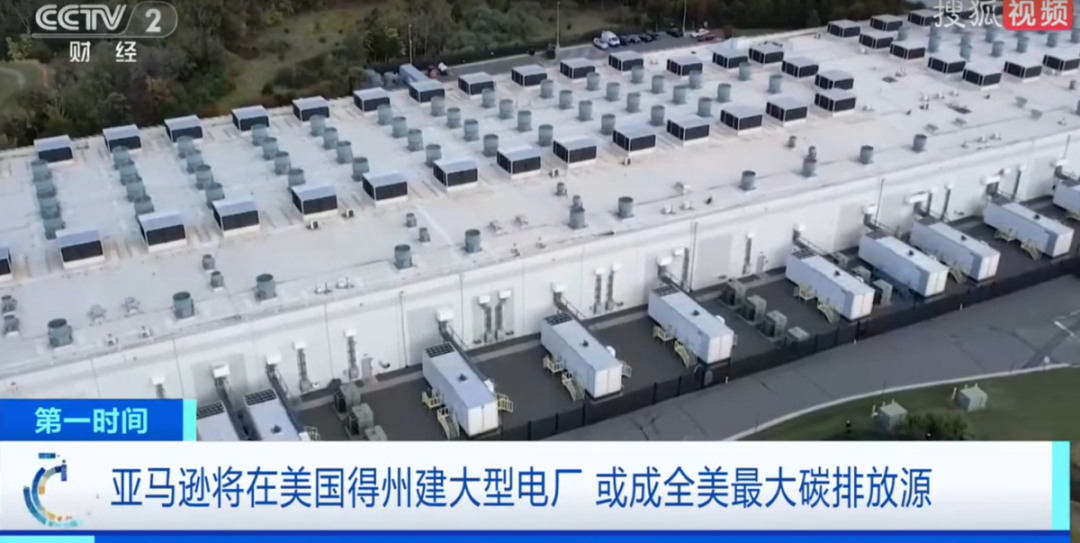
The cost of integrating power upstream is of course extremely high.
But if the upstream infrastructure cannot keep up, it will affect the explosion of downstream applications, and time waits for no one.
Time is actually the “eye of the storm” between U.S. policies and AI manufacturers.
Because states in the United States also want to deploy the AI industry, but it takes time to replenish the power supply. If the data center is in a hurry to launch, it must work with the local area and find a solution together.
In the final analysis, the development of the US AI industry and the construction of data centers have never been a question of whether technology can lead, nor is it just a question of whether industries can collaborate.
This is the "Achilles' heel" of the United States: it is difficult to achieve strong integration from the bottom up.
Comments