
Abstract:
The latest statistics released by the market research organization Counterpoint Research show that
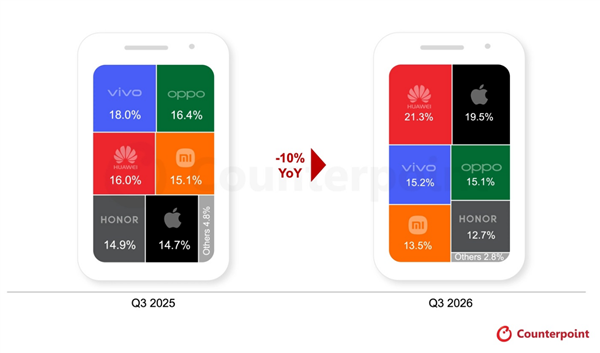
China's smartphone market has quietly formed a duopoly pattern. The two leading brands, Huawei and Apple, are gradually leaving behind their competitors, and their lead continues to widen.
The latest statistics show that China's overall smartphone shipments fell by 10% year-on-year in the third quarter of 2026, setting a record for the lowest shipment volume in the same period since 2012. The overall industry's contraction far exceeded previous expectations of market institutions.
The core reason for this round of sluggish performance in the industry is that global memory chip prices continue to rise, and the overall supply of upstream components is tight, which directly drives up the production costs of complete machine manufacturers.
Judging from the market share data of subdivided brands, the combined shipments of Huawei and Apple have accounted for 40.8% of the entire market, which has increased significantly compared with the total share of the same period last year, almost eating up all the incremental space released by the contraction of the market.
This data also confirms that in an industry cycle in which storage costs continue to rise, the two leading brands have been deeply involved in the high-end market, which has brought them strong risk resistance. The cost pressure can be transmitted through brand premiums, and on the contrary, they can further expand their market share through industry reshuffle.
The remaining domestic mobile phone manufacturers targeting the mid-to-low-end market have almost all experienced varying degrees of market share decline under the impact of the continued crazy price increases of memory chips, and their already meager profit margins have been further squeezed.
The current cost inflation of upstream components has reached its peak in recent years. More and more mid-level manufacturers are no longer able to fully absorb the rising component procurement costs through internal cost reduction. They will have to face the dilemma of increasing prices or selling goods at a loss.
As the range of price increases in the terminal market continues to expand, many consumers who originally planned to replace their phones have begun to actively postpone their replacement cycles and wait for subsequent e-commerce sales promotions before purchasing new phones. Many users have also directly turned to the second-hand mobile phone market for refurbished phones to purchase older models with higher cost performance.
This kind of wait-and-see behavior of consumers will further weaken the market demand for new smartphones and bring additional growth pressure to new phone sales in the upcoming fourth quarter of 2026. The overall recovery pace of the industry is likely to be slower than previously predicted.
The Matthew Effect brought about by rising storage costs will further amplify the current market differentiation. Mid-tier manufacturers without core high-end brand premium capabilities will find it increasingly difficult to survive. In the future, the duopoly pattern of the domestic smartphone market will remain for a long time, leaving the window for other domestic brands to break through.
Comments