
Abstract:
The carnival of U.S. stocks brought about by the midterm elections lasted only one day. Chip stocks sold off sharply on Thursday as the Dow Jones Industrial Average was heading for its second worst trading day since the midterm elections, data dating back to the Dow's inception in 1896 showed. It took just six minutes for the Nasdaq Composite to give up all of its post-election gains, before the sell-off intensified.
The technology-heavy index fell more than 5% in late morning trading, while the S&P 500 fell more than 3%. Both major indexes were on track for their worst single-day performance since the Guanqi slump in April 2025.
After the Democrats took control of Congress, oil prices and U.S. bond yields fell, and investors bought stocks aggressively on Wednesday. Now the market focus turns to the impact of the Democratic Party's control of Congress on AI construction, especially the data center industry.
Looking back on nearly a century of history, the S&P 500 is also about to record its worst performance on the second trading day after the midterm elections; the previous lowest record was in 2002, when the index fell about 2.3%.
This week’s market trend echoes that of 1896. In November of that year, William McKinley won the White House election. The Dow Jones Industrial Average rose about 4.5% the day after the election, then gave up about 2% of its gains on the next trading day. The Dow Jones Industrial Average rose 3% on Wednesday, its best post-midterm performance since 1982.
The Nasdaq 100 Index has already entered a correction range on Monday, with a drop of more than 10% from its highest point (October 6); the broader Nasdaq Composite Index is also about to enter a correction. Both major indexes fell below the
200-day moving average
, a large number of traders regard this moving average as the dividing line between rising and falling trends; since April, the two major indexes have never closed below this level.The Philadelphia Semiconductor Index fell about 10%, having fallen by more than a third from its all-time high set in June.
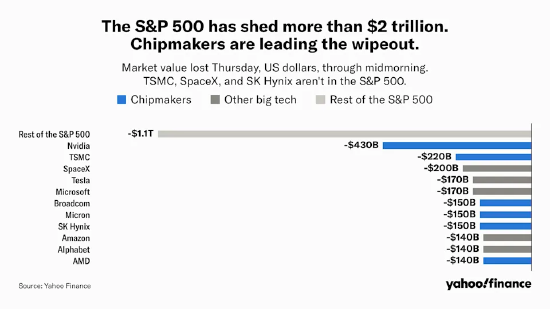
The overall market value of the S&P 500 has evaporated by more than $2 trillion. The market value of NVIDIA alone has shrunk by more than US$400 billion, and the overall market value of the chip sector has lost well over US$1 trillion.
Qualcomm, Micron, and ARM led the decline in the chip sector; SanDisk, Western Digital, and Seagate all experienced double-digit declines. AMD, Marvell, ARM, and Lam Semiconductor also plummeted. Even industry giants Nvidia, Broadcom, and TSMC fell close to 10%.
The downward trend spread to the entire AI industry chain. Cloud computing power vendors Nebius and CoreWeave also fell by double digits; Astera Labs, Lumentum, Coherent, Dell, Corning, and Quanta Services in the optical communications and network equipment sectors fell simultaneously.
High-risk stocks fell along with the broader market: Tesla, SpaceX, Robinhood, Coinbase, and MicroStrategy all fell by more than 10%. (Disclosure: Yahoo Finance has a partnership with Coinbase)
Thursday's decline follows a sell-off on Oct. 30 that wiped more than $1 trillion off technology stocks on concerns about AI capital spending. At the same time, the market began to demand higher risk-return rates for companies that borrowed heavily to build data centers.
There are very few hedging targets in the market. AppLovin (APP) shares rose nearly 30% after releasing its financial report; Motorola Solutions and Verisk rose about 10%; defensive stocks such as Aflac and Allstate rose slightly.
The next important economic point of view is the October non-farm payrolls report due out on Friday.
Comments