
Abstract:
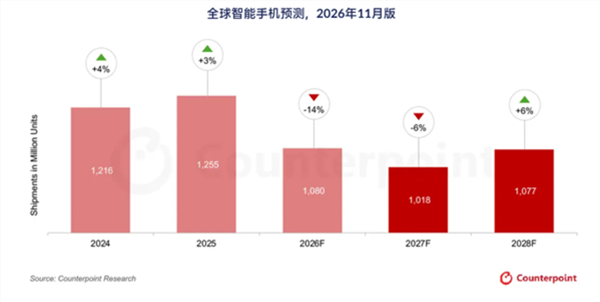
Counterpoint Research’s latest smartphone market outlook predicts that global smartphone shipments will decline by 13.9% year-on-year in 2026 and another 6% in 2027.
By 2028, it will rebound by 6% as memory conditions improve, prices stabilize, and the backlog of replacement demand returns. However, the shipment scale in 2028 is still about 14% lower than in 2025, and the market is not expected to return to the 2025 level by 2030.
The agency believes that this round of downturn is mainly affected by the tight supply of mobile memory. Suppliers’ production capacity is still prioritized for AI and server applications, and mobile phone DRAM allocation is limited.
LPDDR prices are expected to continue to rise in early 2027, and the transmission of component costs along the product mix and retail channels is slower than expected, raising the bottom line of mobile phone costs and retail prices.
Under cost pressure, mobile phone manufacturers have reduced low-memory versions, increased entry-level specifications and selling prices, and exited products that failed to meet profit targets.
The market for models below US$200 (approximately RMB 1,334) has shrunk and is concentrating at the upper end of the price band. Some consumers choose to upgrade and purchase, while others postpone replacement, extend the life cycle of old machines, or turn to refurbished machines.
In terms of brand structure, Counterpoint predicts that Apple will still rank first in the world in 2026 and 2027 with a weak shipment advantage. Apple shipments are expected to fall by 1% in 2026 and 4% in 2027. High-end positioning, installment finance, ecological loyalty and supply chain priority provide support, but price increases and the exhaustion of the replacement peak from 2025 to 2026 will limit growth.
Samsung’s shipments are expected to fall by 1% in 2026 and 3% in 2027, significantly outperforming the market. Self-developed components, a wide product line, and relationships with operators and retail channels give it more advantages in supply security and distribution flexibility. However, the increase in high-end and folding screens will be difficult to offset the weak sales of the Galaxy A series.
After a sharp contraction in 2026, Chinese manufacturers are expected to continue to be under pressure in 2027. Their business is more concentrated in low-price segments and emerging markets, and they are more vulnerable to the impact of component supply and price increases. They may subsequently optimize product lines and withdraw from lower-profit markets.
Comments