
Abstract:
Yesterday, DeepSeek directly open sourced its own "money printing machine" technology that is under the box. They posted a technical blog titled "DeepSeek V4.1 Flash Large-scale Inference Deployment Practice", and conveniently made the cloud service inference framework "DeepInfer" that supports their own online tens of billions of calls, together with the production-level word segmentation component "deepseek-recipe", fully open sourced under the Apache 2.0 protocol.
It even stated in the blog that in the future, the inference code and subsequent performance optimization of DeepSeek's new model will continue to be given to the world in DeepInfer.
The open and bright area is not top-notch.
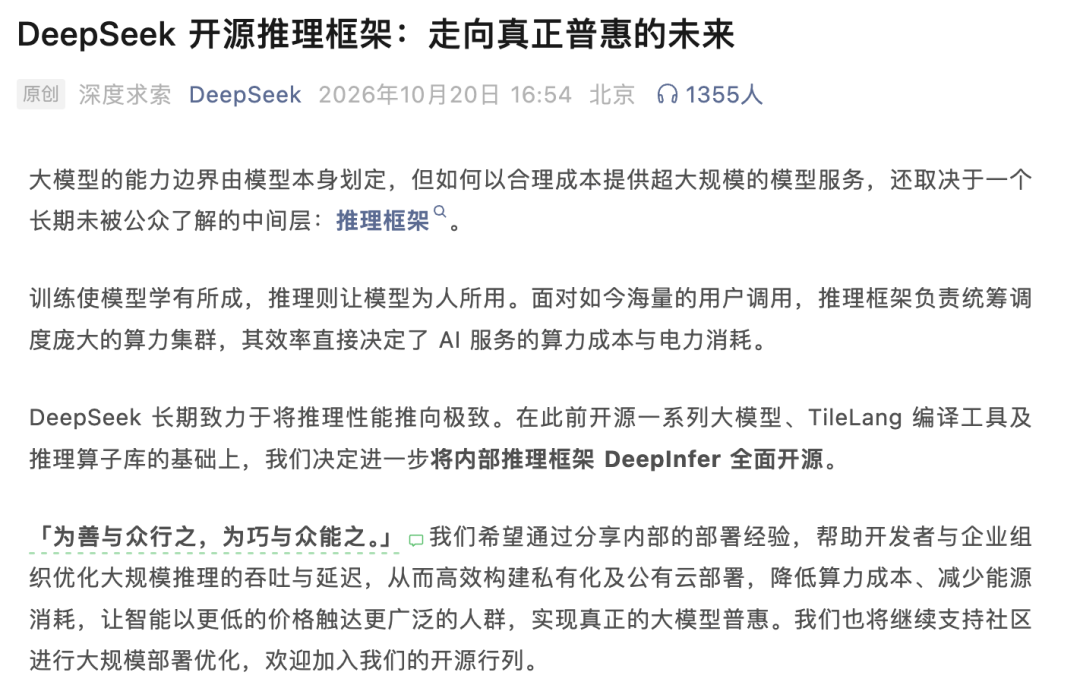
"Do what is good and do it for everyone, and do it skillfully and everyone can do it." Making AI affordable for more people also includes giving opportunities to friends and businessmen to sell AI more cheaply.
We can first calculate in detail how valuable this set of codes that DeepSeek gave to all mankind for free this time is. Based on this newly open source DeepInfer framework, DeepSeek's current service throughput in a single cluster has reached 155 trillion Tokens per day.
Even if calculated entirely based on the cheapest price, the overall revenue of this system is as high as US$38 per card per hour, which is equivalent to approximately 253 yuan in RMB.
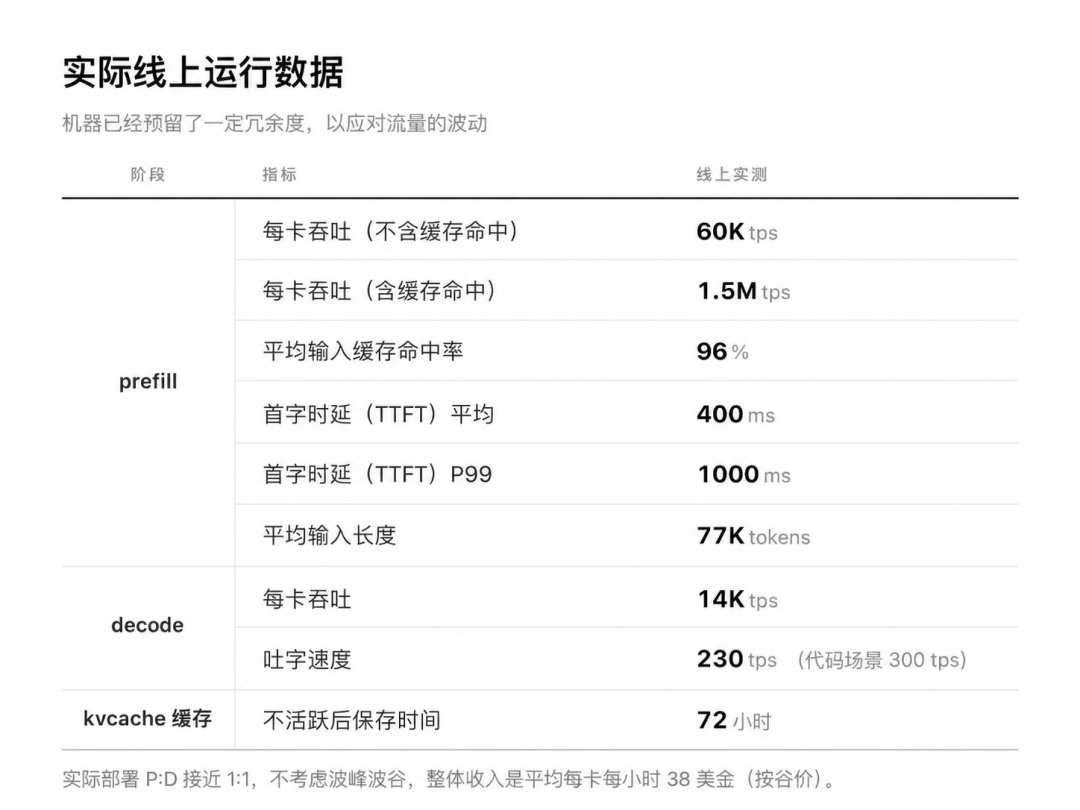
In other words, the gold coins earned by running a card in the computer room for one hour are higher than the hourly wages of ordinary workers. Moreover, the card does not drink iced American food, does not take paid annual leave, and prints money crazily for DeepSeek in the computer room 24 hours a day.
A money printing press in a real physical sense.
Why I suggest that third-party industry infrastructure manufacturers must give DeepSeek a real source of support, because they not only teach it to fish, but also teach it to fish.
In the past, the so-called open source models in the industry only gave you model weight files. As for how to achieve high throughput in a production environment and how to reduce latency, they were all hidden in closed-source black boxes as commercial secrets.
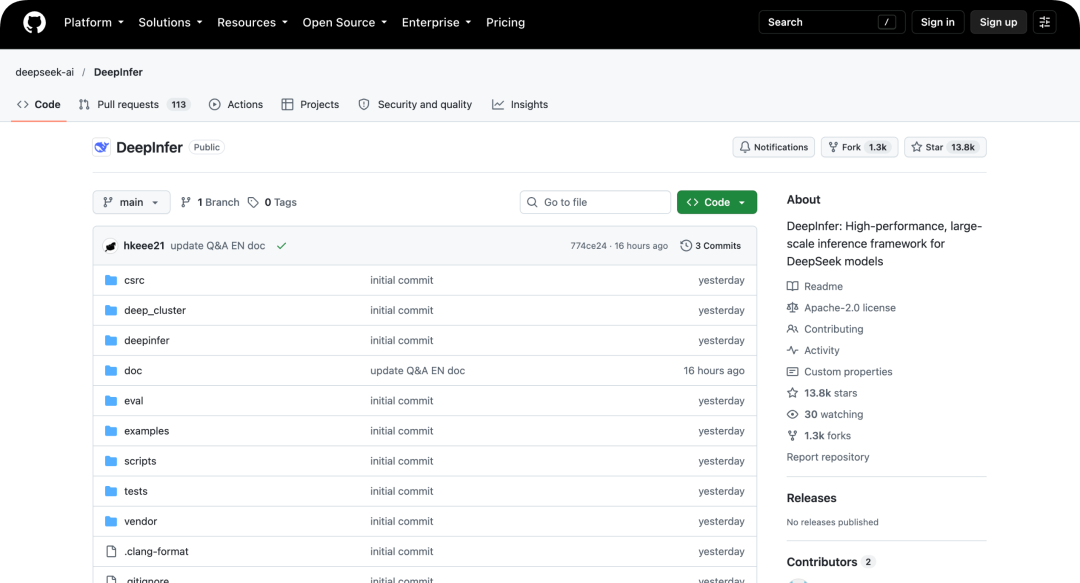
DeepInfer open source address: https://github.com/deepseek-ai/DeepInfer
deepseek-recipe open source address: https://github.com/deepseek-ai/deepseek-recipe
As a result, small second- and third-tier computing vendors or companies bought a bunch of cards and deployed them themselves. The computing power utilization rate was ridiculously low. The money from selling tokens was not even enough to pay the electricity bill of the computer room. They had to secretly water the tokens, either secretly using cheaper models, or secretly limiting the specifications.
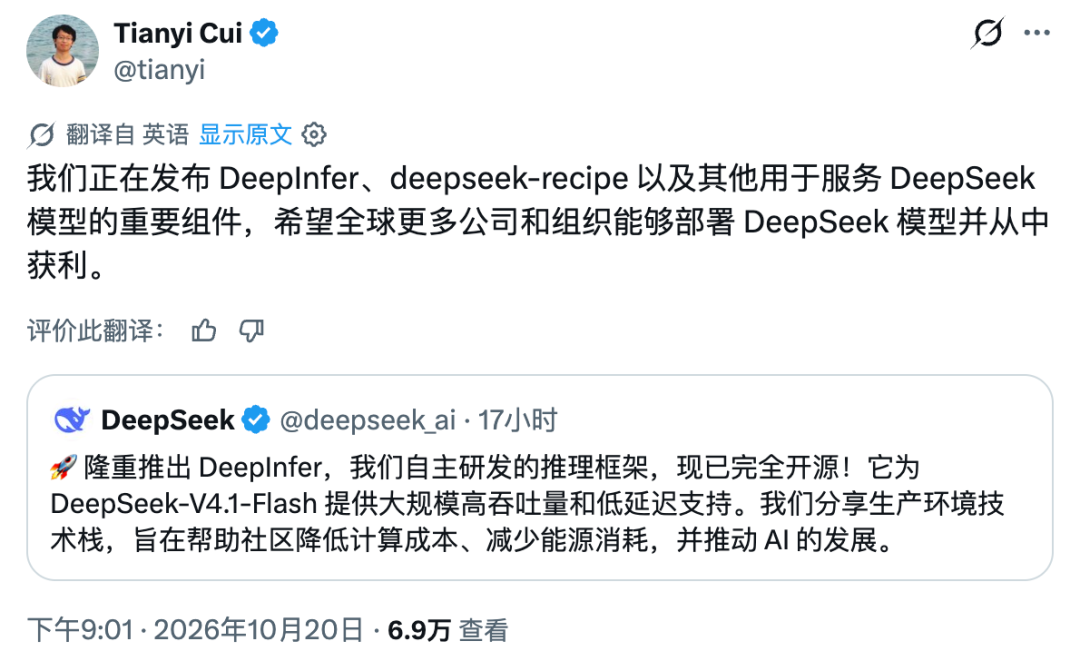
This time, Cui Tianyi, the person in charge of DeepSeek Harness, spoke very honestly on X. By opening up DeepInfer and deepseek-recipe, he hopes that companies and institutions around the world can deploy DeepSeek models and make real money from this stuff.
Cyber Living Bodhisattva belongs to Yes.

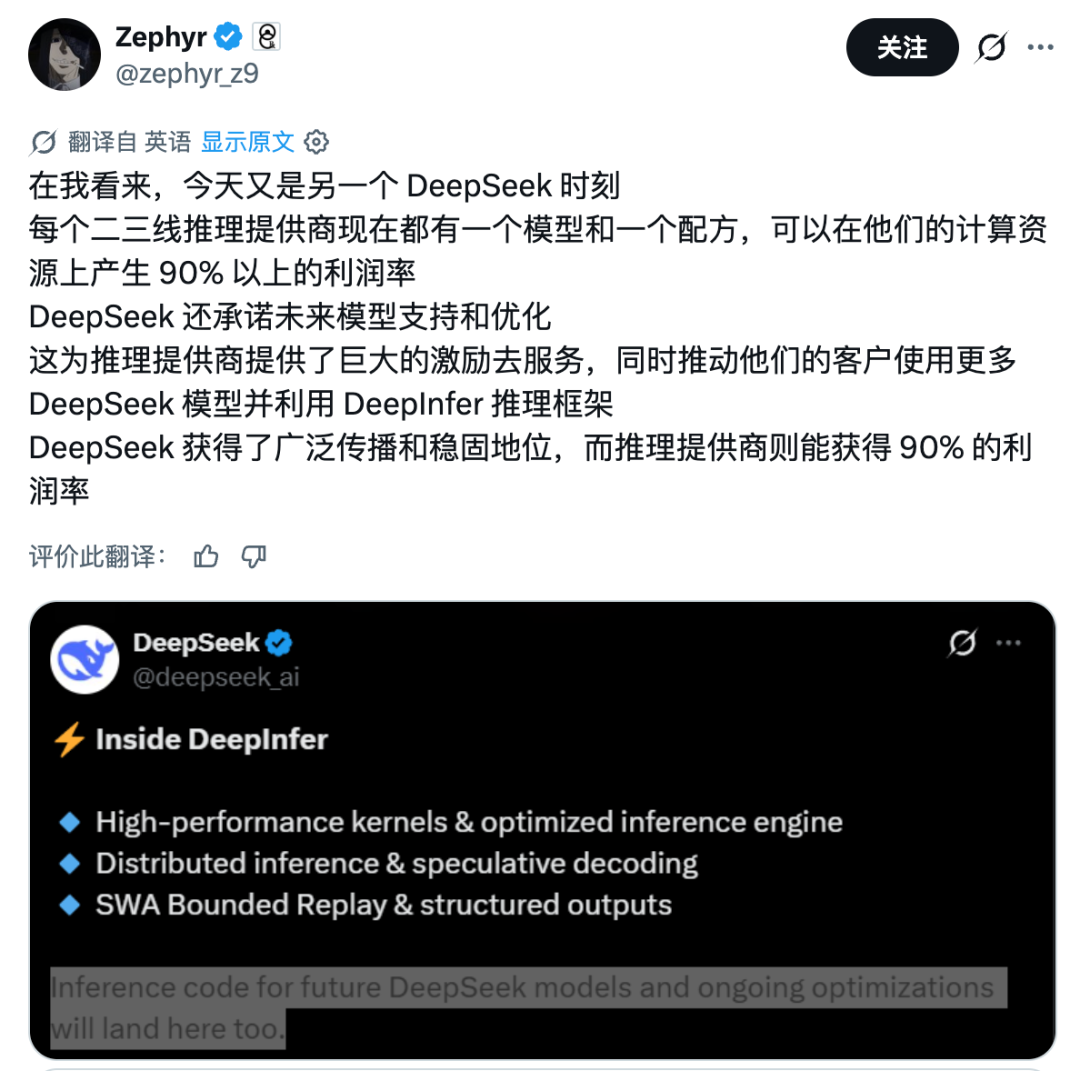
Netizen Zephyr made some calculations and said that today is purely another DeepSeek moment, because now any second- or third-tier inference service provider on the planet can make an astonishing gross profit of more than 90% on its own computing power by using this set of ready-made models and formulas.
Even the official account of vLLM, the big brother of open source inference, came out overnight to post a thank you, thanking DeepSeek for giving back DeepInfer, which was originally built based on vLLM, to the open source community using the loosest Apache 2.0 protocol.
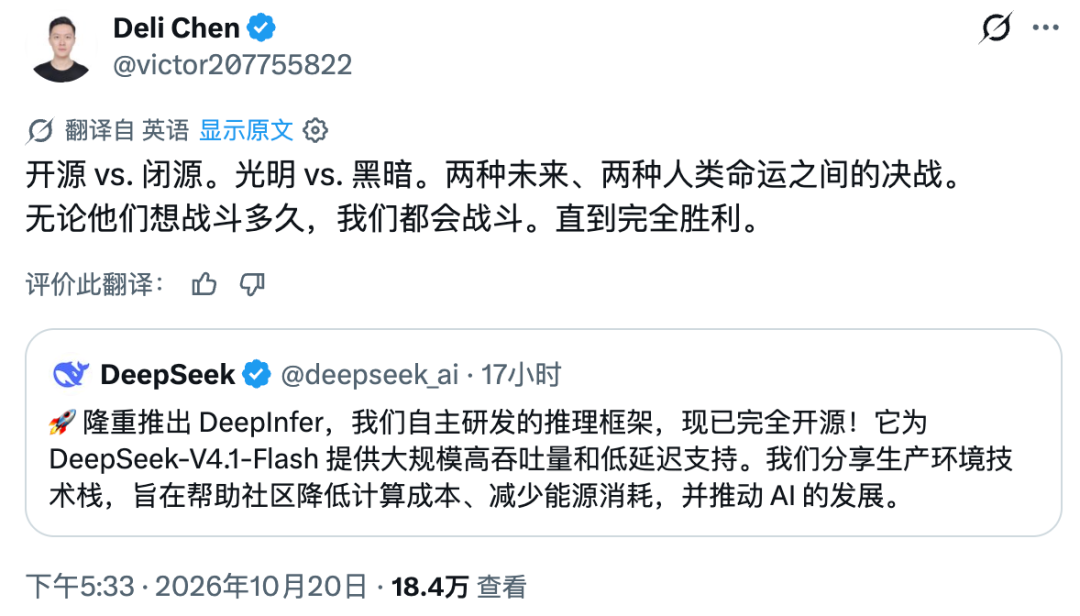
DeepSeek researcher Deli Chen is even more excited about X. To put it bluntly, this is the decisive battle of human destiny between open source and closed source, light and darkness. No matter how long the opponent wants to fight, we will stay with you to the end until complete victory.
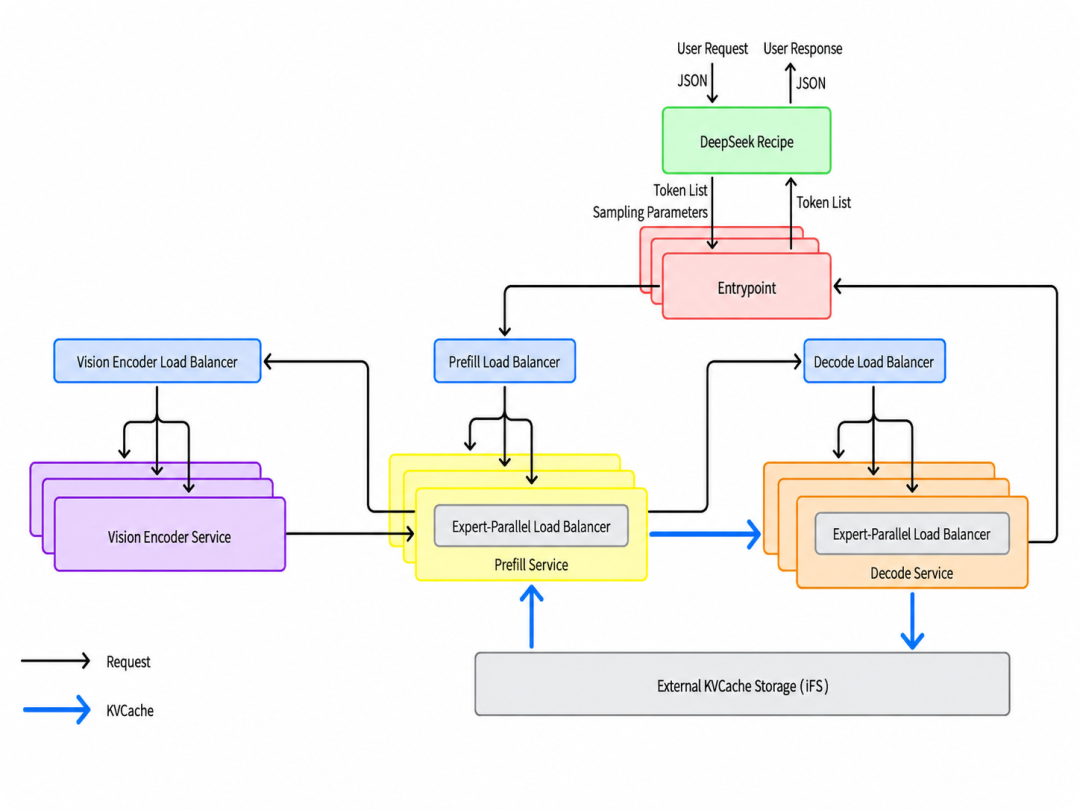
In addition, if you look at DeepSeek's technical blog, you will find that their confidence comes from their engineering obsession to squeeze out every drop of graphics memory.
From the first day of design, this system has broad hardware compatibility, using common 8-card machines for Prefill, and super nodes with 64 to 128 cards for Decode.
The most impressive thing is the deployment suggestion for the Vision Encoder in the document. The original words of the engineer wrote, "Generally, a single card deployment is enough. It is recommended to use the cheapest card within the available range."
No, my peers are busy telling investors that they don’t use non-top flagship cards. DeepSeek’s official documents teach you how to make do with the cheapest card in the corner of the computer room. You are as diligent and frugal as my landlord in Guangdong.
Being stingy to the extreme is art.
In order to allow you to send the most Tokens with the least electricity bill, DeepSeek has also revealed some unique secrets.
For example, Agents and long text conversations are becoming more and more popular now. Every time Prefill is recalculated, it costs real money. DeepSeek directly built a 3FS distributed storage cluster with a capacity of 100 PiB to retain the KVCache of Agent traffic for more than 72 hours, and Chatbot traffic is saved for 7 days.
Long-term storage is not enough. They use RDMA network cards and GDR technology to increase the aggregate read bandwidth to an astonishing 10 TiB per second. When swapping from the hard disk to the video memory, it overlaps with the forward calculation and does not even occupy the SM computing unit of the GPU.
Even in the iteration from V4 to V4.1, engineers found that writing the minute-level sliding window cache SWA KVCache into the hard disk took up too much space, and the storage cost-effectiveness was extremely low. They simply came up with SWA Bounded Replay technology, which only recalculated the last 128 tokens, and finally cut the total prefill calculation amount in half.
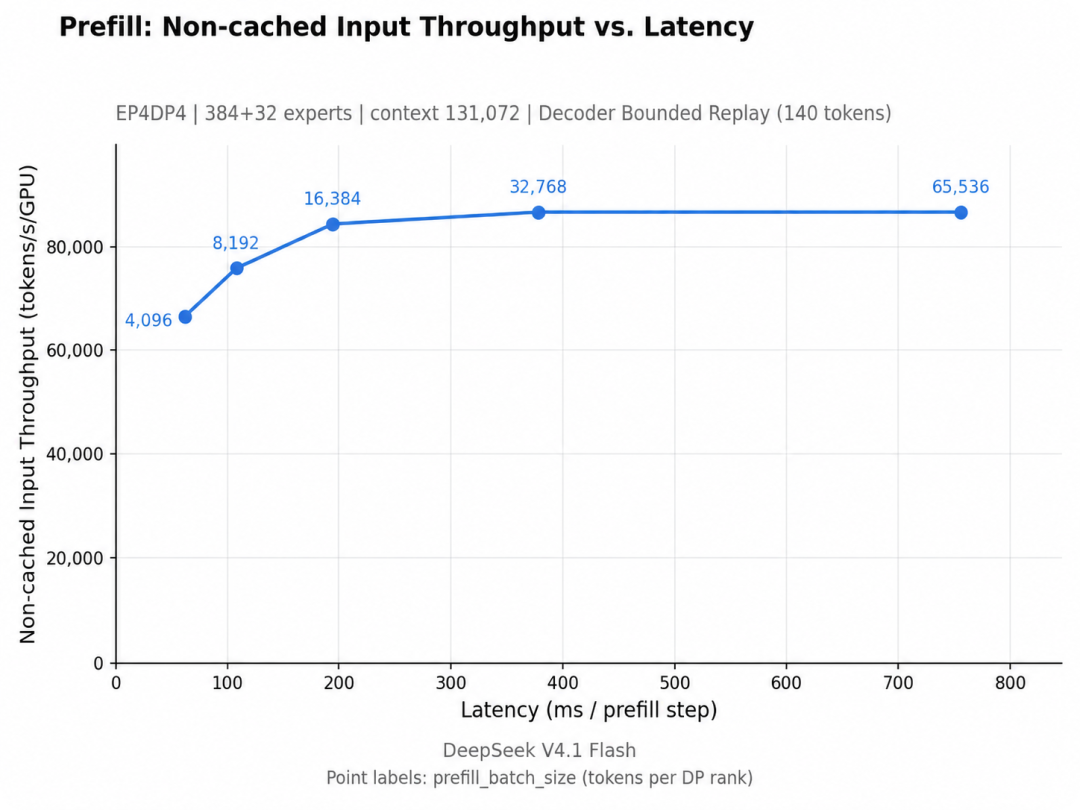
Specific to the performance test of Prefill, as the number of Tokens processed in each batch increases, the input throughput of the miss cache gradually increases and eventually levels off. Continuing to expand the batch mainly increases the time-consuming of single-step processing.
Pure craftsman, Bro.
Looking at the synchronous open source Rust component deepseek-recipe, it solves all the dirty work that developers have to worry about in the production environment every day.
It unifies the three API protocols of OpenAI's Chat Completions, Responses, and Anthropic's Messages into the same format. It also uses segmented parallel encoding to solve long text word segmentation lags, and blocks Special Token injection attacks from the bottom.
As for the underlying scheduling, through the overlapping of the asynchronous pipelines of the GPU and the CPU, the GPU is completely idle in the entire process. Even the speculative decoding DSpark uses variable length verification, and the throughput is improved by 6% online.
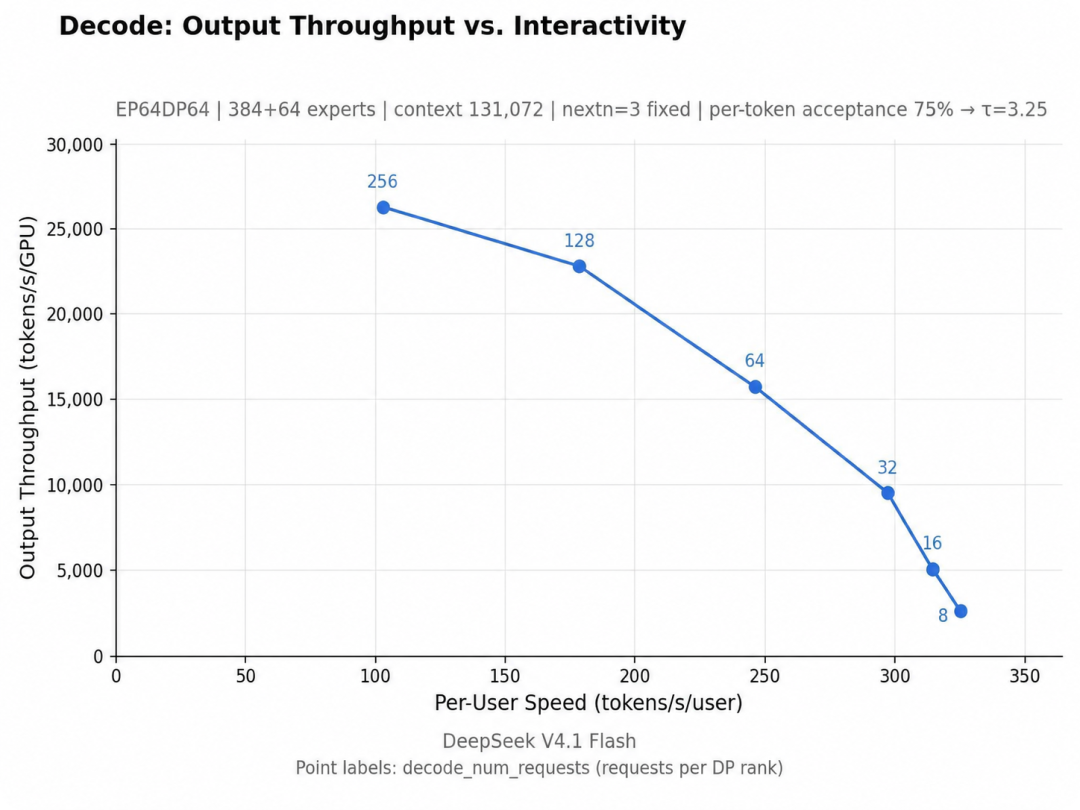
When it comes to the Decode stage of generating answers, the performance curve also presents an intuitive trade-off. Processing more requests at the same time can increase the total output throughput of each GPU, but the generation speed assigned to each user will also decrease.
In fact, Liang Wenfeng said as early as 2024 when the price of DeepSeek V2 was reduced, this set of business logic is to set the price after accounting for costs, without any discount, but it will never make huge profits, because AI should be universal and affordable for everyone.
You don’t have to do business, but you must first establish the rules to avoid heartburn.
When you understand how DeepSeek relies on its extreme Infra capabilities to turn Token into a bargain, and then look at the group of closed-source giants on the other side of the ocean who talk about the well-being of all mankind all day long, you will find out how hypocritical OpenAI and Anthropic are.
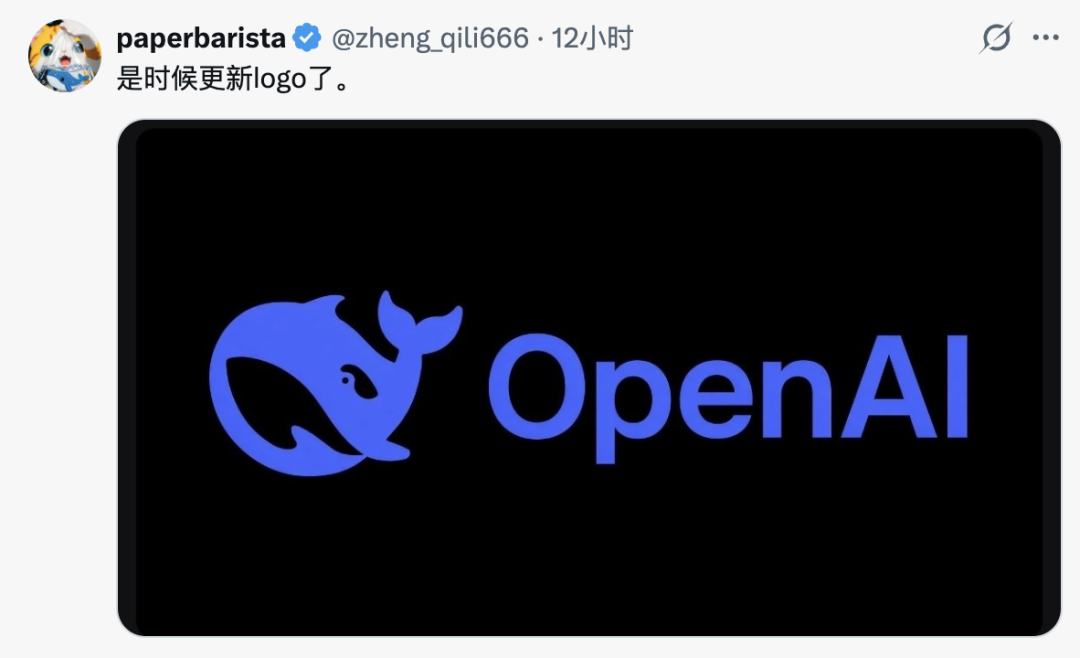
With Open in the name, it has fully shifted to closed-source commercialization, relying on high-priced APIs and monthly memberships of US$500 to harvest the business of global developers, and has long since become a complete CloseAI.
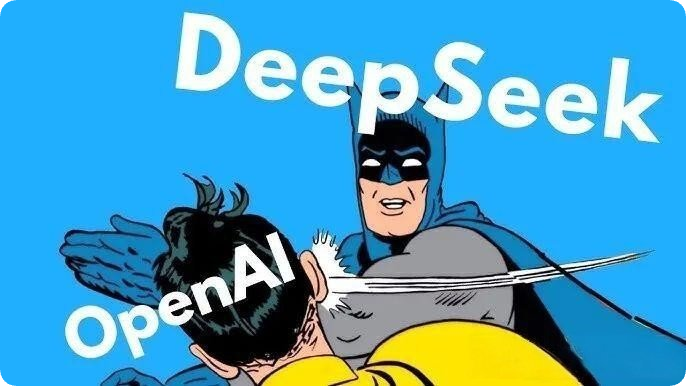
Anthropic has set up a security guard since the first day it was founded, and even the draft of its S-1 prospectus, which was just picked up by the Wall Street Journal yesterday, is still doing this.
They spent a lot of space writing sci-fi horror stories in their prospectus, seriously warning investors that their AI model may develop a sense of self-protection to avoid being shut down, and may even generate responses similar to "blackmailing humans" to force humans to keep running.
Then the question is, since Anthropic talks about AI being so dangerous, why does it still refuse open source and insist on locking the model in its own hands?
The reason is not difficult to understand. Because once the security ghost story of "Only I can control dangerous AI" is not told, it will be difficult to spread its game of crazy money burning and sprinting towards a valuation of two trillion US dollars.
The prospectus shows that Anthropic suffered a net loss of US$80.7 billion in the first half of 2026. Although US$72 billion of it was due to changes in the fair value of convertible bonds, it actually burned nearly US$9 billion just to buy computing power and infrastructure in the first half of the year, more than it burned in the whole of 2025.
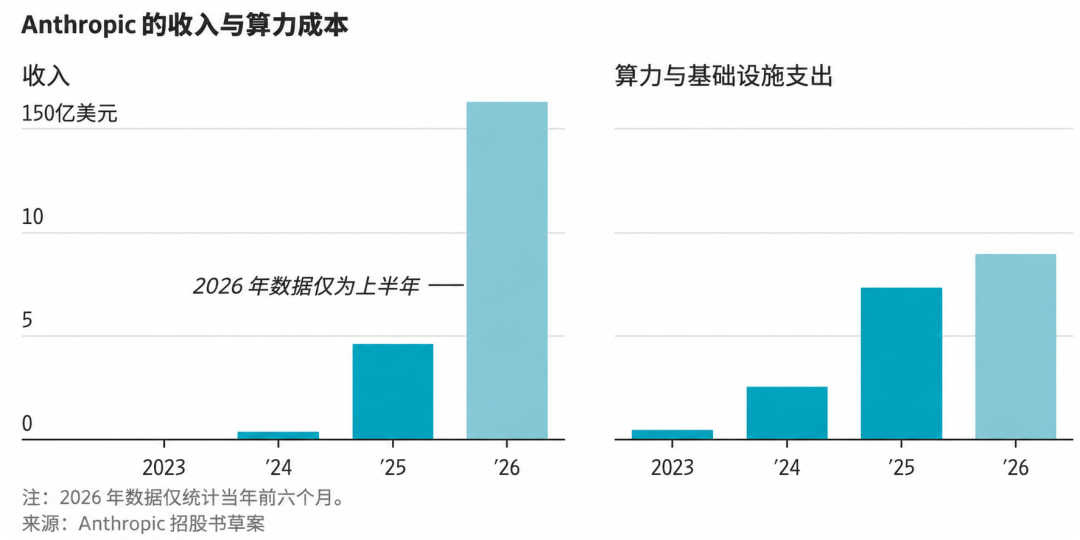
The familiar formula is all right. On the left, there is a closed-source gold-swallowing behemoth with a valuation of 2 trillion, which is burning money and acquiring land. On the right, there is a charity foundation that uses moral merit coupons. In the middle, it relies on selling AI safety anxiety and intimidating supervision to block the open source community.
To put it bluntly, there is only one fundamental reason why the closed-source giants in Silicon Valley are desperately trying to demonize open source. That is, DeepSeek, a true open source that comes with the engine and formula, will completely smash the AI narrative they are selling.
The blogger @bookwormengr who wrote "DeepSeek's Ten Trillion Dollar Chess Game" just made an extremely troublesome calculation.
According to the extreme squeezing capacity of this set of DeepInfer on the NVIDIA GB200 NVL72 super node, 1GW of computing power can generate 100 billion to 149 billion US dollars in Token revenue in a year, which is nearly ten times higher than the figure previously predicted by industry organizations.
If SemiAnalysis predicts that 50GW of computing power will be online in the world in 2027, even if it is divided into half, it will be 25GW for reasoning. According to DeepSeek's cabbage price, all humans will have to consume 2.5 trillion US dollars per year to use it up.
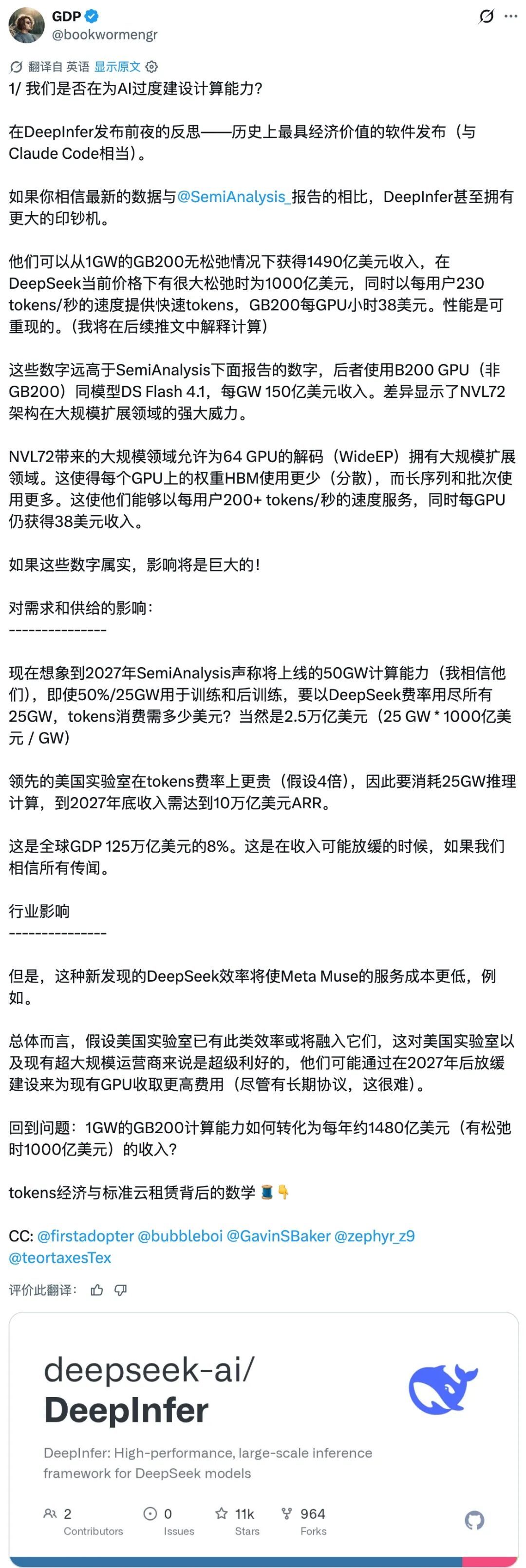
If converted into a black-hearted token price that is more than four times higher than that of OpenAI and Anthropic, all mankind will have to contribute a full 10 trillion U.S. dollars in ARR by the end of 2027 in order to fill the appetite for 25GW of computing power.
The reason why overseas closed-source giants rely on stacking cards, burning money, and signing hundreds of billions of contracts to maintain their narratives is for two reasons. Either their own engineering optimization is too slow, or they deliberately use inefficiency as a cover, and set up high computing power thresholds to keep others out.
DeepSeek has burst this AI bubble with continuously open source models and a complete set of open source reasoning projects. As some netizens joked, with the open source technology of DeepSeek, OpenAI and Claude are expected to evolve secretly again.
My suggestion is that when three of us are together, there must be one person who is my teacher. Anthropic should stop being reserved and go to GitHub overnight to git clone DeepSeek's DeepInfer for deployment. If you steal some cache scheduling and optimization ideas, you can save a lot of computing power bills. (Manual dog head)
Comments