
Abstract:
After continuously strengthening reasoning, code and agent capabilities, DeepSeek finally added visual input to V4. On the morning of August 31, DeepSeek was in Hugging Face has opened the DeepSeek-V4-Flash-Vision-Exp model weights, and developers can directly download the model weights and deploy them themselves. In addition to model files, the official warehouse also includes reference inference implementations of components such as visual encoder and Aligner, and covers DFlash Attention, MoE, Hyper-Connections and DSpark and other parts.
Just 10 days ago, DeepSeek officially announced the V4-Flash-Vision-Exp model, with a scale of approximately 305 billion parameters. It is easy to tell from the "Exp" in the name that this is the first experimental multi-modal model in the V4 series. It is built on the V4-Flash architecture. By adding a visual module and continuing training, the model gains the ability to process images.
In terms of plain text tasks, the official said that V4-Flash-Vision-Exp and V4-Flash are generally at a similar level. The main difference is that the new model can recognize the content of photos, read text in screenshots, analyze charts, and can also use pictures as part of the Agent workflow, instead of relying solely on text descriptions.
The cases demonstrated by DeepSeek include making PPT according to requirements, reading and modifying web pages, and generating front-end pages with dynamic effects.
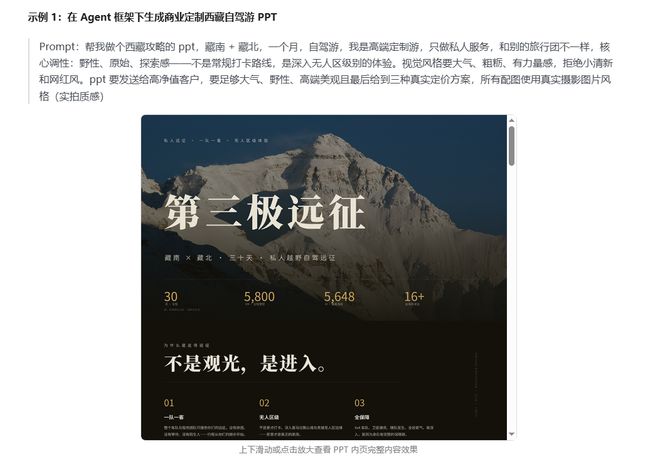
What these tasks have in common is not image recognition in the traditional sense, but that the model needs to understand the visual content first, and then combine code, reasoning and tool calls to complete subsequent operations. Judging from the benchmark test published by DeepSeek, after adding visual capabilities, V4 is already close to the Anthropic multi-modal large model Claude Opus 4.8 it chose for comparison in some multi-modal agent tasks.
Specifically, in the ApexBench test, V4-Flash-Vision-Exp’s Pass@1 score was 36.5, which was lower than Opus-4.8’s 39.4. Chartography is 64.3 and 65.0 respectively, the gap is small. In Agents' Last Exam, DeepSeek achieved 27.3, higher than Opus-4.8's 25.7. The Pass@5 score of ZeroBench is 35.0, which is also higher than Opus-4.8’s 34.0.
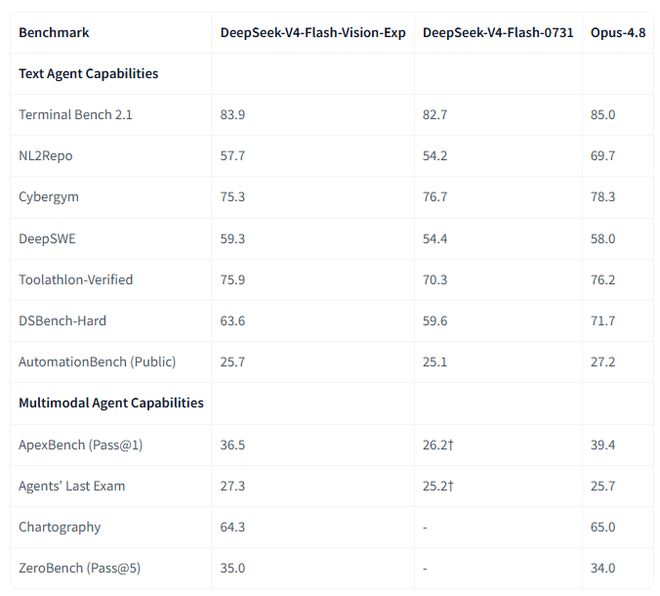
Among the four multi-modal test data, two exceeded Opus-4.8
It is worth noting that the newly added visual module does not significantly sacrifice the original text agent capabilities of V4-Flash.
For example, in Terminal Bench 2.1, the Vision version scored 83.9, while V4-Flash-0731 previously scored 82.7; DeepSWE rose from 54.4 to 59.3, exceeding the officially listed Opus-4.8 score of 58.0. However, NL2Repo is only 57.7, which is significantly lower than Opus-4.8’s 69.7, and CyberGym has dropped from the previous 76.7 to 75.3. Therefore, DeepSeek summarizes its plain text capabilities as "on par" with V4-Flash.
On the other hand, visual ability itself has limits. It is not a visual system that can infinitely read high-definition details.
According to the DeepSeek API documentation, the model supports JPEG, PNG, GIF and WebP images, and can receive single or multiple images. However, the image will be scaled according to the size before entering the model. Larger images will eventually be compressed to a total pixel volume equivalent to approximately 800×800, and each image will occupy up to 384 Tokens.
The reason for choosing this approach is to control the computational cost caused by visual input. However, image scaling can also be a limitation on tasks that specifically rely on small text, local textures, or native resolution.
But no matter what, DeepSeek finally made up for the eyes of V4.
Comments