
Abstract:
A week ago, Apple held a farewell party for Cook. The location is at Apple About 200 people came to the Park campus to perform live at OneRepublic. Jobs’s widow Laurene Powell Jobs, Apple’s former COO Jeff Williams and Eddy Cue, head of service business, all came, and John Ternus, who was about to take over, also came on stage to speak.
In the last few days of his 15-year CEO career, Apple called in all its old friends.
Yesterday, August 31, Cook sent another farewell letter to all employees. He said he would miss his job and left a large message to Ternus, saying that few people knew how to "create products that change the world" like him. Cook then thanked the entire Apple community on social media: "My position will change tomorrow, but my love for the Apple community will never change."
Today, that "tomorrow" has really come.
On September 1, 50-year-old Ternus officially took over the position of Apple CEO.
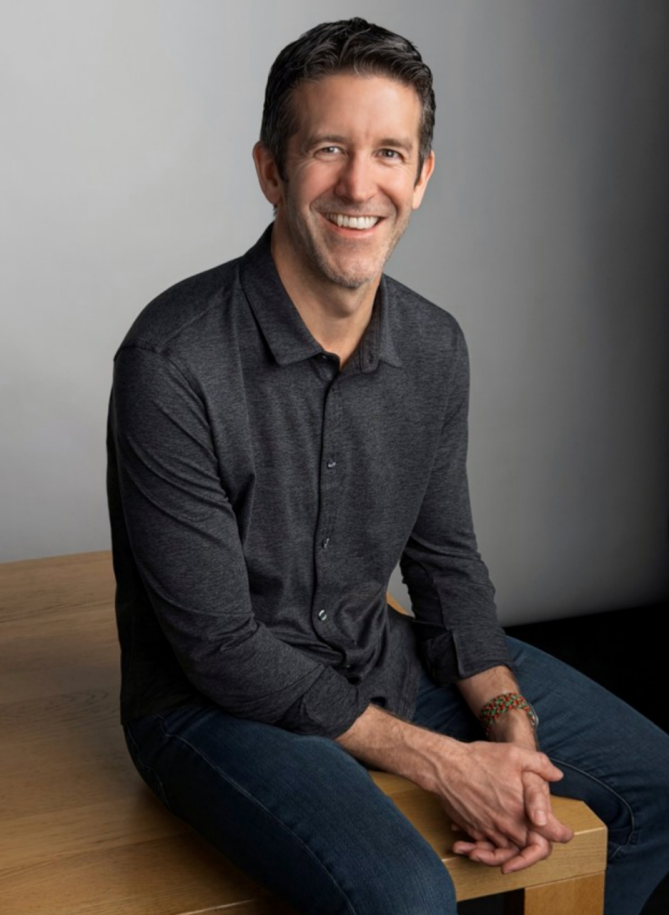
15 years ago, Cook was also 50 years old when he took over. It's just that Cook was to succeed Jobs, but Ternus faced a different situation: the outside world has been waiting for Apple to change its leadership for a long time, and Apple is also lacking a new answer in AI.
More importantly, Ternus didn’t come to the table empty-handed. According to Doudizhu, he got a pair of 2s at the beginning.
When Apple announced its coaching change in April this year, it released a photo of Cook and Ternus walking in Apple Park.
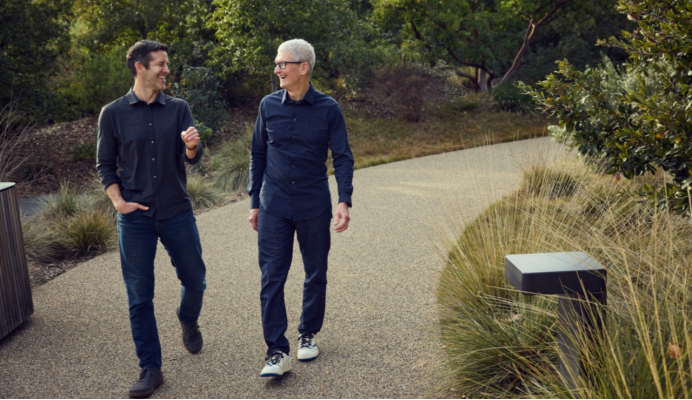
Both men were wearing dark tops and trousers, Cook had silver hair and glasses, and Ternus stood next to him with short dark hair, smiling as he walked, looking more like two colleagues chatting after get off work. Ternus in the photo is also in line with his past image at the conference. There is no exaggerated personal style. He always wears shirts and jeans. He speaks with a bit of engineer-like restraint.
Apple even gave the transition a whole summer, with Cook and Ternus completing the transition together. From September 1, Ternus officially became CEO, while Cook remained on the board of directors as executive chairman.
For a giant like Apple to change its CEO, the handover seemed unusually calm. Fifteen years ago, the same 50-year-old man took over this chair, and the atmosphere was completely different.
On August 24, 2011, Jobs wrote a short resignation letter to Apple’s board of directors. He said that he had always promised that if one day he could no longer perform his duties as CEO, he would be the first to tell everyone, "Unfortunately, this day has arrived." Subsequently, he personally recommended then-COO Cook to take over as CEO.
In after-hours trading after the news broke, Apple's stock price fell 5.9%. The decline gradually narrowed after the market opened the next day, eventually falling only 0.7%. Investors are not without confidence in Cook himself, but the market doesn't know how to digest Apple's loss of Jobs.
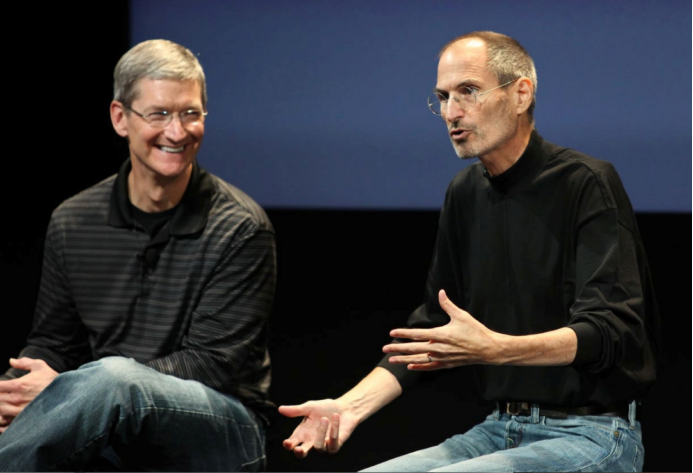
Just a week after Cook took office, the Harvard Business Review was still discussing whether Apple's innovation engine could continue to run after Jobs left. The British "Guardian" described succeeding Jobs as one of the most difficult challenges in corporate history.
Cook has actually proven that he can manage Apple well. During Jobs' several medical leave of absence, he was responsible for the company's day-to-day operations. His capabilities in supply chain, manufacturing and cost control have also been recognized by investors.
But this does not prevent him from being compared with Steve Jobs. Even if Apple Watch sells well, AirPods has become a new hot product, and the service business has achieved annual revenue of more than 100 billion U.S. dollars... the debate about "Apple no longer has the ability to innovate" has not completely disappeared.
Looking back today, Cook has increased Apple’s market value from about US$350 billion to US$4 trillion. This question seems a bit harsh.
Ternus does not have such a heavy burden of succession.
Before Cook left, Apple was still a company with more than 250 million—to be more precise, more than 2.5 billion active devices and annual revenue of more than $400 billion—but the outside world’s dissatisfaction with it was also very concrete. After the wave of generative AI started, Apple moved slowly, the new Siri was repeatedly delayed, and the position of the most valuable technology company was once given to Nvidia.
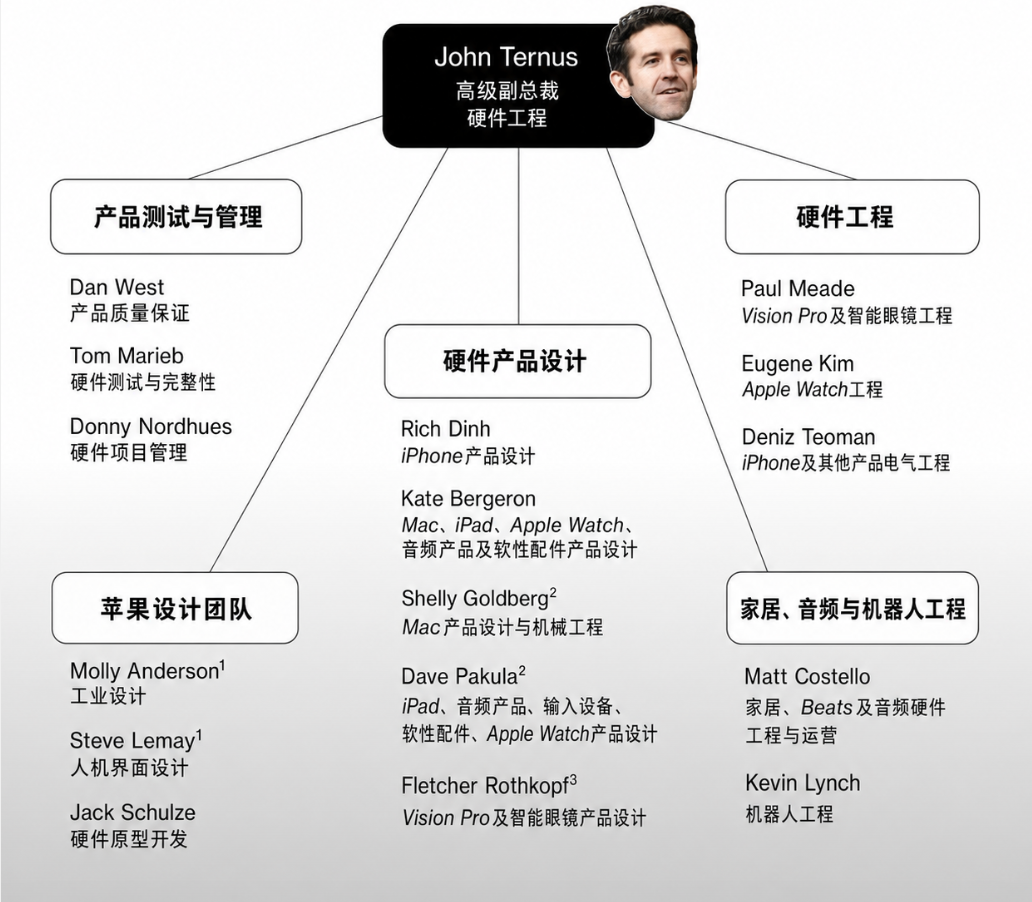
The territory before Ternus took over as CEO
When Apple announced its coaching change in April this year, the focus of discussion quickly focused on "whether Ternus can bring Apple into the AI era." Few people asked "whether Ternus can become the next Cook" as they did in 2011.
Ternus, who was selected by Apple, worked his way up from the hardware system to the top management.
Ternus joined Apple's product design team in 2001, became vice president of hardware engineering in 2013, and entered the top management in 2021. He has been responsible for products such as iPad, AirPods, iPhone, and Mac. He is also an important person in charge of Mac's shift to self-developed chips.
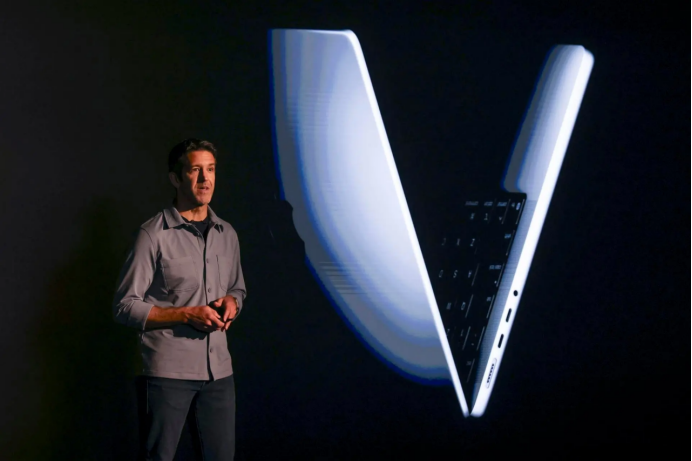
Mac has experienced renewed growth in recent years, and the hardware team he led has launched MacBook Air, iPhone Air, and MacBook Neo in March this year.
Apple even specifically named Neo in its official succession statement, listing it as Ternus' representative contribution to the Mac in recent years.
In other words, when Ternus took over Apple, the outside world was full of expectations for the "Apple coaching change" itself, and the hardware business that Ternus is most familiar with is currently the most eye-catching part.
When Ternus took over Apple, Mac was catching up with a new round of changes.
Some AI laboratories and startups have begun to purchase Mac mini and Mac Studio in bulk to run models and develop agents locally. There are even cloud service companies that specialize in providing Mac computing power.
Some reports quoted people familiar with the matter as saying that Nvidia has internally regarded Apple as its biggest competitor in the local AI field.
This is also Ternus's biggest trump card when he takes office.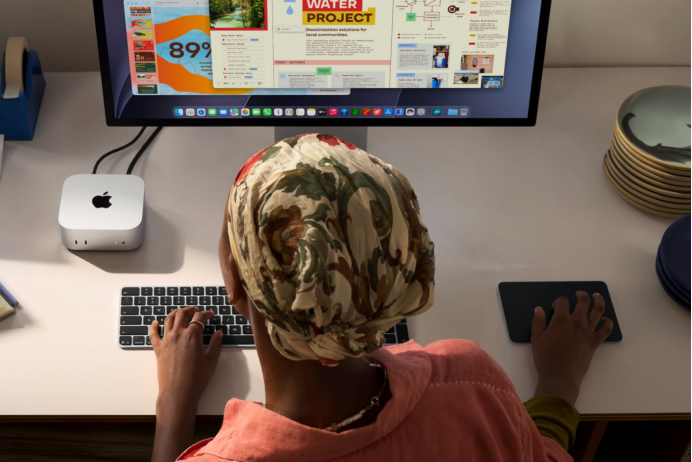
Apple will start switching Macs to Apple Silicon in 2020, and its self-developed chips will store CPU, GPU, neural network engine and unified memory in the same architecture. In the past few years, Apple has mainly used it to emphasize performance and battery life.
After large models and agents began to enter personal computers, the ability of models to run directly on Mac became a more realistic advantage of this architecture.
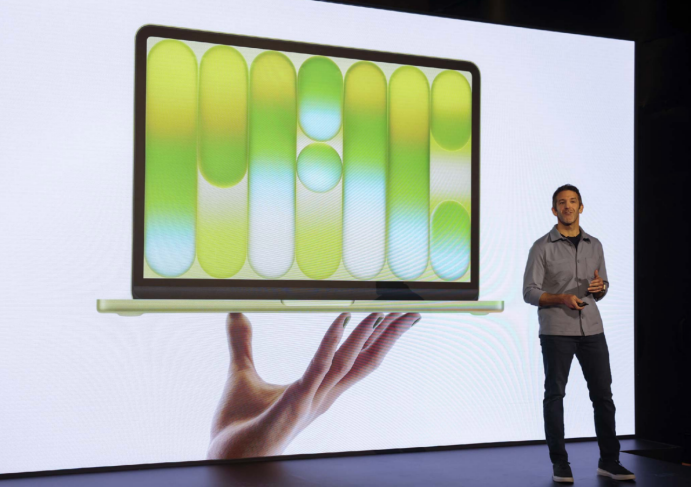
In March this year, Apple released MacBook Air and MacBook Neo for two consecutive days, and AI performance was placed in a very prominent position.
Neural Accelerator is added to each GPU core of the M5 version of MacBook Air. Apple claims that its performance in processing AI tasks is up to 4 times that of the M4 version and 9.5 times that of the M1 version. Official usage scenarios include "running large language models locally."
The MacBook Neo released the next day is even more radical. This entry-level Mac, which starts at $599, does not use M-series chips and is equipped with A18 Pro and a 16-core neural network engine. According to Apple's tests, it can handle some end-side AI tasks up to three times faster than best-selling PCs using Intel Core Ultra 5.
In this round of AI PC competition, Apple has at least spread its local computing power to the entire Mac product line. Neo has lowered the threshold to US$599, Air takes on the mainstream market, and then there are Pro, Mac mini and Mac Studio.
Business performance has also been impressive.
IDC data shows that MacBook Neo shipped about 1.1 million units in the March quarter after its launch, when it was actually only sold for about three weeks. First-quarter shipments of the M5 version of MacBook Air and MacBook Pro exceeded 900,000 units and 550,000 units respectively.
Gartner的数据也显示,今年一季度苹果PC出货量同比增长12.7%,在主要厂商中增幅最高,Neo的需求是主要推力之一。 In the June quarter, Mac revenue further increased by 28.7% year-on-year to $10.4 billion, making it Apple's fastest-growing product line in the quarter.
Creating advantages in hardware is the most "comfortable" path for Apple.
In January this year, Apple announced that there were more than 2.5 billion active devices worldwide. A huge user base and a strong ecosystem are another trump card in Ternus’ hands.
Entering the Agent era, AI has truly reached the stage of doing things for people, and the demand for cross-applications has increased sharply. Apple owns iOS, macOS, etc., and these capabilities are naturally available.
Apple has further opened these capabilities to developers this year. The new Foundation Models framework allows apps to directly call Apple’s client-side models, and can also connect to other models such as Claude and Gemini. App Intents connects the content and operations in the App to Siri, supporting personal context, screen understanding and cross-App actions. Apple even directly used the example of "send the latest report to Mary" in the WWDC demonstration: Siri first finds the file pointed by the user, and then calls the email to complete the sending.
Putting the two cards together, Ternus's start is indeed not bad. On one side are Macs and Apple Silicon that are already running, and on the other side are the ecological roads that Apple has spent decades paving.
However, when it comes to AI, the number of 2.5 billion devices must be discounted first.
Morgan Stanley made a calculation in June this year.
Among Apple’s current iPhones, more than 850 million cannot even run basic Apple Intelligence, and more than 1.3 billion cannot use advanced features in the new version of Siri that has been released but has not yet been fully rolled out to ordinary users.
The reason is simple. On-device AI increasingly consumes chips and memory, and old equipment cannot make up for it through software upgrades.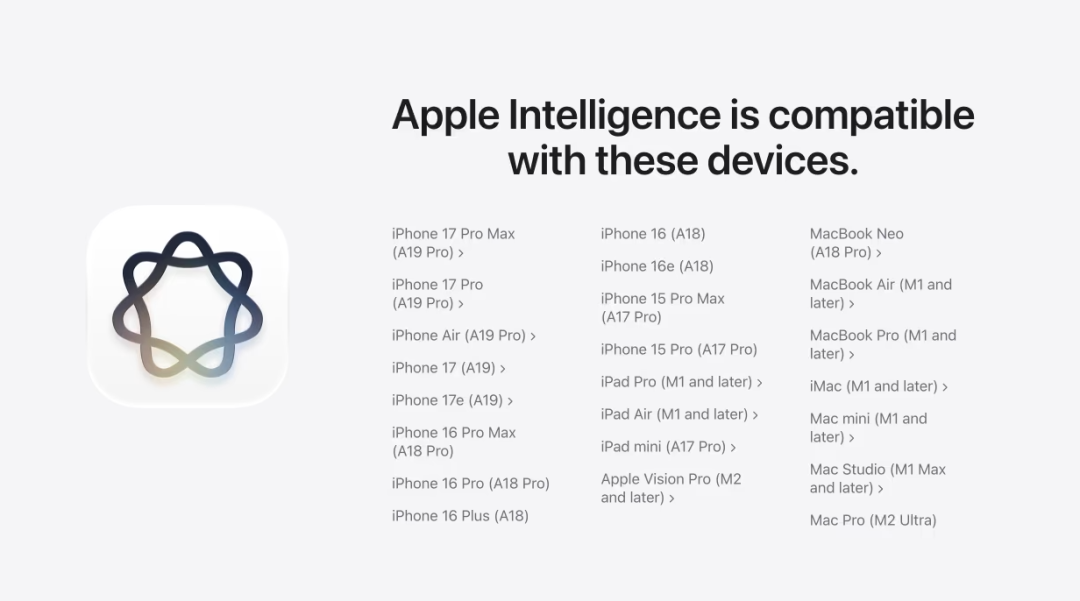
So 2.5 billion devices is certainly a huge fortune, but to turn them all into AI portals, Apple has to wait for a large number of users to change their phones. This can sell more hardware, but it is a real limit to the speed of AI popularization.
On the model side, Apple is getting more and more thoughtful.
The third generation of Apple Foundation Models released this year was jointly developed by Apple and Google. The most powerful AFM 3 Cloud Pro also uses the NVIDIA GPU in Google Cloud. Apple has also further opened up the Foundation Models framework. Developers can either call Apple's own models, switch to Claude, Gemini, or even access other models that comply with the protocol.
Use whose model is suitable. Apple seems to have given up its obsession.
This at least shows that Apple is not prepared to put all its chips on "I must train the most powerful large model in the world." Continue to build your own model while borrowing help from outside.
But I can borrow models, but not products.
The new version of Siri is the most ready-made example. At WWDC in 2024, Apple demonstrated personal context, screen understanding and cross-App operations. It was originally planned to be launched in the second year, but was later postponed all the way to 2026. Apple did not re-release Siri AI until June this year. It is still in the developer testing stage. Ordinary users will not be able to use the Beta version until later this year. There is no official news about its launch in the Chinese market.
The "new Siri" on display is actually very close to the AI that Apple should do - to put it bluntly, this is an AI application rooted in the system itself, with powerful scheduling and cross-application coordination capabilities, a system-level agent that truly makes Apple hardware users more inseparable from Apple.
The new version of Siri has been delayed from 2024 to now, which has shown that this step is not easy. Obviously, the current scheduled launch time of the new Siri, which is this month, will be the first key test after Ternus takes office.
What Apple used to do best was actually turning existing technologies into new mass products. Touch screens and smartphones were not invented by Apple. Later, the iPhone organically combined these things with the operating system and app ecosystem. Wireless headphones have been around for a long time, but AirPods eventually became a hit along with the iPhone. Apple's most important innovations in the past have been a latecomer advantage, an ability to "stand on the shoulders of giants" and use them.
This is the problem Ternus faces. The most popular hardware in the AI era is still Apple. Its huge user base and strong ecosystem are "waiting for support". If the model is not strong enough, external help will be needed. But these things must eventually become a product that users are willing to use every day.
Apple has ushered in the Ternus era. Whether Apple can start the AI era depends on the fate of Ternus. After all, anyone who knows how to play Landlord knows that even if you start with a pair of 2, you may lose.
Comments