
Abstract:
The United Nations recently announced a cooperation with Google, planning to make the huge global statistical data system more accessible and usable by artificial intelligence systems. The goal of this cooperation is not only to help human users obtain data more conveniently, but also to build reliable data infrastructure for the emerging era of AI agents.
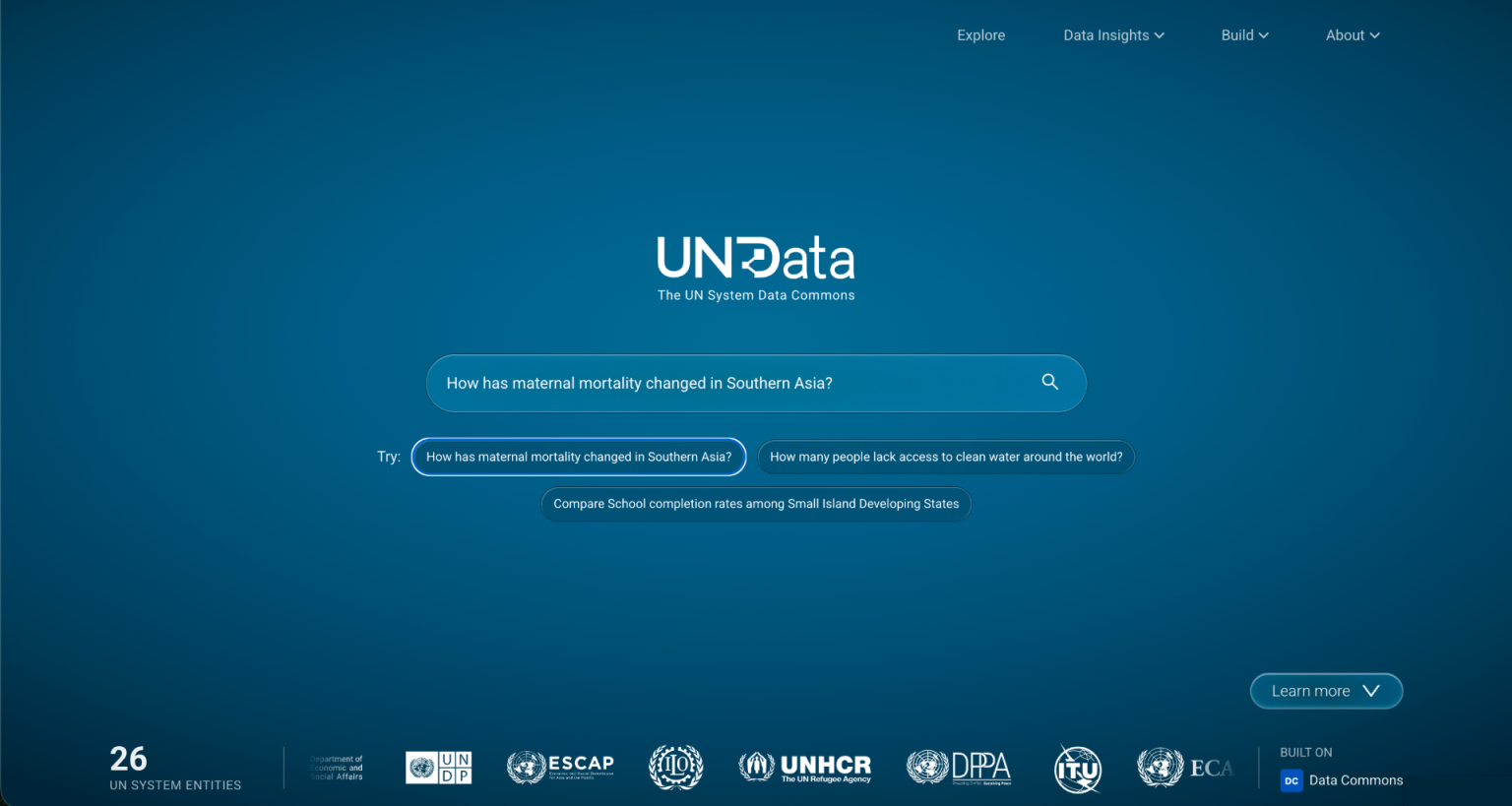
The new platform launched this time is called "UN System Data Commons". The system is built on Google's open source Data Commons technology, allowing users to directly query statistical information from multiple United Nations agencies through natural language, without having to search and filter data layer by layer in traditional database interfaces as in the past.
The new platform will replace the existing UNData portal. Compared with the old system, which mainly relied on keyword search and database browsing, the new platform is more adaptable to artificial intelligence tools and natural language interaction environments. In the future, users can directly search for data on global development, population, education, health, economy and other fields by asking daily questions.
More importantly, the system supports the Model Context Protocol (MCP), which is currently widely concerned in the field of artificial intelligence. This technical standard enables artificial intelligence models to directly connect to external data sources, allowing AI agents to directly call upon official United Nations statistics when performing analysis, research and query tasks, rather than relying on unstable or unverified information sources.
An important reason why the United Nations promotes this project is that more and more studies show that current mainstream AI models still have obvious problems when processing authoritative statistical data.
A recent test conducted by UNICEF showed that large language models from several companies, including OpenAI, Anthropic and Google, did not perform satisfactorily when answering questions related to global development indicators. The test covered more than 133,000 answer samples, and the average accuracy of six mainstream large language models was only 21.2%.
The researchers found that about 60% of the responses failed to even provide usable figures. Many models tend to avoid answering with vague wording, and even when they can provide numerical results, the answers they give often change when the same questions are asked repeatedly at different times.
The models participating in the test include GPT-4o, GPT-4o-mini, Claude Sonnet 4.5, Claude Haiku 4.5, Gemini 2.5 Flash and Gemini 2.0 Flash. The research team believes that this situation reflects the serious reliability challenges that current artificial intelligence systems still face when calling global development data.
At the same time, UNICEF is also observing another important trend: more and more users are accessing statistics through artificial intelligence tools rather than traditional search engines.
Data shows that since the beginning of this year, the number of visits to the UNICEF data website through artificial intelligence tools such as ChatGPT has increased by 67% year-on-year. Currently, visits from artificial intelligence assistants account for about one-tenth of the site’s total traffic. For a data platform that receives more than 6 million visits per month, this change shows that the way users obtain information is rapidly changing.
In this context, the United Nations realizes that simply publishing data is no longer enough. If we hope that future artificial intelligence systems can accurately reference authoritative statistical data, we must proactively make these data machine-readable, AI-accessible, and intelligent-agent-callable.
Currently, 26 United Nations agencies have committed to joining this new platform, and the data of nearly 20 of them have been made available for use when the system goes online. In the future, with the access of more institutions, the platform is expected to bring together large-scale official statistical resources within the United Nations system covering multiple fields such as economy, society, environment, education, health and sustainable development.
The United Nations stated that it hopes that through this plan, global researchers, policymakers, businesses, and the general public will have access to a more reliable data basis, while ensuring that in the future, more and more systems that rely on AI for analysis and decision-making can be based on authoritative facts, rather than unstable or erroneous information sources.
As artificial intelligence gradually becomes an important portal for people to obtain knowledge and query information, the United Nations' cooperation with Google is also regarded as the first important attempt by an international organization to systematically build official data infrastructure for the "AI era of agents".
Comments