
Abstract:
Apple CEO John Ternus appears on the cover of the latest issue of Time magazine, with the theme “Apple’s New Era”. This is another landmark event that has attracted the attention of international mainstream media after Ternus took over from Tim Cook at the helm of Apple. Through an exclusive interview with Apple's new leader, Time magazine discussed his engineering background, product design philosophy, artificial intelligence strategy, and how Apple will find new growth directions in a changing competitive environment.
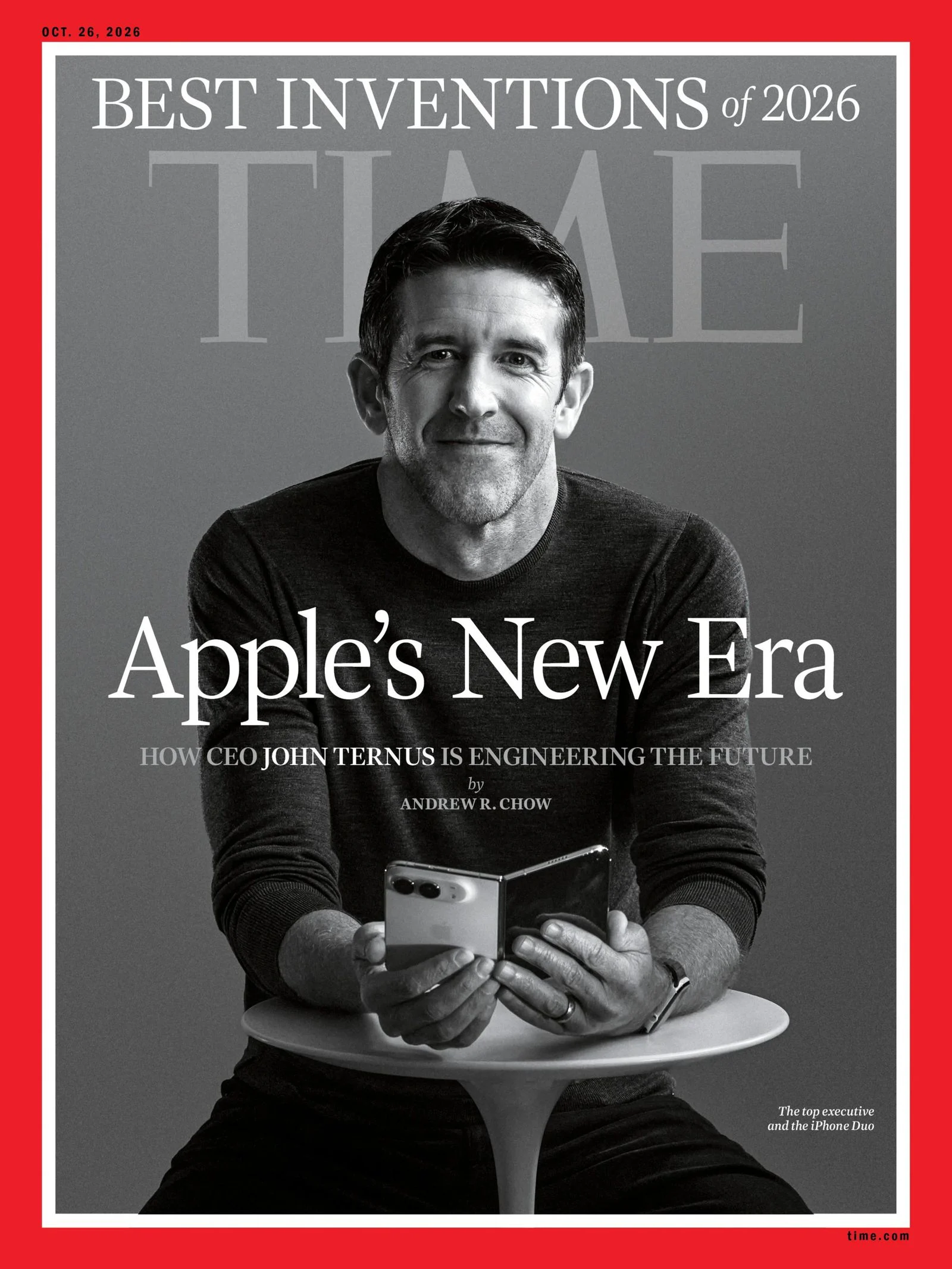
This report was published on October 15, 2026. Time magazine linked Ternus to Apple’s first foldable screen phone, iPhone Duo, and regarded this product as one of Apple’s most important design changes in recent years. Ternus officially took over as Apple CEO on September 1, and the launch of iPhone Duo happened to become one of the most high-profile product events after he took charge of the company.
Unlike Steve Jobs's distinctive personality and Tim Cook's image of being good at supply chain management, business operations and international affairs, Ternus has long been a relatively low-key engineer. He joined Apple in 2001, previously worked in a virtual reality company, and has a background in mechanical engineering from the University of Pennsylvania. During his 25 years at Apple, he gradually rose through the ranks, eventually becoming the core head of the hardware engineering department and deeply involved in the development of products such as Mac, iPad, iPhone and AirPods.
Ternus' career experience has given him a deep understanding of product design, engineering implementation and manufacturing processes. Apple insiders believe that he attaches particular importance to the synergy between hardware and software, hoping to integrate technology into the user experience as naturally as possible when using the product, rather than making users feel the complexity of the technology itself at all times.
In Ternus' view, Apple's competitiveness does not come only from an isolated technology, but from the overall coordination of hardware, software and services. This philosophy is also reflected in the development process of iPhone Duo. Although Apple entered the folding screen mobile phone market later than competitors such as Samsung, the company hopes to avoid the product becoming just an ordinary smartphone that can be folded through more complete design and manufacturing processes.
According to Time magazine, Apple began exploring the design of foldable electronic devices as early as 2011. At that time, Ternus and five other engineers submitted relevant patent applications to study the batteries, circuit boards and internal structures required for flexible display devices. As flexible OLED technology matures, Apple begins to have the opportunity to transform this early idea into a real consumer product.
However, it still took a long development process from concept to final product. Ternus believes that some early folding screen mobile phones had shortcomings in durability, appearance and user experience, especially the problem of screen creases, which can easily damage the overall look and feel of the device after it is unfolded. So instead of rushing the product, Apple continues to invest time in improving the display, hinge, and internals.
In order to improve the overall experience of the folding screen, Apple redesigned the display system to enable the device to switch more naturally between the inner and outer screens. It also adjusted the iOS interface layout and moved some main control elements to positions that are easier to reach by thumbs in the unfolded state.
In terms of mechanical structure, iPhone Duo uses a complex hinge design with more than 100 precision parts inside. Apple has also developed special surface materials and nano-texture treatment solutions in the hope of reducing reflection and minimizing the visual impact of screen creases. Richard Dinh, Apple's vice president of product design, said Ternus encouraged the team to continue exploring better solutions during the development process, rather than accepting a design that only met basic requirements because competitors had already launched similar products.
When iPhone Duo is unfolded, it can provide a space close to that of a tablet. Users can view two websites side by side, run apps suitable for the big screen, or use the dual cameras to show themselves and their surroundings simultaneously during FaceTime video calls. At the same time, the device still fits in your pocket when folded, trying to balance the portability of a smartphone with the display area of a small tablet.
However, the commercial prospects of this product remain uncertain. "Time" magazine pointed out that the starting price of iPhone Duo is more than $1,999, and the higher price may deter some consumers. Foldable phones will also need to prove their durability and practical value before they can evolve from a relatively niche product category into a broader mainstream market.
In Ternus's view, Apple's future is not just about launching new-looking hardware. Artificial intelligence has become one of the most important areas of competition in the entire technology industry, and Apple has made relatively slow progress in the field of generative AI, and therefore faces increasing doubts from the outside world.
Since ChatGPT quickly became popular at the end of 2022, companies such as Microsoft, Google, Meta, Amazon, Nvidia, OpenAI, and Anthropic have invested huge sums of money in the field of artificial intelligence, competing for model capabilities, computing infrastructure, and the enterprise market. In contrast, Apple did not officially launch Apple Intelligence until 2024, and has since encountered delays in the development of personalized Siri.
Time magazine pointed out that Apple once tried to promote Siri upgrades through internal technology, but later decided to redirect its direction. The new version of Siri finally uses an artificial intelligence solution combined with Google Gemini technology and will be launched in the United States in September 2026. This puts Apple in a special position: it needs to rely on some key technologies provided by competitors to improve the AI capabilities of its own products.
Turnus disagrees with the outside world’s doubts that Apple is giving up on independent development of core technologies. He said that Apple does not require itself to manufacture every component of its products independently. Hardware such as displays, memory and modems come from suppliers. The key is whether Apple can create truly differentiated products through its own technology and design.
Apple hopes to position artificial intelligence as an auxiliary capability integrated into daily devices, rather than purely pursuing model scale or complex reasoning capabilities. Ternus believes that even if other companies succeed in developing more powerful artificial intelligence, consumers will still need to interact with these technologies through devices. He emphasized that people still need mobile phones to talk, view pictures, record life and handle daily affairs, so smart devices will not lose their meaning due to the development of artificial intelligence.
Apple also emphasized that personalization and privacy protection are important parts of its AI strategy. The new version of Siri can, with the user's permission, combine information from the device to complete more complex tasks, such as finding flight confirmations in email, helping users prepare for a meeting, or analyzing health data collected by the Apple Watch.
Apple believes that the practical value of artificial intelligence depends not only on how strong the underlying model is, but also on whether the model can be effectively combined with the operating system, device chips, and personal information authorized by users. Rather than letting AI freely generate various answers or engage in open conversations with users for a long time, Apple hopes that it can help users complete actual tasks in clear scenarios.
However, this strategy also faces practical challenges. Apple lags behind some rivals in generative AI, and its reliance on outside technology could affect how much control the company has over the core experience. How to continue to maintain product differentiation and privacy protection advantages while leveraging partner technologies will be a problem that Ternus must solve during his tenure.
In addition to artificial intelligence, the supply of memory chips is also an important challenge that Ternus needs to face after taking office. Tight supply in the global memory market has pushed up related costs and may affect the production schedule of Apple products. Previously, there were reports that Apple had tested memory chips produced by a Chinese company to find more sources of supply, but this approach also caused some U.S. lawmakers to worry about national security issues.
Ternus described the current memory supply issue as a crisis and said Apple believes all feasible solutions should be considered. This statement reflects that even if Apple has strong supply chain management capabilities, it cannot completely avoid the fluctuations in the global semiconductor market.
At the same time, Ternus is further strengthening the position of product design within Apple. According to previous reports, after taking office, he frequently visited the industrial design and human-computer interaction teams to discuss product solutions with relevant personnel. This contrasts with Cook's more familiar background in supply chain and operations management, and is seen as a signal of Apple's renewed emphasis on hardware engineering and product design.
Apple has gradually expanded the importance of its services business over the past decade, with services such as iCloud, App Store and Apple Music becoming an important part of the company's revenue structure. However, as the growth rate of some service businesses has slowed down, Ternus' appointment may mean that Apple will re-intensify its focus on hardware product innovation.
At the same time, Apple also needs to deal with growing concerns from society and regulatory agencies about the impact of digital products. Governments are tightening regulations on children's use of social media, artificial intelligence and smartphones, and requiring technology companies to provide better safety tools. Turnus said child safety will continue to be an important consideration in Apple product design. He also mentioned that he has used Apple's Screen Time feature to manage his children's device usage in the past, but believes that there is still room for improvement in previous tools.
In his view, Apple needs to make it easier for parents to manage which apps their children can use and how much time they spend on the devices. The company has updated the screen time function in September 2026, hoping to provide parents with more intuitive control methods.
Despite artificial intelligence competition, supply chain pressure and regulatory challenges, Apple still has a huge user base. Time magazine reported that Apple currently has about 2.5 billion active devices and annual revenue of nearly $500 billion. The vast ecosystem enables users to seamlessly switch between iPhone, Mac, iPad and other products, and also provides an important foundation for Apple to integrate artificial intelligence into existing products.
It remains to be seen whether Ternus can turn this advantage into the next stage of growth. Compared with Jobs, he lacks a distinctive charisma label; compared with Cook, he has yet to prove that he can handle global politics and supply chain issues with the same skill. But his experience in engineering and product development may become an important advantage in his leadership of Apple.
This appearance on the cover of Time magazine not only focuses on Ternus’ personal career experience, but also reflects the outside world’s expectations for Apple’s new leadership era. iPhone Duo shows that Apple still has the ability to make major innovations in hardware design, and artificial intelligence will determine whether this hardware advantage can continue to be transformed into competitiveness in the future.
For Ternus, the real challenge is not to simply copy the successful model of Jobs or Cook, but to find a leadership style that suits his own engineering background while adapting to the competitive environment of new technologies. Whether Apple can narrow the gap in the field of AI while maintaining its product design advantages will become the most important test for the new CEO in the next few years.
Comments