
Abstract:
On September 1, John Ternus will officially become the CEO of Apple. He has little buffer time since taking over, as Apple is about to launch its annual fall product release cycle. This year’s product lineup is particularly radical, including Apple’s first foldable iPhone, as well as smart display devices that can identify speakers and adjust content according to different users. Ternus led these projects during his previous role as Apple's hardware chief.
In addition to products set to debut this fall, Ternus has overseen a number of devices still in development, including camera-based AirPods that can understand their surroundings, smart glasses, home security systems, home displays with robotic arms, and camera pendants that can be worn around the neck or clipped to clothing. These products will become an important bargaining chip for Apple to deal with the core problem: how to extend decades of growth into the era of artificial intelligence.
Apple is essentially a hardware company. Ternus has worked at Apple for 25 years, initially as an engineer involved in Mac design, and later responsible for iPad, AirPods, iPhone, and eventually took over the entire hardware engineering system. In contrast, he has less experience in CEO responsibilities such as finance, sales, legal affairs, government relations and procurement, so he needs to rely more on the management team. Chief operating officer Sabih Khan, chief financial officer Kevin Parekh and services business chief Eddy Ku will be given larger and more impactful responsibilities, people familiar with the matter said.
Tim Cook, who is stepping down as CEO, will not completely leave Apple. Since taking over from Steve Jobs in 2011, Cook has led Apple's revenue to roughly quadruple to $416 billion, and the company's market value to expand about 15 times. Although he did not launch a new revolutionary product with an impact close to that of the iPhone, AirPods and Apple Watch were successful; services such as Apple Pay and Apple Music also helped Apple develop its services business from a negligible source of revenue to a business that is now larger than Apple's overall revenue when Cook took over.
On August 23, Apple executives and employees held a farewell dinner for Cook at Apple Park in Cupertino, California. Ternus, Laurene Powell Jobs, and a number of former and current Apple executives delivered speeches, and Cook's favorite rock band OneRepublic also performed at the venue. However, this is not a true farewell. Cook will serve as Apple's executive chairman and has told Ternus that he will continue to be responsible for Apple's relationship with U.S. President Donald Trump and the Chinese government, and is also willing to take on other tasks assigned by his successor.
Cook has said he hopes to increase outdoor activities and spend more time at his vacation home in Palm Springs after retirement, but he also told employees that Apple will remain his first priority because he "can't imagine it any other way." There is no indication within Apple that Cook's arrangement stemmed from a lack of confidence in Ternus. Cook began seriously considering Ternus as his successor two years ago, and said at an all-hands meeting after the decision was announced that no one was more trustworthy than Ternus to lead Apple into the future.
Cook described Ternus as being able to maintain a clear vision from a big-picture perspective while also delving into the technical details of a problem. However, Cook's continued involvement in key company affairs also makes it difficult to judge how quickly Ternus can transform Apple in his own way.
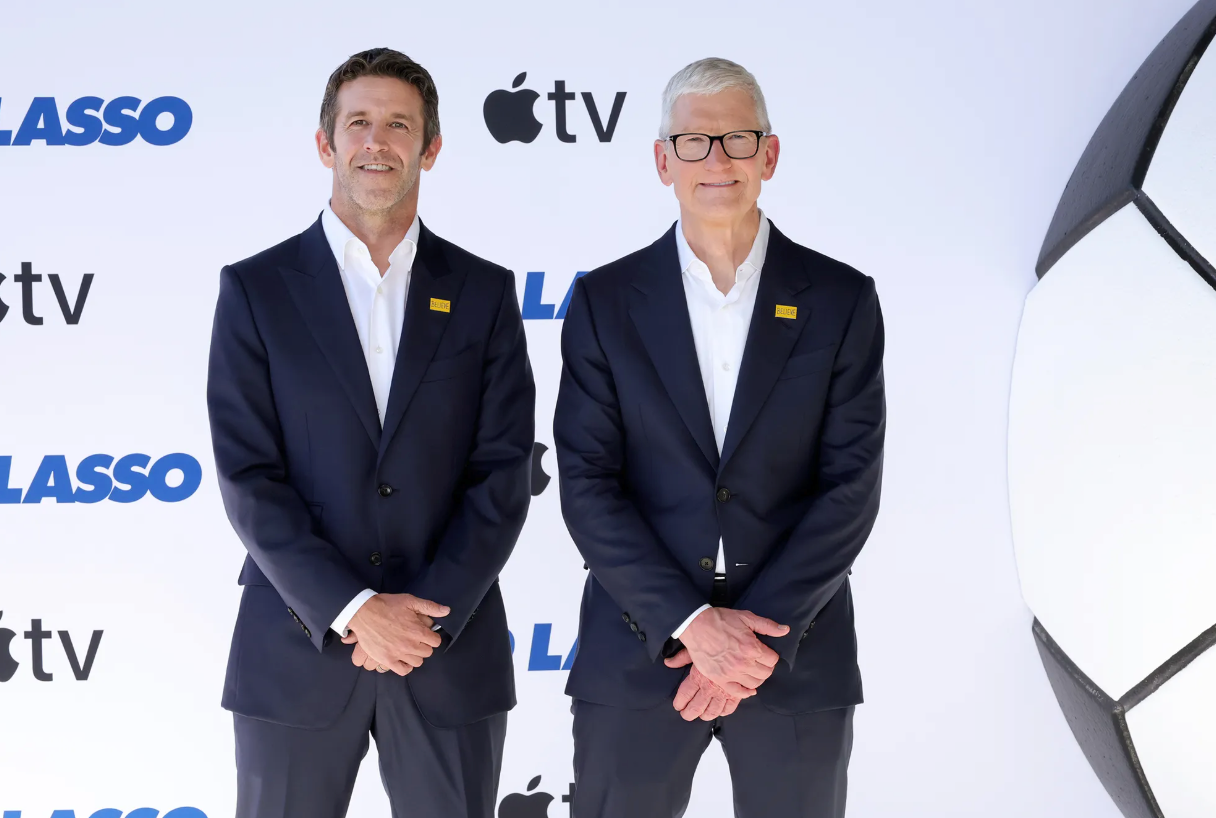
Currently, Ternus and Cook have not completely eliminated the outside world’s impression of “the continuation of the Cook era.” The two have appeared almost inseparable in recent months at internal company meetings and public events, and Ternus has repeatedly publicly affirmed Cook's leadership style. Unlike Cook who did not move into Jobs' office after taking over, Ternus is expected to use Cook's office in Apple Park. The two even wore nearly identical outfits when they attended the "Ted Lasso" season 4 premiere this summer.
This power transfer is destined to be gradual. Cook, 65, and many of his equally wealthy lieutenants who are nearly 65 years old may leave Apple one after another in the next few years. Whether Ternus, 51, can become as successful a CEO as his mentor will depend largely on his ability to manage this long transition.
During Cook's tenure, Apple watchers have long worried that the company's business would stagnate if it couldn't launch a new product that was nearly as successful as the iPhone. But Apple's overall performance remains solid. AirPods and Apple Watch mainly exist as iPhone accessories; HomePod has not won as wide a market as smart speakers from competitors such as Amazon; Apple's multi-billion-dollar, ten-year self-driving electric vehicle project has also been canceled in 2024.
The prospects for Apple’s latest major bet, Vision Pro, are not optimistic. Cook once viewed this mixed reality headset as a product that could replace smartphones in the future and become the masterpiece of his career. But people familiar with the matter said Ternus, who worked at a virtual reality startup before joining Apple, always believed that the Vision Pro was too heavy and expensive to become a mass product, so he never really supported the device. In recent months, Apple executives have been trying to persuade him to stay invested in the platform despite its poor commercial performance.
Ternus supports Apple launching smart glasses next year, code-named N50, without augmented reality functions, but if the head-mounted device still fails to gain market acceptance, he is also willing to consider withdrawing from this field. This may affect the new version of Vision Pro code-named N224, which will not be released until the end of 2028 at the earliest.
In June of this year, Paul Mead, the executive in charge of Apple Intelligence glasses and mixed reality head-mounted display departments, left to join OpenAI. He has told long-time colleagues that the personnel changes caused by Ternus' promotion made him unhappy with his position at Apple. Since then, Apple has cut positions in related teams, mainly related to games and immersive video content. Apple has also cut Vision Pro positions in multiple departments in previously undisclosed layoffs, involving areas such as device security, audio engineering, Siri integration, testing and device operating systems. This system will also be used for smart glasses in the future.
Ternus disagrees with the idea that the iPhone is about to lose its core role. He has led a three-year iPhone update plan: a thinner iPhone Air was launched last year, a folding screen model was launched this year, and a new model with stronger glass texture will be launched in 2027 to commemorate the 20th anniversary of the iPhone. At Apple's presentation to Wall Street analysts this summer, Ternus said the iPhone will remain central to Apple's product strategy and users' daily lives. He believes that people still want to have a versatile device with a screen that can handle a variety of tasks.
The supply chain is also a practical test facing Ternus. Some Apple executives worry that his ability to handle complex logistics issues such as ongoing memory shortages has yet to be proven. Apple has publicly stated that memory shortages are one of the reasons for recent price increases, and supply chain risks are exactly what Cook is best at. Cook has been helping the company deal with the issue over the past few months. Ternus is expected to rely heavily on Khan and its purchasing, sales and operations teams to minimize the impact of parts price increases and shortages on the business. Apple predicts that this problem may continue into next year.
Apple also needs to reverse the recent slowdown in its services business. Apple executives believe that as users turn to other forms of entertainment such as TikTok, reduced game purchases are one of the reasons for the weakening of the services business. At the same time, regulatory pressure has forced Apple to reduce the share of the App Store in many markets, and the European Union has also required Apple to allow independent app stores to operate, which may further weaken its commission income.
Apple's appeal as a gathering place for top hardware talent is also declining. As organizations mature, bureaucracy and internal fighting increase, some employees are attracted to competitors with higher salaries, more ambitious hardware projects, and the ability to build new products from scratch. Today, the OpenAI hardware division has hundreds of former Apple employees. Apple has accused OpenAI of stealing trade secrets in a lawsuit.
Ternus knows talent retention is an issue. He has handed out hundreds of thousands of dollars in non-cyclical bonuses to several iPhone design team members, and has also supported Apple's lawsuit against OpenAI, in part because the latter's poaching disrupted multiple hardware teams. At one point, he also asked Richard Ding, the head of iPhone design, to meet in person with an engineer from Singapore in an attempt to persuade him to stay with a promotion and higher salary, but the employee eventually joined OpenAI.
People close to Apple say about half of the company’s leadership may leave in the next few years. A particularly high-impact potential departure is chief hardware officer Johnny Slugy. He now takes over Ternus' previous responsibilities and merges them with the chip division. Sluji, 61, seriously considered leaving Apple last year, but Cook successfully persuaded him to stay by expanding his responsibilities and asking him to assist in the CEO transition. People familiar with the matter said Sluji could still leave within a year or two as the transition is gradually completed. The heads of Apple's marketing, services and retail departments have also been with the company for about 40 years and may retire in the next few years.
But the biggest uncertainty facing Apple is still the company’s lagging behind in the field of artificial intelligence. At the end of 2022, after OpenAI released ChatGPT and triggered a craze for generative artificial intelligence, Apple has vigorously promoted related businesses, including developing its own large language model, heavily recruiting talents, and looking for acquisition targets. However, the first version of Apple Intelligence performed poorly, and Apple failed to complete a major AI startup acquisition. Cook subsequently replaced the head of Apple's AI and adjusted the head of Siri, handing relevant responsibilities to the head of software engineering and the developers of Vision Pro.
After the self-developed technology failed to meet expectations, Apple began to rebuild the model behind Siri last year and paid to use Google Gemini technology as the basis. This decision disappointed many people in Apple's large language model team, and some employees, including the team leader, left for companies with better salaries. At the same time, Apple has lowered the priority of AI research projects, further exacerbating the unease among internal model developers.
The real test will come in September. Apple plans to fully roll out the new version of Siri's artificial intelligence capabilities to compete with ChatGPT. Due to the high cost of running such an AI system, Apple eventually hopes to charge users or find ways to make money by letting third-party applications connect to the voice assistant. But for developers or consumers to pay, Siri AI must get rid of its long-standing impression of being "unusable and often not working properly." So far, early reviews of the new version of Siri have been relatively positive.
Ternus also began to focus on how to use AI to improve Apple's internal product development and operations processes. One of his last major tasks as head of hardware was to launch an AI platform designed to speed up product development, improve hardware testing and increase device reliability. He told employees that AI will help Apple extract experience from past products and apply it to devices still under development to solve more complex problems.
Apple not only hopes to use AI to improve product manufacturing, but also hopes to make products more useful to consumers. Camera-based AirPods and flagship home devices with screens have been planned for years, but their releases have been repeatedly delayed due to insufficient AI software capabilities. The new version of Siri is expected to change this situation and support new versions of Apple TV set-top boxes and HomePod mini. Ternus once said in an all-hands meeting that he was happy to take over at this moment because Apple "is about to change the world again" and the company has an exciting product roadmap.
However, there is still no answer as to which AI consumer electronics products will ultimately succeed. In recent years, there have been many failures in the field of AI hardware. The most popular solutions currently are often the deployment of cameras and AI sensors in homes and human bodies, which poses reputational risks to Apple, which has always emphasized privacy protection. In order to alleviate user concerns, Apple has adopted a different design: smart glasses can take photos and videos, but the cameras equipped with the new AirPods and planned home security equipment will not save watchable videos, but will transmit relevant information to the AI system for analyzing the surrounding environment.
Ternus also spent a lot of time this year managing Apple's industrial design and software design teams. These teams, historically key to Apple's efforts to create unique consumer products, began reporting directly to Ternus before the leadership transition was officially completed. Apple's design organization has been severely weakened by the departure of a large number of people over the years to former design chief Jonathan Ive's new studio, or OpenAI. Rebuilding the influence of the design team has become a priority for Ternus.
When planning the business for 2027, Ternus and Cook have been attending nearly every department meeting together. In recent weeks, Ternus has increasingly assumed a major leadership role in these meetings. Cook told employees that he would provide knowledge, experience and act as an advisor when needed, but he also admitted that "there can only be one CEO at a time." The iPhone launch event on September 9 will be hosted by Ternus. Cook may be sitting in the front row, but this will be the first time in 15 years that he won't be headlining a launch event.
Apple’s handover history also has failed precedents. Former Walt Disney Company CEO Bob Iger clashed with his designated successor, Bob Chapek, while serving as an advisor after stepping down, and eventually returned to the CEO role in his 70s. Salesforce founder Marc Benioff twice brought in co-CEOs who were considered successors, but both eventually left the company. By contrast, Amazon founder Jeff Bezos has remained as executive chairman while handing over day-to-day operations to Andy Jassy, an arrangement that has been successful. People close to Apple believe that the relationship between Bezos and Jassy is closest to the combination of Cook and Ternus.
One sign that Cook may be winding down the company's affairs came in a recent job posting from Apple. The company is looking for an executive bodyguard who can hike for miles at a time in difficult environments. The recruitment information did not mention Cook, but outsiders believe that this position is likely to be prepared for him. Cook has repeatedly talked about his love for hiking and said he would increase this activity after retirement. In contrast, Ternus prefers riding bikes and driving race cars. As the CEO begins his new job, he may soon find that he doesn't have much time left for personal hobbies.
Comments