
Abstract:
When Cook took over Apple, the iPhone had already proven its direction. Fifteen years later, Ternus took over Apple, a company with a market value of US$4.67 trillion. There is no ready path to where the next growth curve will be.
On August 31, local time in the United States, Tim Cook will end his 15-year term as Apple CEO. Starting from September 1, Apple officially enters the era of John Ternus. Cook will not leave completely. He will transition to executive chairman of the board and continue to be involved in some company affairs.
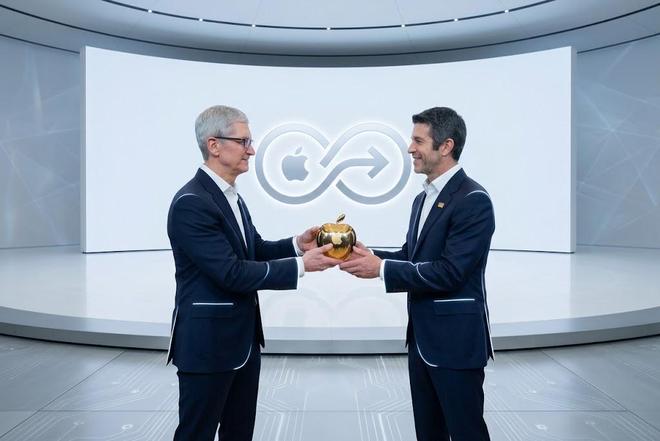
This coaching change did not occur at a time when Apple was experiencing operational difficulties. What Cook handed over is still a large, profitable company with a huge user base around the world. In fiscal year 2025, Apple's revenue will exceed US$416 billion, the number of active devices will exceed 2.5 billion, and the annual service business revenue will exceed US$100 billion. As of August 28, the company's market value was approximately US$4.67 trillion.
The problem before Ternus is how to find room for growth again in this already highly mature business system.
When Jobs handed Apple over to Cook, the iPhone and iPad had become the company's core products. Cook's main task after taking over is to make the products that have been proven by the market bigger and more stable, and to continuously expand the hardware, software and service ecosystem around the iPhone.
15 years later, Apple has reached another stage. The iPhone is still the most important product, but it is difficult to explain where the next round of growth will come from simply by expanding the existing product line and increasing service revenue. Generative AI is changing the way software and hardware compete. Next-generation devices such as smart glasses have entered a new competition cycle. Apple is also facing a replacement of old and new management and core talents.
Ternus joined Apple's product design team in 2001, became vice president of hardware engineering in 2013, and was promoted to senior vice president of hardware engineering in 2021. During his 25-year Apple career, he has participated in multiple product lines such as iPhone, iPad, Apple Watch, AirPods and Mac, and also participated in the transformation of Mac from Intel processors to Apple Silicon.
He is familiar with how Apple makes a product, but what the CEO has to judge is another thing: what Apple should do next.
01 Cook took the correct answer to the extreme
The most common misunderstanding when evaluating Cook is to compare him with Steve Jobs to see whether he has launched the next "iPhone".
If you only look at disruptive product innovation, it is indeed difficult for Cook to receive the same evaluation as Jobs. But stretching the timeline to 15 years, Apple in the Cook era has undergone tremendous changes.
In 2011, Apple's market value was approximately US$350 billion, and now it has reached approximately US$4.67 trillion, an increase of more than 13 times.
In fiscal year 2025, Apple's revenue will reach US$416.1 billion, compared with approximately US$108 billion in fiscal year 2011. The number of active devices has also increased from about 200 million to more than 2.5 billion, and the services business has grown from a relatively minor source of revenue to a business of more than $100 billion.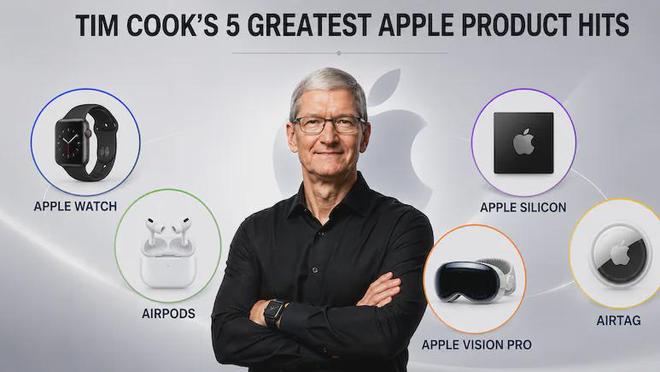
David Yoffie, a Harvard Business School professor and former Intel board member, believes that Cook's performance is "excellent" if measured by traditional business metrics. He specifically pointed out that Cook inherited a company left by a legendary CEO and was still able to increase shareholder value by about 10 times on such a basis, making Cook one of the most successful CEOs in driving shareholder value in the past 15 years.
What Cook has changed is not just the size of Apple, but also the way it operates.
The iPhone is still the core of the entire business system, but Apple continues to expand its product line and build a larger hardware and service ecosystem around the iPhone. Apple Watch was launched in 2015, and AirPods were launched in 2016. Starting in 2020, Macs will gradually switch from Intel processors to Apple’s self-developed Apple Silicon.
At the same time, the service business continues to expand.
In 2025, Apple’s services business revenue will reach US$109.1 billion, becoming the company’s second largest business.
Revenue from the wearables, home and accessories business reached US$35.6 billion.X account @CHARTISKING, who has been paying attention to the market for a long time, regards Apple’s market value and profit growth in the past 15 years as the most intuitive result at the end of Cook’s term. In his judgment, Cook's most important contribution is not to launch a new product with Jobs-like influence, but to establish a business mechanism that can continue to expand scale, improve execution efficiency, and allow growth to accumulate.
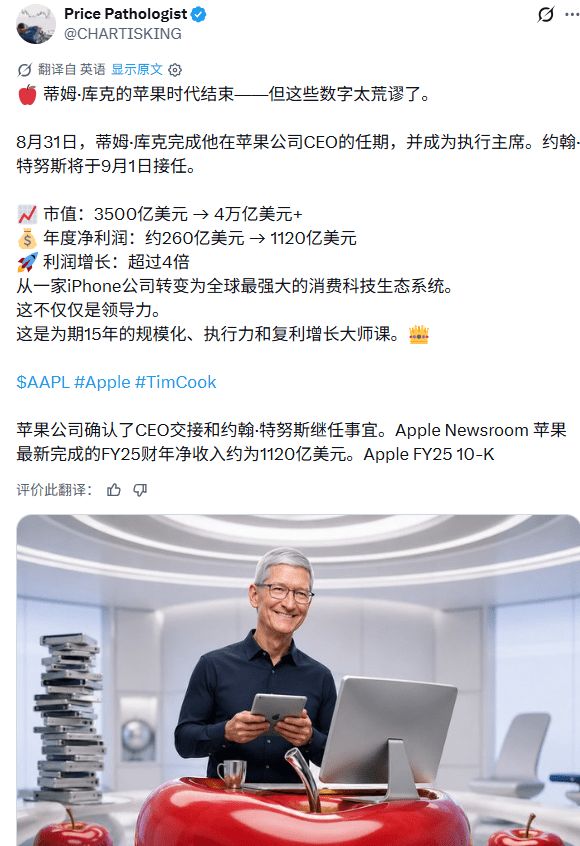
This echoes the judgment of Wamsi Mohan, a global research analyst at Bank of America. Mohan believes that Cook has significantly expanded the iPhone product system, increasing product models and price ranges, while also making the supply chain behind Apple more complex.
And how to manage this complexity is what Cook is best at.
Apple's competitiveness today does not come from just one product. More than 2.5 billion active devices have formed a huge user base. The global supply chain is responsible for the stable delivery of products. Software and hardware collaboration keeps users within the ecosystem. The service business continues to generate revenue based on this set of devices. The more products, the more users, and the more complex the supply chain, the higher the requirements for the company's operational capabilities.
This is exactly what Cook solved.
Apple Watch and AirPods have opened up new product categories, services such as Apple Pay and Apple Music have expanded Apple’s business boundaries, and Apple Silicon has allowed Apple to further master core technologies.
Cook’s most outstanding ability is to turn a choice into a system that can be run repeatedly and continuously amplified.
What Jobs left behind was a set of core products that had been proven by the market, and Cook expanded them into a global consumer technology company that was far larger than it was back then. To evaluate Cook, you can't just judge whether he created the next "iPhone", but also whether he enabled Apple to continue to grow and operate efficiently without Steve Jobs.
But this success also constitutes another side of the Cook era.
When a company already has such a large user base, revenue scale and cash flow, the space to continue to expand its existing business will eventually become smaller. Even if a new business reaches billions of dollars, it will be difficult for Apple, with annual revenue of more than 400 billion U.S. dollars, to quickly change the overall growth curve.
02When Ternus took over, there were fewer ready-made answers
In the past 15 years, the iPhone has always been Apple's most important product. Services, wearables and Macs are all growing, but no one business has truly replaced the iPhone as the core of revenue and profits.
Cook is also looking for new growth points. Apple Watch and AirPods have formed scale, and Apple Pay has expanded the boundaries of the service business, but they have not changed Apple's overall growth structure. At the same time, some long-term investments fell short of expectations.
Vision Pro has not yet become a mass consumer product, and Apple’s self-driving car project, which it has invested for many years, was eventually abandoned.
Forrester analyst Dipanjan Chatterjee therefore believes that Cook has brought huge financial returns to Apple, but has not left a new growth engine like the iPhone to the next CEO.
Apple has enough cash, users and supply chain resources. The question is where to invest these resources next.
Investor and entrepreneur @NoLimitGains sums up this difference in terms of management style. He believes that the difference between Cook and Jobs lies not in their ability, but in their different management priorities: Jobs is more focused on products and innovation, while Cook is better at operations, supply chain and capital return. In his judgment, Apple's core mission in the past 15 years has shifted from product breakthroughs to large-scale operations, while Ternus's background is obviously closer to product and engineering.
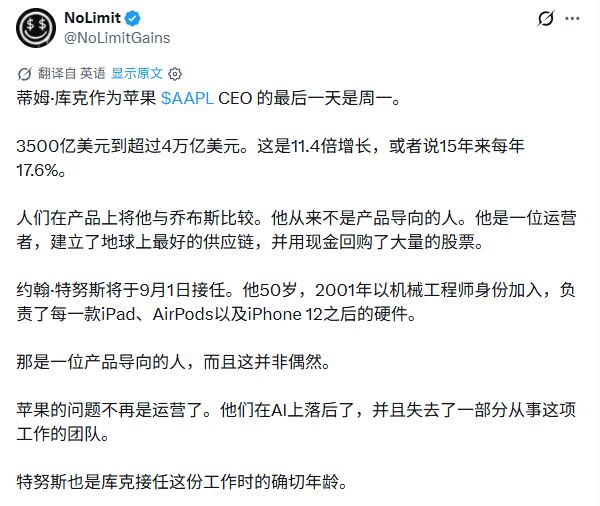
Ternus joined Apple in 2001 as a mechanical engineer. He has worked in the company for 25 years and has long been involved in the development and iteration of products such as iPhone, iPad, Mac and Apple Watch, and also participated in the transformation of Mac to Apple Silicon.
His career experience has a strong correspondence with Apple’s need to re-emphasize product judgment in the next stage.
In the past, he judged how a product should be made, how to complete research and development and mass production; after becoming CEO, he needs to face more upstream choices: what Apple should do, and which directions are worthy of investing more resources.
MacBook Neo provides a case for observing Ternus’ product ideas.
This $599 notebook changes Apple's long-term product strategy towards the high-end market.
Ternus pushed Apple to launch lower-priced Macs in the hope of attracting younger users. The product received positive feedback upon launch and sold out quickly.This shows that Ternus is facing not only engineering issues, but also product positioning and market selection. MacBook Neo itself is still a positioning adjustment within a mature product line, and the real test of product judgment is yet to come.
This kind of decision-making ability will become increasingly important in Apple's next stage. The iPhone already has a huge user base, product line and supply chain, and it is not difficult to add another product model.
The difficult thing is to judge whether a new direction is worth investing in and whether it can form a large enough market.
The adjustment of the Vision product line is an example.
After Vision Pro failed to meet Apple’s initial expectations, the company began to re-evaluate its investment in spatial computing resources. Tianfeng International analyst Ming-Chi Kuo revealed that Apple's Vision product line, which originally included seven devices, has now been reduced to two: one is AI smart glasses, and the other is AR glasses with a display using optical waveguide technology; the Vision Pro follow-up products and the lighter Vision Air have been cancelled. Among them, AI glasses are expected to be launched in 2027, and AR glasses will not be launched until 2029 at the earliest.
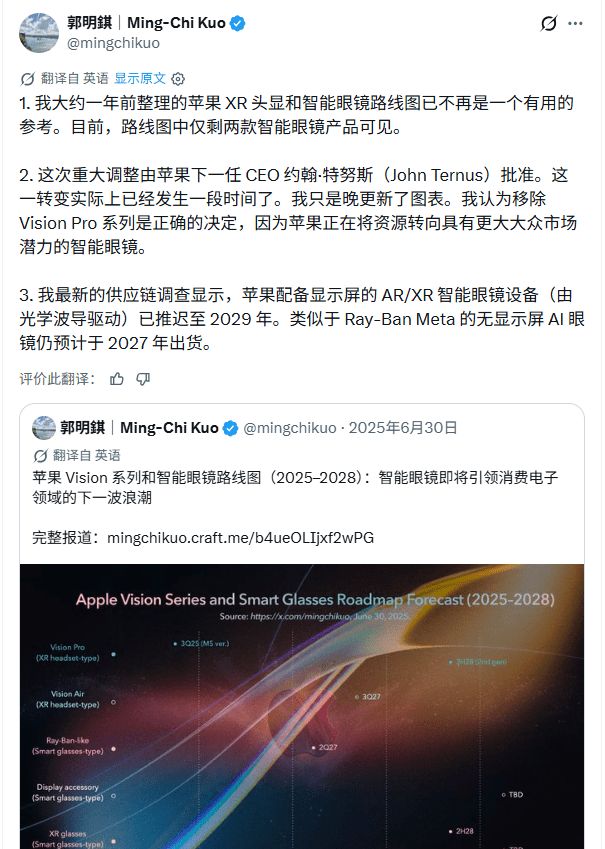
Apple’s shift in focus from high-priced headsets to lighter, more mass-market devices has become an important clue for observing its product roadmap.
Smart glasses look closer to the mass consumer market than Vision Pro, but when Apple enters this field, competition has already begun. According to a report released by Counterpoint Research in February this year, global smart glasses shipments will increase by 139% year-on-year in the second half of 2025, and Meta's market share will reach 82% during the same period.
Apple is no longer facing a blank market.
In addition, Apple is also developing smart display devices with facial recognition capabilities, desktop robots for video conferencing and media playback, privacy and security cameras, as well as smart glasses, pendants and new AirPods with cameras.
These projects compete for the same resources: chips, sensors, models, software teams, supply chains, and management attention.
Apple has the ability to make many of these products, but it cannot turn all directions into core businesses at the same time.What Ternus needs to solve is not simply a hardware design problem.
When there is already a leader in a new market, the bigger test is whether Apple can complete its judgment earlier, determine the product direction faster, and get hardware, software, AI and supply chain into synchrony.
03 Ternus wants to re-answer "What should Apple do"
Ternus taking over as CEO does not mean that Cook will completely quit Apple.
Entrepreneur @AbdoKerdawy summed up the handover in a vivid way: Cook just "left the driver's seat" and did not leave the car. After stepping down as CEO, he will serve as executive chairman of Apple's board of directors, while Ternus will take the driver's seat and be responsible for daily operations.
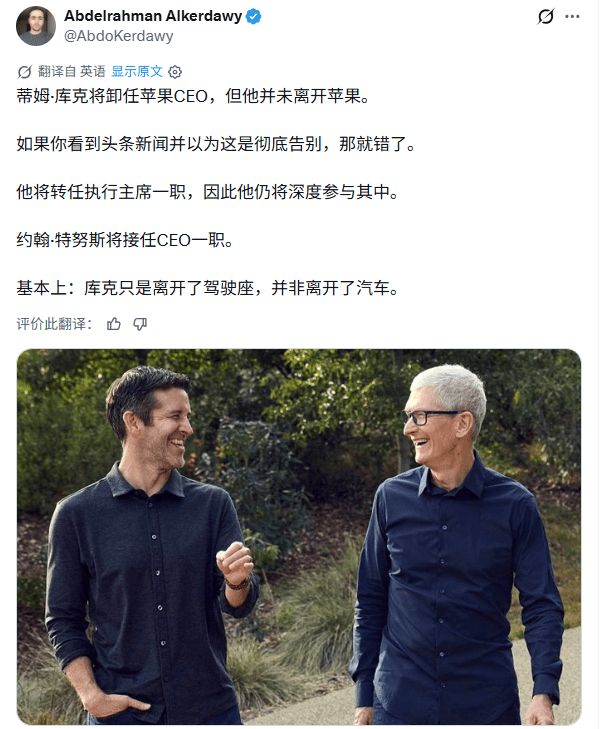
Apple officials made it clear that Cook will assist in handling some company affairs and communicate with global policymakers.
Judging from the available information, Apple is trying to moderately separate the two sets of tasks that were simultaneously undertaken by one CEO in the past: Ternus takes on more product, engineering and daily operating decisions, while Cook continues to use his experience in global policy communication and long-term external relations.
The supply chain system that Cook has established over the past 15 years is one of his most important management assets. Apple products are sold around the world, with production and parts supply distributed in many countries and regions. As Sino-US relations, tariff policies, and the global manufacturing landscape change, the supply chain is no longer just a cost issue, but also directly affects product prices, production capacity, and time to market.
Apple has been reducing its reliance on a single production location in recent years. Part of iPhone production has been transferred to India, and AirPods and other products have expanded their manufacturing scale in Vietnam. At the same time, Apple has also increased investment in supply chains such as chips and servers in the United States.
But for a company with annual revenue of more than $400 billion and billions of devices, supply chain adjustments cannot be accomplished through a simple relocation. Any changes in the production process may affect suppliers, parts, transportation and inventory management, which will ultimately be reflected in product costs, time to market and profit margins.
Therefore, after Ternus took over, product decisions were still inseparable from the supply chain system established during the Cook era. Which chip a new device uses, how much memory it is equipped with, when it will be released, and how much it will cost seem to be issues of the product and R&D departments. In fact, they are often affected by component supply, manufacturing costs, and global production capacity at the same time.
If Ternus is responsible for deciding "what to do" and Cook continues to help with "how to enter different markets", this arrangement can allow the new CEO to focus more on products and technology.
Nor does Ternus have to take on all the issues of product roadmap, AI strategy, supply chain, government relations, and global trade on day one.But this arrangement also brings a new problem:
When product judgment conflicts with external relationships, who will make the final decision?
AI models in the Chinese market, manufacturing in India, domestic production in the United States, and procurement of key components are all simultaneously product issues, cost issues, and political issues. Whether the two sets of capabilities can truly synergize will directly affect the speed at which Apple launches its next-generation products.
The most important change before Ternus is not just the product list, but the way Apple makes decisions. During the Cook era, a large number of major decisions were repeatedly discussed and consensus reached by a small group of executives. Bloomberg quoted people who have worked with the two as saying,
When faced with two options A and B, Cook is more inclined to ask questions continuously; Ternus is more willing to make a choice directly.
This is exactly what the board of directors expects of Ternus: maintaining the operational discipline established by Cook while shortening the judgment time on new products and AI.
04Where to start investing Apple’s money
Apple in the Cook era also has a very obvious feature:
The company's ability to generate cash is getting stronger and stronger, and capital return has become an important part of its operations.
Over the past decade, Apple has returned huge amounts of cash to shareholders through stock buybacks and dividends. The large amount of cash flowing back to shareholders first shows that the mature business has generated cash that far exceeds the needs of daily operations. It also makes the outside world pay more attention to whether Apple can find a large enough long-term investment direction in addition to its existing products and services.
This is not the same thing as "Apple has no projects to invest in". Buybacks, dividends, R&D, and M&A can all happen at the same time, and capital return itself does not mean a company lacks innovation.
But when a technology company returns so much cash to shareholders, and the Vision Pro and automotive projects do not form new large-scale businesses, how the next CEO allocates capital will naturally become an important issue.
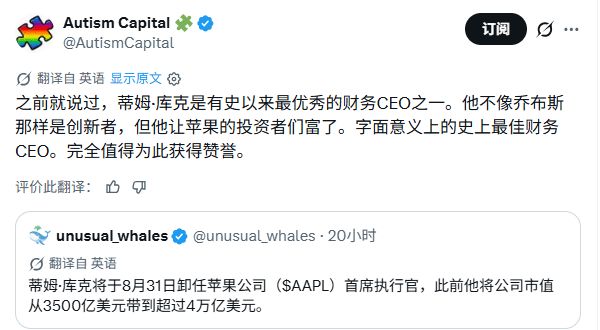
X account @AutismCapital in the field of finance and technology believes that Cook is one of the most successful financial CEOs in Apple’s history. Unlike Jobs who focused on product innovation, Cook is better at using cash generated by mature businesses to transform Apple's existing business advantages into continued growth in shareholder value through supply chain management, cost control and capital returns.
Apple Silicon, Apple Watch, AirPods and service businesses all require long-term investment, and Apple’s R&D expenditures have also been growing.
The problem is that compared with the company's huge revenue and cash flow, new projects that can really change the business structure are still limited.
Vision Pro and automotive projects are two typical cases. The former requires huge investment and has not yet formed a mass market; the latter has been promoted for many years and finally stopped.
They show that Apple is willing to make bets. They also show that the larger the size, the more expensive it is to tolerate failure, and the fewer successful projects that can meet the company's requirements.
Therefore, what will change in the Ternus era is not necessarily whether Apple will continue to repurchase shares, but how the company reallocates resources between mature businesses and new businesses.
Continuing to optimize the supply chain, expand service revenue, and improve product profit margins can still bring stable returns. But to maintain long-term growth, Apple will ultimately need new products and markets.
When Cook took over, Apple already had a clear growth engine, the iPhone.
He needs to expand production capacity, expand markets, improve product lines, and manage cash flow more efficiently. After Ternus took over, the iPhone is still important, but Apple cannot always rely on expanding the iPhone price range and increasing service revenue to solve its growth problems. Smart glasses, AI hardware, smart homes and other immature products require companies to invest in advance, and these projects may not be able to bring profits in the short term.This also explains why Ternus' engineering background has attracted attention.
Engineers first judge whether the product can be made, and the CEO has to further judge: Even if it can be made, is it worth Apple's investment of billions of dollars? Does it have the chance to become the core business in the next ten years?
From the MacBook Neo to Vision route, Ternus has begun to participate in this more upstream choice.
The real test is whether he can prioritize when multiple directions put forward demands for funds and talent at the same time, and whether he can stop an expensive project in time when there is insufficient evidence.
05 AI is challenging Apple’s most successful way of working in the past
If the timeline is shortened from Cook’s entire 15-year tenure to the emergence of generative AI, his evaluation will change significantly.
X user @DrTomsLens believes that Cook succeeded Jobs and developed Apple to today's scale, which is worthy of recognition;
However, after the emergence of ChatGPT, Apple's advancement in AI has exposed problems.
If AI becomes an important entry point for the next round of consumer electronics competition, then Apple, which Ternus took over, will not only be faced with finding new products, but also how to make up for the time gap left before.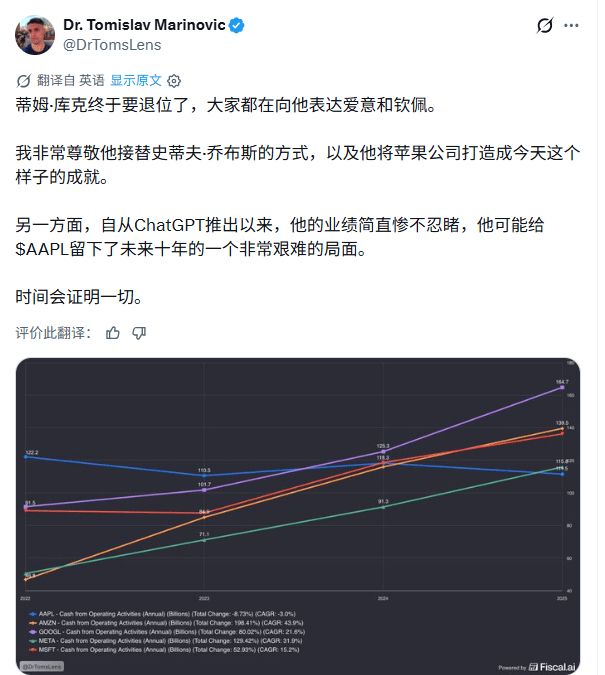
Apple's past product approach emphasized control, integration, and mature release. The hardware, chips, operating systems and services are in their own hands as much as possible. After repeated coordination, each team polishes the experience until it is stable enough before handing it over to users.
This method helped Apple establish a reliable and unified product system, and was also an important foundation for expansion in the Cook era.
The rhythm of generative AI is not exactly the same. Model capabilities are continuously updated, and products often need to be put into real use first and then continuously revised based on feedback; tool invocation, model updates, and external ecology will also rapidly change the boundaries of capabilities.
No company can finalize models, applications, and developer ecosystem with just one release.
After Apple Intelligence was announced in 2024, the originally planned Siri upgrade has experienced multiple delays. Former Apple executive Todd Daly believes that Cook should bear at least some of the blame for the Apple Intelligence feature that ended up being rolled out two years later than originally planned.
In June this year, Apple released the new Siri AI, which is open to developers for testing, and plans to provide a beta version to ordinary users within the year.
Apple is also working with Google to develop a new generation of Apple Foundation Models using the technology behind the Gemini series, and then use these models for Apple Intelligence and Siri.
This change is critical. Apple still controls the product experience and its own model, but it no longer insists that all underlying capabilities must be completed individually. Partnering with external model companies is emerging as a way to speed things up.
The situation in the Chinese market is more complicated. According to a Reuters report in August, Apple has trained a large language model for the Chinese market with the support of Alibaba. Apple Intelligence for domestic devices also plans to access Qwen and involve Baidu technology. Apple and Alibaba did not respond to reports of self-developed models.
The same set of AI functions may require different models, partners and regulatory solutions in different markets.
Apple used to rely on a highly unified software and hardware system to cover the world, but now it must accept differences in underlying technology and deployment methods while maintaining a consistent experience.AI’s impact on Apple will not stop at the iPhone.
Smart glasses need to understand the environment around the user, desktop robots need to recognize people, objects and commands, and smart homes, AirPods and other devices in the future will also rely on more natural interactions.
The model, Siri and software platform are not ready, and even if the engineering design of the hardware is completed, it will be difficult to launch it as planned.
Apple’s current smart glasses may be postponed to 2027, and there is also a risk that desktop robots will be postponed from 2027 to 2028.
The progress of the new version of Siri and AI models has begun to affect the development rhythm of other hardware.
This makes AI no longer just a problem that needs to be solved by the software department, but begins to affect the entire product line.
Apple’s problem isn’t just missing a leading model. It also enables hardware, software, model teams and external partners to make decisions together at a faster pace than in the past.
The high degree of control, cross-departmental coordination, and post-maturity releases that once helped Apple reduce risk may appear sluggish in an environment of rapid model iteration.
What Ternus needs to solve is balance: which technologies must be mastered by oneself, and which can rely on external partners; which products should wait to mature, and which capabilities need to be launched first and then continuously updated.
06 Ternus may rewrite who decides what at Apple
Another immediate problem facing Apple is talent.
OpenAI is actively recruiting Apple employees.
Tang Tan, Ternus’ previous important deputy, has joined OpenAI as head of hardware and will work with Sam Altman and Jony Ive to promote the equipment business. Tang Tan was previously responsible for Apple's core product design work. His departure means that Apple faces not only competition for AI model talent, but also competition for next-generation hardware talent.The bigger change comes from management itself.
When Cook took over as CEO, most of Apple's core executives were in the middle of their careers, so he basically retained the management team left by Jobs. Hardware engineering chief Bob Mansfield prepared to retire in 2012, but was eventually persuaded by Cook to stay on; chief design officer Jony Ive also continued to work at Apple for many years.
Of course, Cook's handover was not without shock. Retail chief John Browett's tenure was short-lived, and iOS chief Scott Forstall also left in 2012. But overall, Cook can rely on a core group of executives still in their mid-careers to advance his approach to business.
15 years later, things have changed.
Starting in 2024, Apple’s top management will gradually enter a transition period. CFO Luca Maestri first withdrew from day-to-day management, COO Jeff Williams subsequently resigned, and senior executives such as general counsel Kate Adams also entered retirement arrangements. Cook himself completed the handover on September 1 and became executive chairman of the board of directors.
What Ternus is facing is a management change that lasts for several years, not a simple CEO change.
According to a report by Bloomberg on August 30, in the next three years, many of Apple’s core executives responsible for hardware, marketing, retail and human resources may complete the handover. Ternus will need to adjust reporting lines and build his own management team faster than when Cook took over in 2011.
Among them, hardware may be the most important part.
Johny Srouji, the 61-year-old chip chief, seriously considered leaving Apple last year, but later chose to stay after being given greater responsibilities and became Apple's first chief hardware officer. He now manages both the original chip team and the hardware engineering system that Ternus was previously responsible for.
With the completion of the task of switching Macs to Apple Silicon and the gradual implementation of self-developed modems, several core projects that Sluji has promoted for a long time are nearing completion. According to Bloomberg's judgment, he may still consider leaving again in the next one or two years.
If this happens, Apple may need to re-split the hardware engineering and technology teams currently overseen by him, with different executives responsible for the engineering and chip businesses respectively.
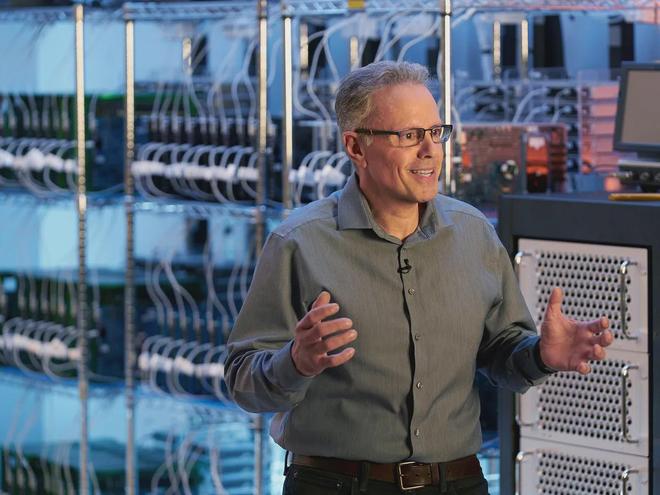
Chips, hardware and AI equipment increasingly require unified coordination, and the company has yet to find another person who can fully take over these responsibilities.
Marketing and retail face similar problems. Greg Joswiak, 62, has been with Apple for about 40 years, and the likelihood of a transition being completed in the next few years is increasing. Lilian Rincon, head of AI marketing, and Kaiann Drance, head of iPhone marketing, are seen as next-generation managers to watch.
Deirdre O'Brien, senior vice president of retail and personnel, has also worked at Apple for nearly 40 years. In terms of retail business, Vanessa Trigub has begun to assume more store operation responsibilities and may take over from within in the future; the human resources position does not rule out the introduction of external managers again.
Service businesses may take different approaches. Eddy Cue, 61, currently manages a large number of businesses such as television, music, sports, and iCloud. Due to the large scope of jurisdiction, Apple may not be looking for a complete replacement of a senior executive in the future, but may split the service organization. Oliver Schusser and Adrian Perica are the candidates mentioned in the report.
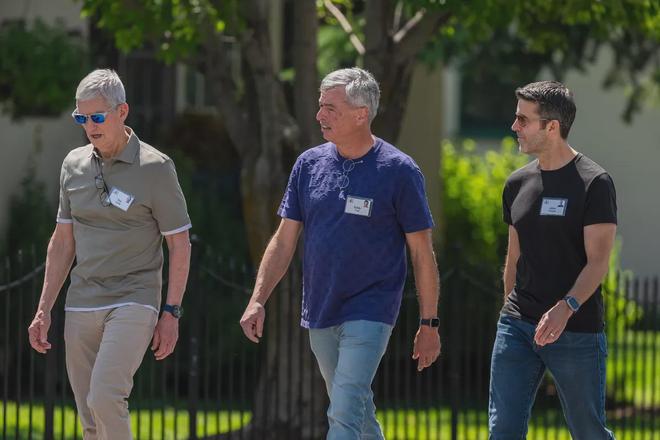
Craig Federighi has expanded his responsibilities for AI software and Apple Watch and Vision Pro operating systems. A relatively clear succession path has emerged for the finance and operations teams: 54-year-old CFO Kevan Parekh is expected to stay at Apple for a long time, 59-year-old COO Sabih Khan has also formed a relatively complete operational echelon, and Vice President of Product Operations Priya Balasubramaniam may assume greater responsibilities in the future.
These names are not just retirement and succession lists.
Who is responsible for chips, who is responsible for AI software, who controls product marketing, and whether the service business is split will all change who proposes plans, coordinates resources, and makes final decisions within Apple.Tony Blevins, Apple’s former head of procurement, believes that an important challenge faced by Ternus is similar to that of Cook: completing the transition of Apple’s management team from the previous generation to the next generation.
The difference is that this time Apple has to deal with more than just executive replacement.
In the past, the core capability was to organize hardware, software, supply chain and retail system to sell a product on a large scale. After entering the AI stage, companies also need to increase models, algorithms and AI software capabilities, and truly embed these technologies into hardware.The centralized change of management gave Ternus an opportunity that Cook did not have back then: to rearrange the reporting relationships within Apple.
Which teams report directly to the CEO, how hardware and AI collaborate, how much independence the chip team has, and whether the service business is split can all be rearranged.@iDubeyDheeraj, a practitioner in the AI field, reminds that when evaluating Cook, you cannot just judge whether he has created the next product that changes the industry. What Cook has really accomplished is to keep Apple operating at scale after Jobs, and this ability itself is an important foundation for Apple's growth over the past 15 years.
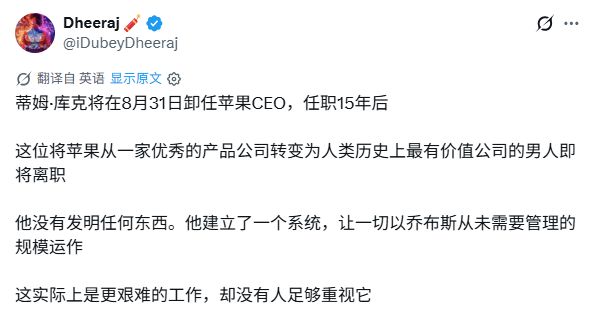
This foundation won't expire on September 1, but it won't answer Ternus's next step.
Ternus has been solving the problem of "how to make products" for the past 25 years. After becoming CEO, he needs to start answering what Apple will do next. He also needs to build a new management team capable of executing those choices and redraw decision-making boundaries with Cook, who remains executive chairman.
Therefore, the first phase of Ternus does not necessarily require the immediate creation of a new "iPhone moment."
He needs to let Apple complete product decisions faster, form a clear route in the direction of AI, smart glasses and next-generation hardware, and complete the update of the management team and talent structure.
The first signals will be whether Siri AI can enter user devices as planned, whether smart glasses and smart home projects will be rescheduled, and how the next round of executive appointments will change Apple's internal reporting relationships.
After September 1, Apple will not immediately become another company. It still has the world's largest consumer electronics user base, the most mature supply chain and the most stable service revenue.
Changes will first appear in the rhythm of decision-making. When a product is launched, when it is cut off, and who makes the decision are the first clues for the outside world to observe the Turnus era.
Comments