
Abstract:
The dramatic fluctuations in stock prices after the listing made Yushu Technology a focus event in the humanoid robot industry. The hot and cold changes in the capital market are essentially a concentrated re-evaluation of the market's pace of implementation of the humanoid robot industry. What really deserves the attention of hardware and robot practitioners is the realistic contradiction between the technical capabilities and commercialization behind it.
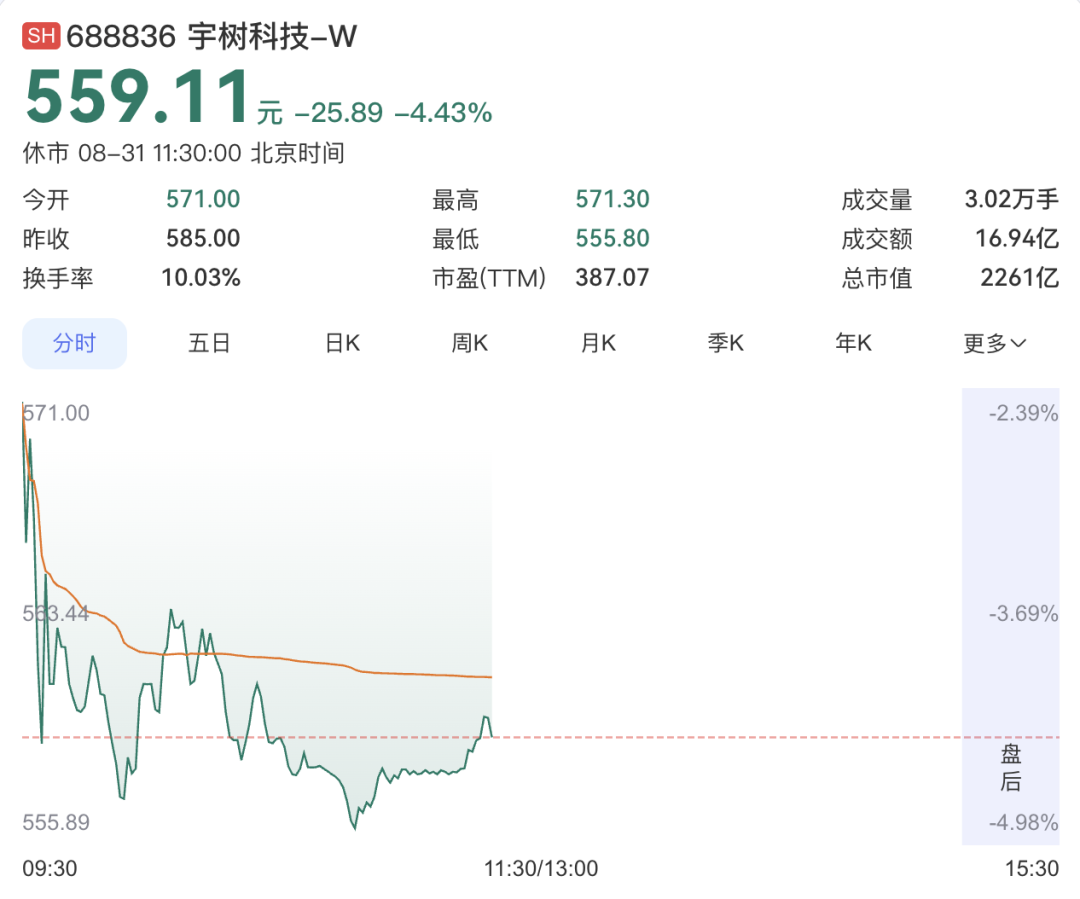
On August 19, Yushu Technology was listed on the Science and Technology Innovation Board. Driven by sentiment on the track on the first day of listing, the stock price soared to 1,100 yuan. After a brief carnival, the stock price continued to fall.
In the early trading on August 31, Yushu Technology continued its adjustment trend. It dropped to 555.8 yuan during the session, setting a new low since its listing. As of midday, it closed at 559.11 yuan, a decrease of 4.43%. Compared with the hype high of 1,100 yuan on the first day of listing, the maximum retracement was close to 49.5%. It needs to be made clear that this retracement is relative to the short-term hype peak of the listing. Compared with the issue price, the company's stock price still increased several times. The circulating market ratio is only 7.44%, which amplifies the price fluctuations in the secondary market. This market value peak is not an enterprise value generally recognized by the industry.
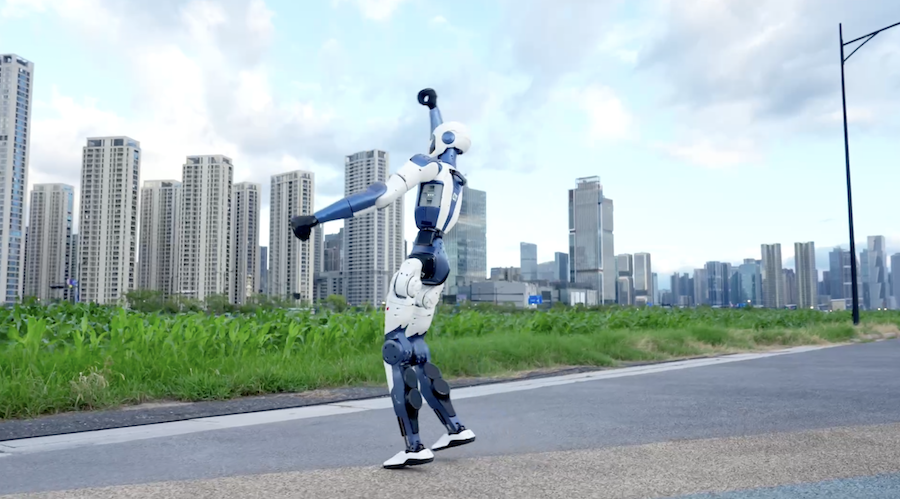
Putting aside price disturbances in the secondary market, Yushu is one of the few manufacturers in the world that has achieved large-scale shipments of humanoid robots. Its core advantages are concentrated in the body hardware and high-dynamic motion control. The hardware side implements full-stack self-development of motors, drive boards, and motion control algorithms. The QDD direct-drive joint solution can complete difficult dynamic actions such as running and backflips, and its motion robustness ranks in the first echelon in global laboratory scenarios. The product opens its SDK to the scientific research ecosystem, and a large number of university laboratories purchase its equipment to verify embodied intelligent algorithms, forming a scientific research cycle of "hardware sales, algorithm iteration, product iteration".
However, the data disclosed in the prospectus also exposed the practical bottlenecks of implementing this technical route in real industrial scenarios. In the first three quarters of 2025,
73.6% of Yushu’s humanoid-related business revenue came from procurement from universities and scientific research institutions, while revenue from industrial and commercial landing scenarios accounted for only about 5%
. The vast majority of equipment flows to laboratories, and cases that are actually used in factories and commercial sites are still in the pilot stage.From an engineering and technical perspective, scientific research scenarios and industrial scenarios are two completely different sets of assessment standards. Scientific research scenarios value extreme sports performance, open interfaces, and secondary development; industrial scenarios require long-term continuous operation, low failure rate, environmental tolerance, sufficient terminal load, and controllable operation and maintenance costs, which are precisely the shortcomings of current products. The G1 humanoid robot has a dead weight of 35kg and a single-arm end load of only 2kg. Under highly dynamic working conditions, the joint motors heat up severely and require shutdown for cooling for long periods of time. The continuous effective working time of the whole machine is limited, making it difficult to directly undertake continuous tasks such as factory transportation and assembly. Engineering issues such as sealing, heat dissipation, and load capacity are not easily exposed in laboratory demonstrations. Once it enters a real industrial site with dust and large temperature differences, the reliability test will rise sharply.
Changes in performance also reflect the pressure of commercial transformation. In 2025, the company's revenue and non-net profit will grow rapidly; in the first half of 2026, revenue growth has dropped to 48.5%, and non-net profit has dropped 19.34% year-on-year, indicating an increase in revenue but no increase in profits. R&D investment continues to increase, on the one hand it is used to iterate joints and complete machine hardware, and on the other hand it is invested in embodied intelligent large-scale models and perception decision-making algorithms; however, the release speed of industrial orders is not as fast as expected, and it is highly dependent on the fundamentals of scientific research procurement. Once the rhythm of scientific research procurement fluctuates, it will be directly transmitted to corporate financial reports.
Many engineers in the industry recognize Yushu's motion control technology, but they also generally point out two major practical constraints. First, the QDD direct drive solution pursues high dynamic motion capabilities, but at the cost of high thermal stress on the motor and high requirements for heat dissipation and device life. To achieve industrial-grade long life, a large number of engineering iterations and optimizations must be done; second, the core component supply chain still relies on external dependence. Key components such as harmonic reducers account for a high proportion of external procurement, and large-scale mass production and cost reduction are still a big challenge.
There is now a reality gap in the industry: in the demonstration video, the robot runs, jumps, and flips, which has a strong visual impact; but for real industrial production, what is needed is stability, durability, low cost, and ability to work. Motion control does not mean work ability, and being able to run and jump does not mean being able to stably complete repetitive tasks such as grabbing and assembly. Yushu has proven himself in
Laboratory research-grade humanoid robot
It has mass production capabilities, but from scientific research prototypes to large-scale industrial commercialization, it has to cross multiple thresholds of engineering, reliability, cost, and supply chain.Capital market sentiment fades as quickly as it comes, and the violent fluctuations in stock prices are just superficial. For hardware practitioners, the real point of view is not the rise or fall of market value, but whether this set of highly dynamic motion control technology can complete industrial-level engineering transformation; when will the income structure, which is highly dependent on scientific research procurement, be truly switched to industrial and commercial implementation on a large scale. The humanoid robot industry is still in its early stages, and running a technical prototype is only the first step. From "acting well" to "actually working to create value" is the industry's biggest test.
Comments