
Abstract:
This National Day holiday, in addition to "everyone, everyone" in the scenic spot, there are also a group of robot "employees". They are no longer just "performers" doing somersaults and dancing on the stage, but have begun to schedule shifts, sell goods and collect payments, inspect security, and perform night performances. According to incomplete statistics, nearly 30 personal intelligence and robot companies have entered cultural tourism, retail and consumer service scenarios, with thousands of units on duty during the National Day.
At the same time, the "rent rush" for robot rentals has also disappeared, with daily rents falling from 10,000 yuan in early 2025 to less than 1,000 yuan. After bidding farewell to the performance model that relies on novelty to attract attention, the cultural and tourism scene has become a realistic testing ground for embodied intelligence. Robots have been "able to work", but to achieve sustainable profitability, the industry still has to overcome multiple structural hurdles.
After the "avalanche" of rental prices, the cultural and tourism industry bid farewell to the pure performance economy
The robot rental market that became popular during the Spring Festival Gala in 2025 once made "it is hard to find a machine" the norm. Since the beginning of this year, the daily rent of humanoid robots has dropped sharply, from the "daily salary" of 10,000 yuan at the beginning of last year to 2,000 to 3,000 yuan at the beginning of this year. A reporter from "Kechuangban Daily" noticed that the current daily rent of humanoid robots has dropped below 1,000 yuan. E-commerce platforms such as Xianyu show that the starting price for renting a humanoid robot from Yushu Technology has dropped to 289 yuan/day as marked on the merchant page.
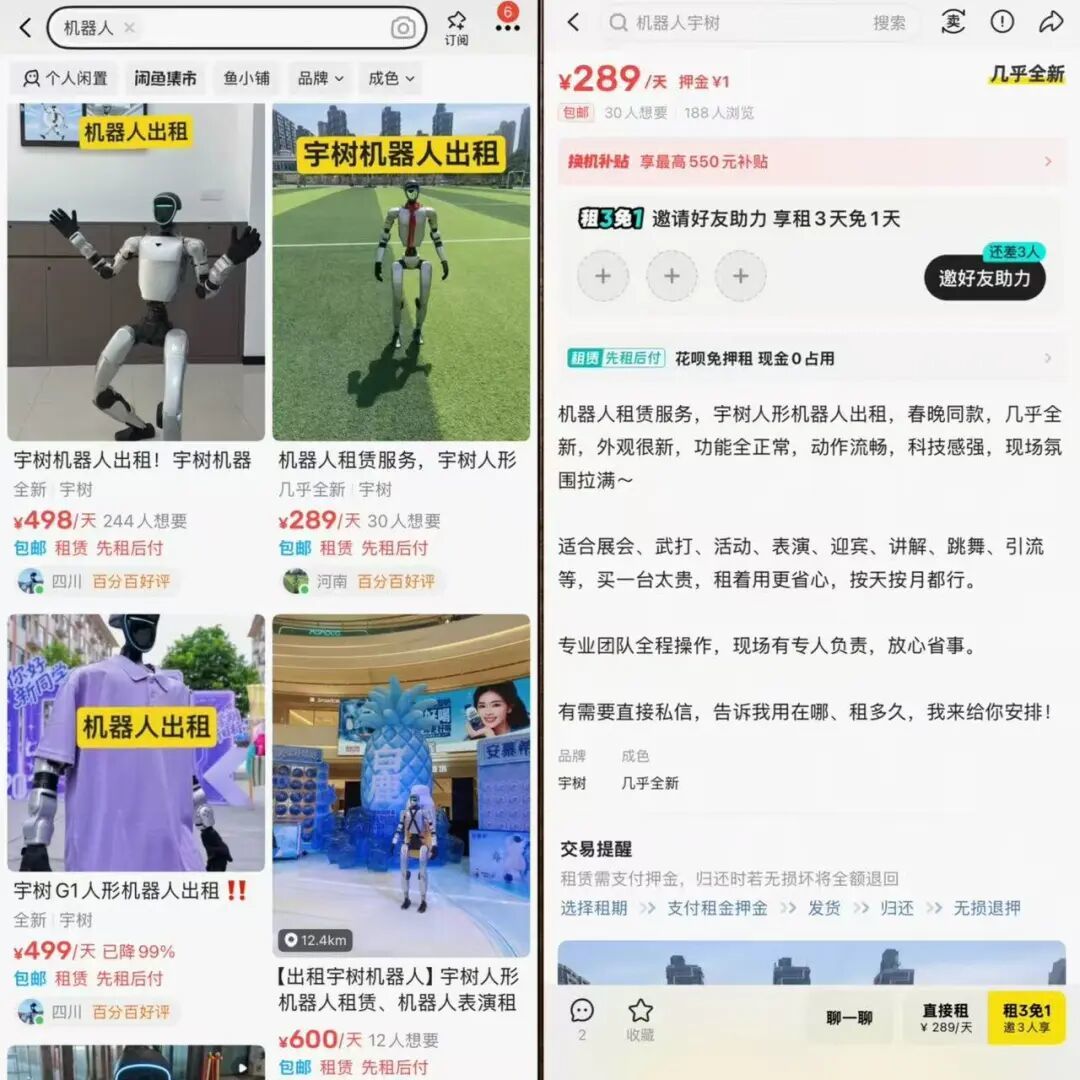
The underlying reason for the plummeting price of robot rentals is not only the congestion of the track, but also the serious homogenization of "robot performances" in the cultural and tourism scene. When every scenic spot can rent a robot that can dance and shake hands, "freshness" will no longer be a scarce resource.
The most significant change during this year’s National Day is that the functional boundaries of robots have expanded from “showing people” to “doing work for people.” It is not difficult to see that the robots in the scenic spots are no longer just "guest performers" who dance and sing, but actually work in major scenic spots. The retail and service scenes are expected to be the first to generate positive cash flow.
In the Taoxichuan Cultural and Creative District of Jingdezhen, Jiangxi, a reporter from the Science and Technology Innovation Board saw that Galbot G1, a humanoid robot from Galaxy General Motors, was already working as a salesperson in a mobile sales vehicle. The shelves behind him are filled with drinking water and other retail products as well as cultural and creative souvenirs. The robot can autonomously complete greetings, product recommendations, order payment, grabbing and delivery. Many children gathered around the window to interact with the robot, and even sang and danced with it.
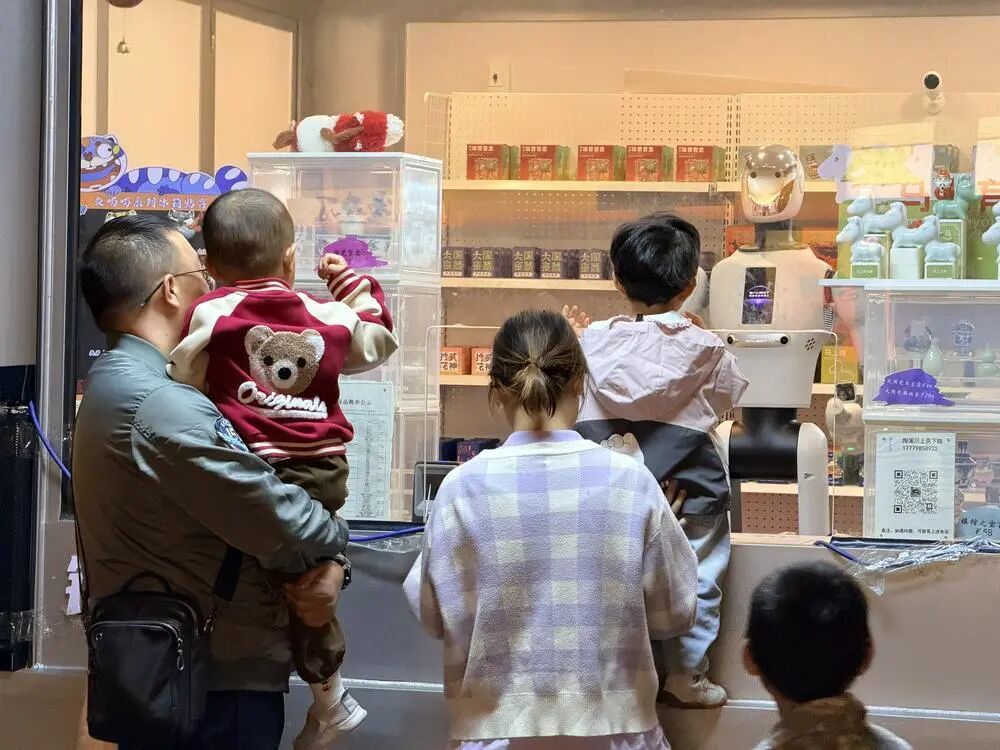
In addition to Tao Xichuan, Galaxy General's Galaxy Space Capsule smart retail store has opened in scenic spots such as the Summer Palace, Old Summer Palace, Badaling Great Wall, and Dunhuang Mingsha Mountain. It is reported that the space capsule has landed at about 200 points in about 50 cities across the country.
From October 1st to 7th, Prime Rental and Sinar Mas Group launched the "Robot National Day Wonderful Night" at Shanghai Magnolia Plaza. Lingxi, a humanoid robot owned by Zhiyuan, also serves as a one-day store manager for offline stores of the ski brand BURTON and the fragrance brand AD VITAM, responsible for customer interaction and photo taking, guidance in store browsing, consultation and recommendations, etc.
Qingtian Leasing told a reporter from the Science and Technology Innovation Board Daily that the overall performance of the linked brands had good performance during the National Day holiday, with Ivydan increasing by 9% year-on-year and Burton's unit price increasing by 16%.
On the eve of the National Day, the Embodied Intelligence Theme Park jointly built by Chiyuan and Chimelong opened in Hengqin Chimelong Spaceship Park. More than 300 robots have been deployed to more than 100 points, "scheduled to work", and undertake tasks such as science popularization explanations, table tennis games, calligraphy writing, and guessing games. With the arrival of tourists during the National Day holiday, these robots began to enter the daily operations of the park.
In addition, during the National Day, Interdimensional Intelligence operated more than 30 robot commercial service stations in cultural and tourism scenic spots, theme parks, commercial complexes and other scenes. Humanoid robots provided ice cream, popcorn, coffee, drinks and other ready-made and retail services. It is reported that the above-mentioned small stations received a total of more than 110,000 passengers during the golden period, a single robot served more than 500 orders per day, and the benchmark store's total holiday revenue reached 150,000 yuan.
At the same time, inspection and security are another B-side entrance that is opening. The Shenxianju Scenic Area in Zhejiang uses intelligent patrol robot dogs during the National Day to "build a 'human defense + technical defense' safety defense line"; the four-legged patrol robot dog at Huayan Temple in Datong is put on regular duty, undertaking tasks such as civilized persuasion, daily inspections, and fire prevention inspections, and achieves 24-hour uninterrupted duty.
After the "Novice Village" trial, how does embodied intelligence overcome the gap between scenarios and costs
A large number of humanoid robots came to work during the National Day holiday and completed a large-scale real-life drill. This trial proved that robots are already capable of working, but to break through the closed loop of commercial profitability, the industry has to face a series of structural challenges that are more difficult than immature technology.
The most direct challenge comes from the seasonal dependence of operating accounts. At present, the income of most cultural and tourism robot projects mainly relies on freshness bonus and holiday passenger flow. But what really determines the sustainability of profitability is whether operation and maintenance costs can be absorbed during non-holiday periods. There are clear quantitative standards for judging the value of robots in the industrial field, but the business calculations in cultural and tourism scenarios are much more complicated: there are no standard answers for tourists' willingness to interact, whether they will generate incremental consumption, supporting human operation and maintenance costs, etc.
Take the embodied smart theme park cooperated by Zhiyuan and Chimelong as an example. Xiong Yan, a partner, co-president of Zhiyuan, president of the central R&D department, and president of the interactive business system, revealed to a reporter from the Science and Technology Innovation Board Daily that the current ratio of Chimelong’s on-site robots to operating personnel is about 3:1, “but 3 The ratio of :1 is not long-term. Our basic expected goal is 10:1, 10 robots for one person. Both parties believe that the ideal goal should be 20:1. "Based on the scale of Chimelong's more than 300 robots, there are currently more than 100 on-site operation and maintenance personnel.
Wang Chuang, Partner, Senior Vice President and President of the General Business Department of Zhiyuan, further breaks down the cost reduction path, optimizing the manpower ratio from 3:1 to 10:1 to 20:1, while extending the service life of equipment to dilute procurement costs, and controlling network, token fees and spare parts losses, aiming to reduce customers' overall costs in various differentiated scenarios.
At the same time, "data shortage" is becoming the biggest obstacle to the industrialization of embodied intelligence, and Internet data cannot replace real physical interaction data. For robotics companies, another value of cultural tourism scenarios lies in the continuous flow of real human-computer interaction data that feeds back algorithm iterations. The robot receives a large number of tourists every day, collects cases of interaction failures and recognition errors, and can continuously iterate the model, which is expected to form a flywheel effect of "scenario usage - data reflow - technology iteration - experience upgrade".
However, there is still a question to be answered, that is, whether the cultural tourism scene can become a springboard for embodied intelligence to be implemented in various industries. Many people in the industry regard the cultural and tourism scene as a "newbie village" for embodied intelligence. The tasks are relatively standardized and the room for error is much larger than that of the industrial scene. Even robots stuck or falling will create topics and trigger secondary spread on the Internet. However, it is still unknown whether the practical experience of "Novice Village" can be reused in more complex real-life business scenarios.
“I think it will take at least 3 to 5 years to truly achieve what the general public thinks does not require debugging, just like a human being.” Xiong Yan told a reporter from the Science and Technology Innovation Board Daily, “But this does not prevent robots from entering thousands of industries. It just means that efficiency, experience, and how much tasks can be completed are still in the process of continuous improvement, but this process is necessary.”
The National Day centralized implementation proves that humanoid robots can already work in the real world, but seasonal profitability, operation and maintenance costs, scene migration, etc. are still realistic tests. The novelty will eventually fade away, and how to get through the closed business loop is the key to the emergence of embodied intelligence in the cultural and tourism scene.
Comments