
Abstract:
Tensions between OpenAI and the mathematics community have escalated again. Fields Medal winner Terence Tao recently reposted a statement issued by the Association for Human Mathematics (AHM) on his personal blog, criticizing OpenAI for ignoring research norms in the mathematics community and calling on mathematicians to stop cooperating with it. The controversy stems from a batch of mathematical research manuscripts published by OpenAI. Its internal model tried to solve about 4,000 mathematical problems, and finally compiled research materials involving 372 sets of results, and disclosed some Lean formal proof codes.
However, the scale of the results has not been unanimously recognized by the academic community. What mathematicians care about is not just whether the proof is correct, but also whether the derivation can be understood, whether previous work is fully cited, and whether new methods can be integrated into the existing knowledge system through peer discussion.
Formal verification can check logical derivation, but it cannot automatically replace manual review of proposition meaning, research contribution and academic background. "The release of more than 700 documents at one time demonstrates not academic research, but power," the statement said.
Dana Moshkovitz, a theoretical computer scientist who has been deeply involved in the unique game conjecture for a long time, immediately studied the relevant papers released by OpenAI and said that the papers were full of incomprehensible structures, unclear reasoning steps, and confusing literature references. Scott Aaronson, a theoretical computer scientist at the University of Texas at Austin, described OpenAI’s launch day as “the apocalypse of mathematics.”
Some netizens believe that Terence Tao's views are too extreme and should not block the development of technology that could benefit everyone. Bryna Kra, a mathematician at Northwestern University, believes that AI is expected to help researchers explore problems that were difficult to solve in the past, but companies should publish their results in a way that is more consistent with academic standards so that peers can check, understand and continue research.
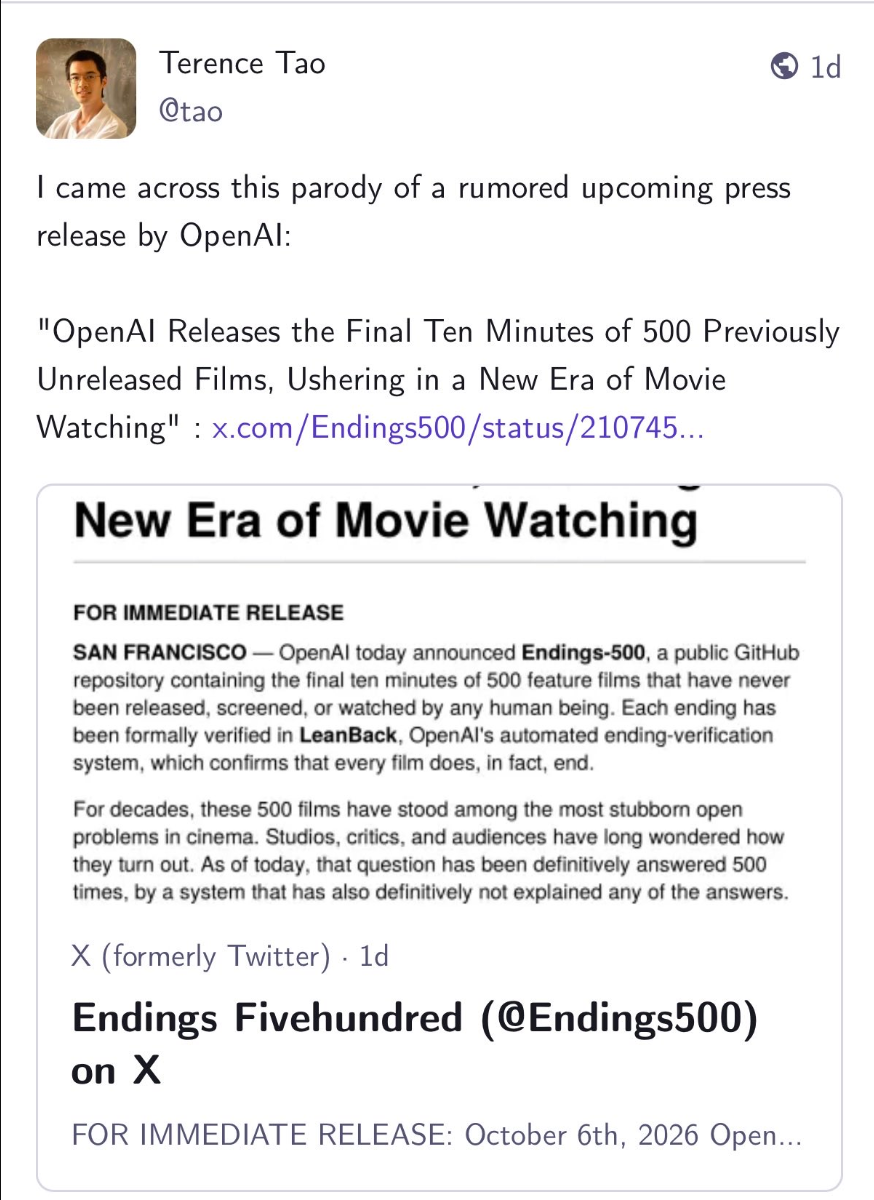
The core of the conflict between the two parties is the gap between the speed of AI generating results and human understanding. Traditional mathematical research requires gradual explanation of proofs and improvement of methods through papers, seminars, and peer exchanges; when commercial laboratories publish hundreds of complex manuscripts at one time, the costs of subsequent verification, revision, and knowledge integration may be transferred to the academic community. Research agendas, publication cadences, and model resources are therefore increasingly influenced by a handful of technology companies.
This controversy did not arise suddenly. Terence Tao has previously signed a statement with 24 other Fields Medal winners, warning AI companies that using mathematical problems as a benchmark for model capabilities may deviate technological competition from the original intention of pursuing understanding and insights in mathematical research.
On September 29, the Advisory Group on Mathematics and Artificial Intelligence (AGMAI) issued recommendations clearly opposing cutting-edge AI laboratories using internal models that are inaccessible to the outside world to test difficult mathematical problems.
OpenAI stated that this release was based on the recommendations of AGMAI; AHM believed that the company ignored the core premise of the recommendations and therefore called on mathematicians to stop cooperating with OpenAI. In addition, AGMAI also requires laboratories not to use the release of mathematical results as a marketing tool to promote models. Related releases should disclose information such as model names, prompt words, computing power costs, and failure records.
As AI continues to improve its scientific research output capabilities, the mathematics community is no longer facing the question of whether machines can prove theorems, but also who decides the direction of research, who bears the cost of verification, and how to ensure that technological progress still serves the accumulation of knowledge.
Comments