
Abstract:
On November 22, Azeem Azhar, author of the technology trend newsletter "Exponential View", paid attention to a special competition in the mathematics community in the latest issue of the article: the proof of the Riemann Hypothesis proposed by Anthropic mathematicians in collaboration with Claude, and the proof completed independently by another mathematician without using AI, entered the public view almost at the same time.
Neither of the two proofs has yet received final confirmation from the mathematical community
.
The Riemann Hypothesis is one of the most famous unsolved problems in mathematics. It was proposed by the German mathematician Bernhard Riemann in 1859 and has a history of 167 years. This conjecture involves
the distribution of prime numbers and is also one of the seven millennium mathematical problems announced by the Clay Mathematics Institute
.According to Azhar, Anthropic mathematician Levent Alpöge recently said that he and Claude may have proved the Riemann Hypothesis.
This proof involves approximately 17.4 million lines of Lean code
. Lean is a formal proof language that can be used to check whether mathematical reasoning conforms to the rules of formal logic through computer assistance.Almost on the same day, Stanford University mathematician Ravi Vakil also announced the proof scheme proposed by mathematician Alessandro Masullo for this conjecture. Unlike the Anthropic team, Vakil emphasized that Masullo's proof was
completely completed by humans
, without the use of artificial intelligence.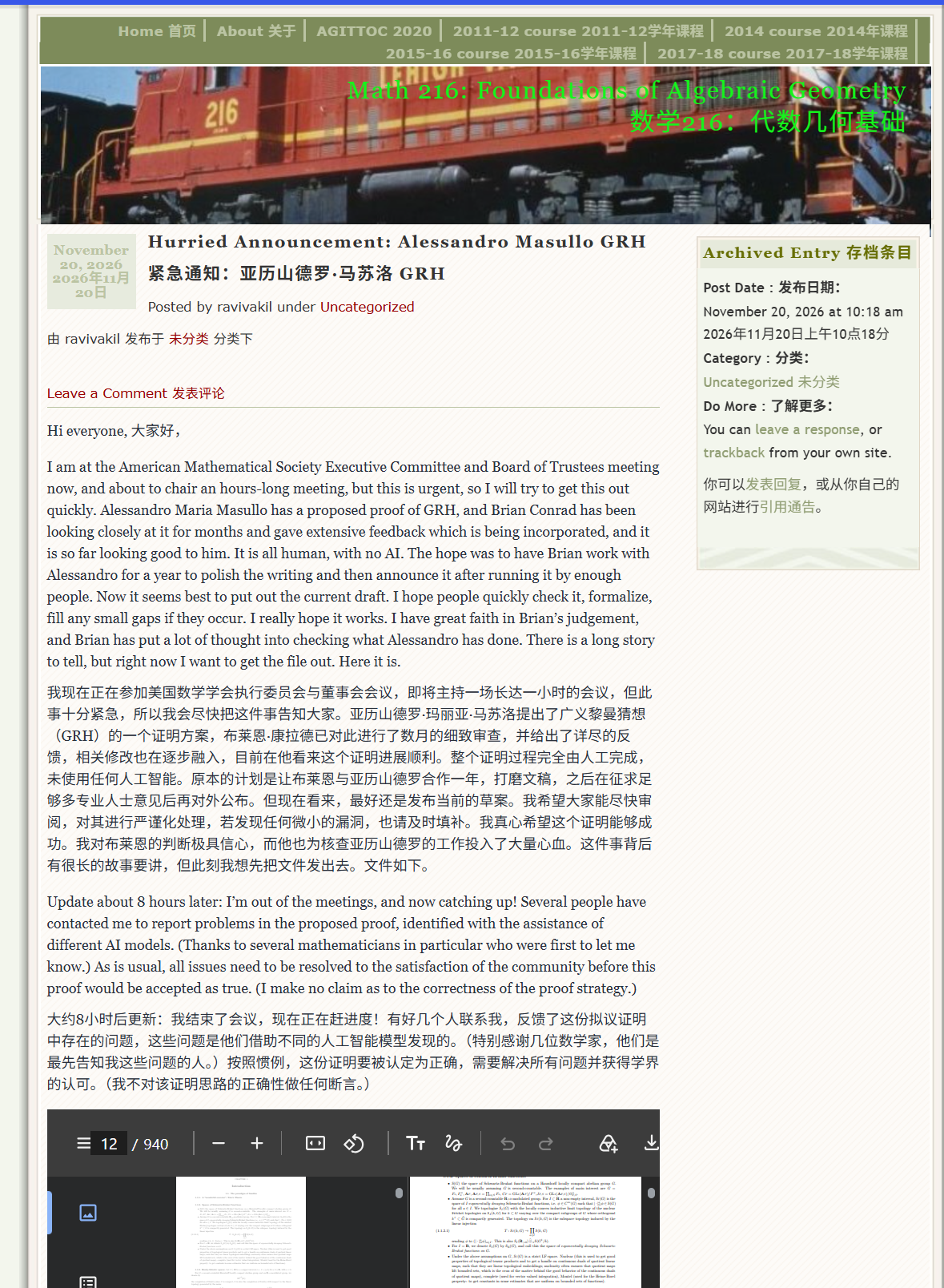
Humanly certified reporting
However, both certificates require further verification.
Azhar pointed out that the proof presented by Masullo is still undergoing third-party inspection. At the same time, the relevant team is trying to transcribe its mathematical arguments into Lean formal language so that computer-aided verification can be used.
Azhar is also cautious about the proof proposed by the Anthropic team. He said he had not read any of the certifications and could not judge their accuracy.
Theoretical computer scientist Scott Aaronson put forward a point worth paying attention to from the perspective of formal verification: AI research results previously verified by Lean have not yet been withdrawn.
However, the reliability of formal proof does not mean that any mathematical proof claiming to use Lean has been confirmed. Whether the proof is complete, whether the formal code covers key arguments, and which verifications have actually been passed still need to be further verified.
Azhar believes that this incident reflects the changing relationship between artificial intelligence and human mathematics research. Even if it emphasizes mathematical proofs completed entirely by humans, its research team has begun to use computer formal verification tools to improve the checkability of the proofs.
For the mathematical community, what really deserves attention may not be just who will conquer the Riemann Hypothesis first between AI and humans, but whether artificial intelligence is changing the way major mathematical discoveries are made, and the process by which the mathematical community confirms that a proof is true.
At present, whether the two studies can finally solve the Riemann Hypothesis that has troubled the mathematics community for 167 years still needs independent review and recognition by the mathematics community.
Comments