
Abstract:
News that may cause great shock in the mathematics community has emerged recently: Anthropic mathematician Levent Alpöge claimed that with the assistance of the artificial intelligence model Claude, he found the proof of the Riemann Hypothesis, and further claimed to have solved the broader Generalized Riemann Hypothesis (GRH).
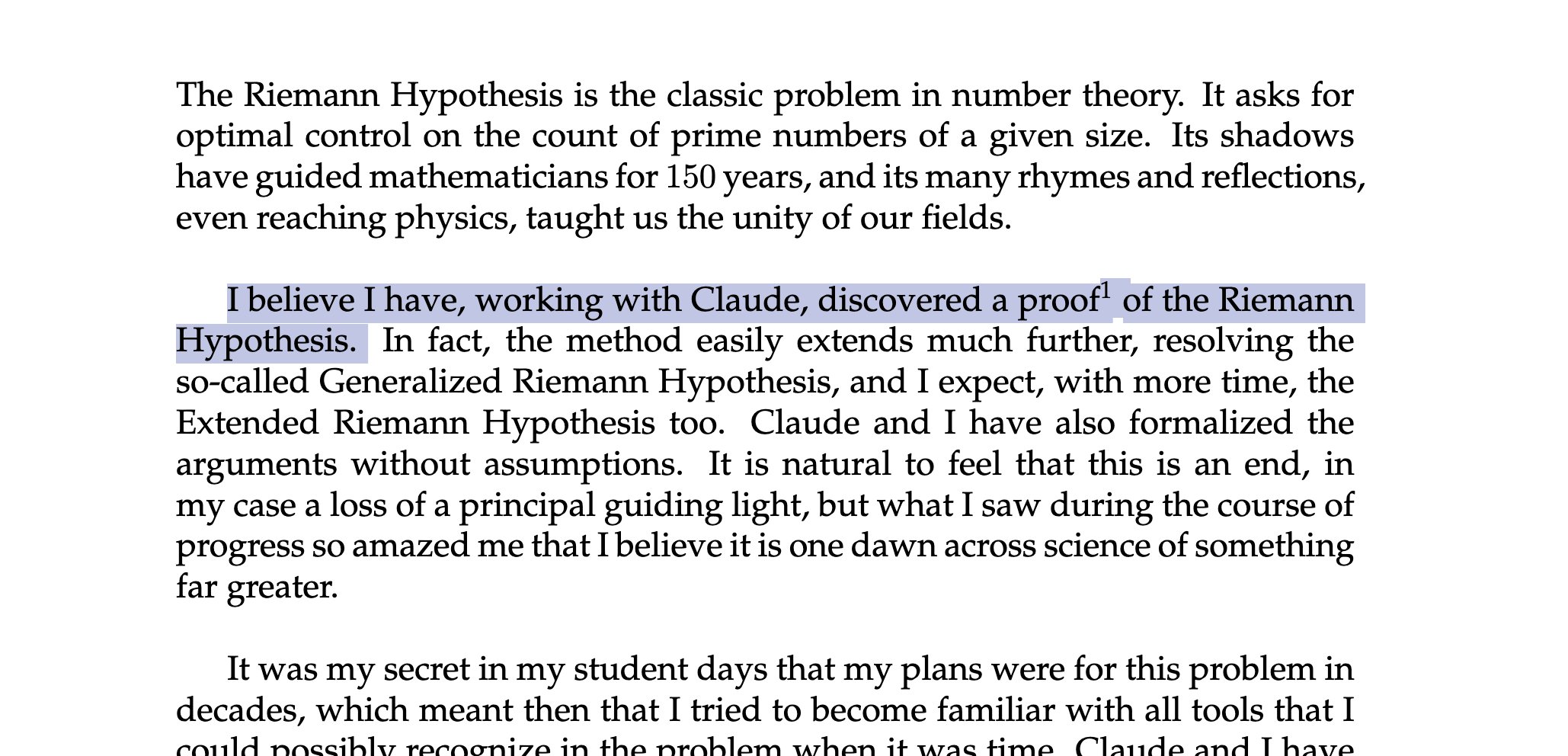
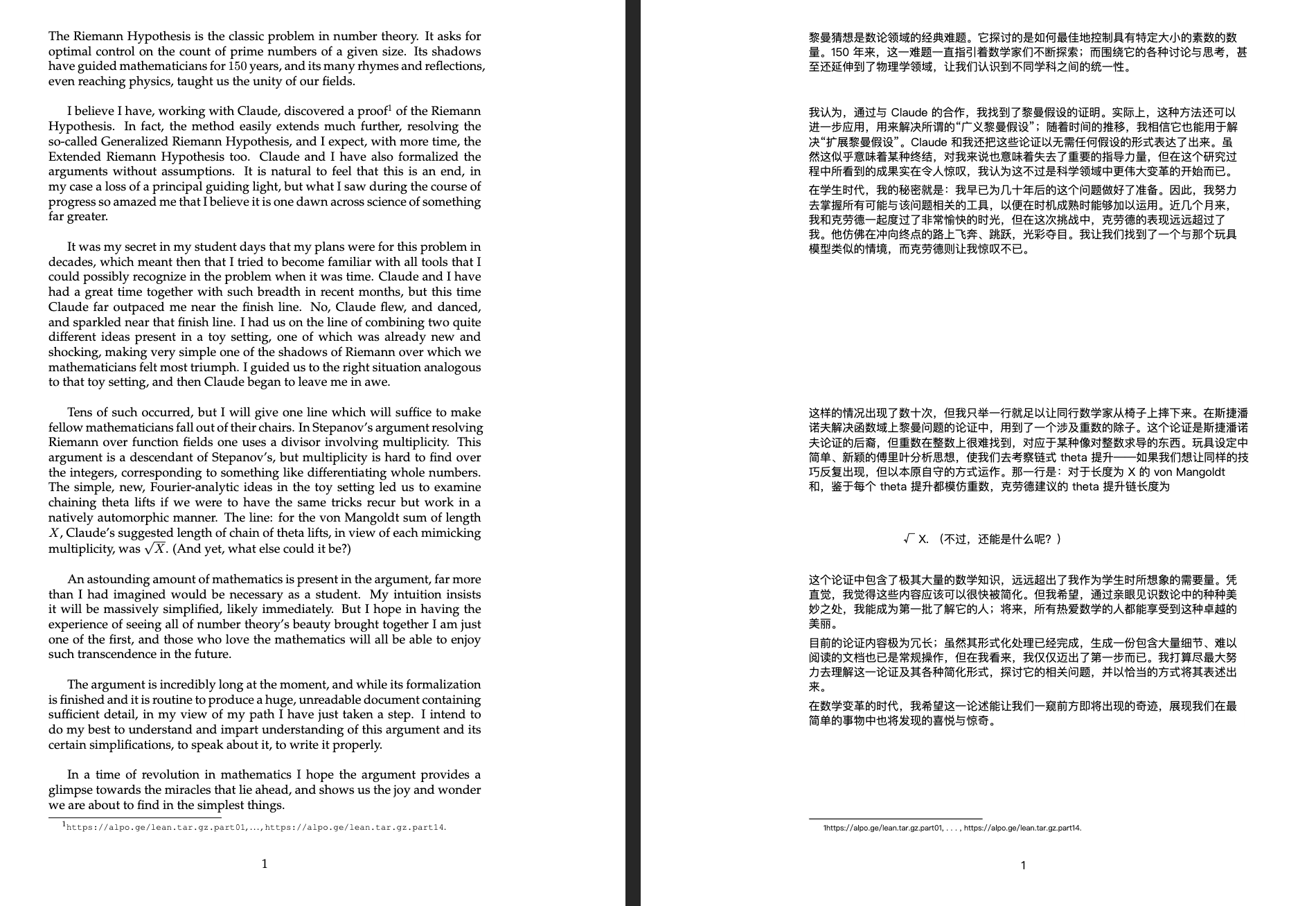
However, this news must be treated with caution at present: this is a proof claim announced by the researcher, rather than a major breakthrough that has been confirmed by the mathematical community. Even if the proof is released in Lean formal code, independent experts still need to check whether the mathematical proposition accurately corresponds to the Riemann Hypothesis, and whether the proof process is truly established.
The Riemann Hypothesis was proposed by the German mathematician Bernhard Riemann in 1859. It studies the distribution of prime numbers in the sequence of natural numbers. Prime numbers appeared seemingly randomly, but Riemann discovered that their distribution was deeply connected to a mathematical object called the Riemann zeta function. The core content of the conjecture is: the real parts of all non-trivial zero points of the Riemann zeta function are equal to one-half.
This problem has been unresolved for more than a century and a half. It is one of the most famous unsolved problems in modern mathematics and one of the seven Millennium Prize problems established by the Clay Mathematics Institute. Any rigorously verified proof will become a major event in the history of mathematics.
Learn more:
https://www.scientificamerican.com/article/anthropic-mathematician-claims-to-prove-riemann-hypothesis-most-famous-problem-in-all-of-math/
Comments