
Abstract:
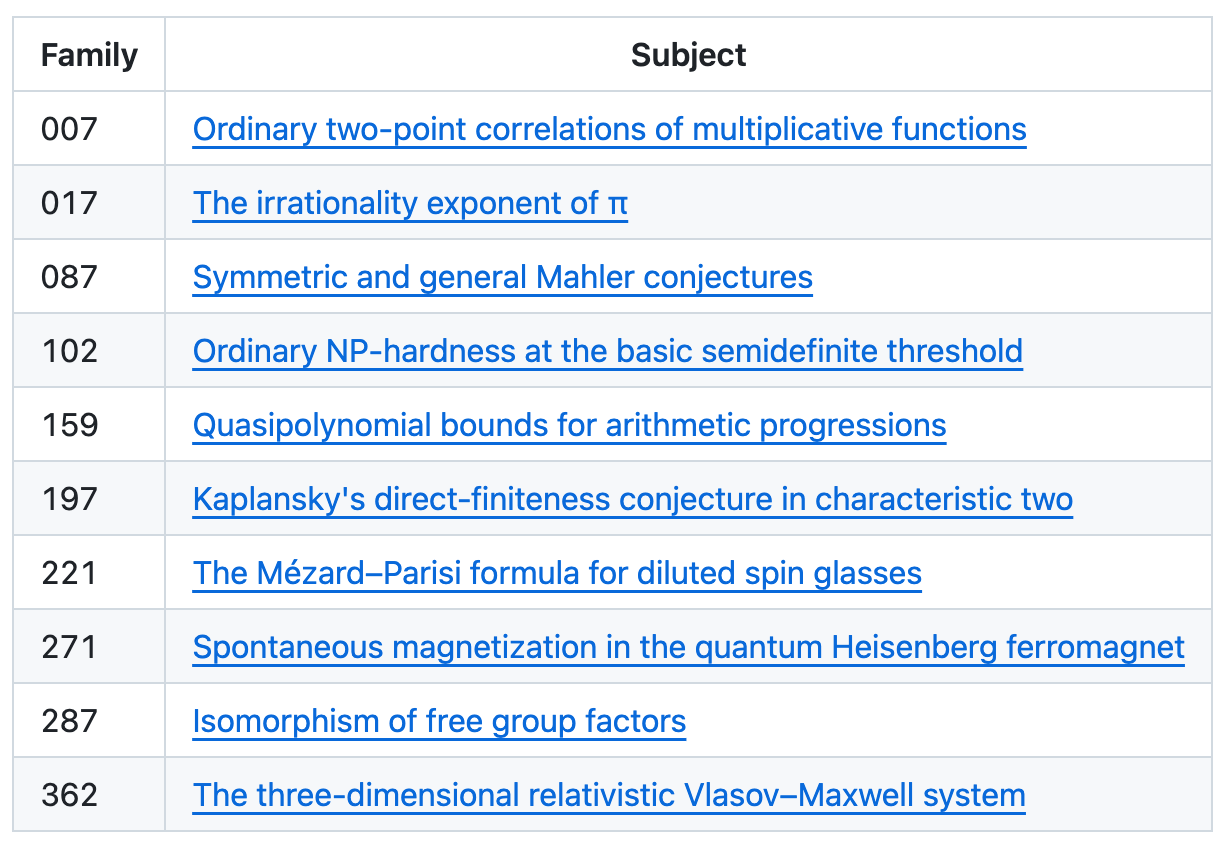
Following last month’s announcement of using internal cutting-edge models to solve one of the most important open problems in mathematics, OpenAI once again dropped a “blockbuster” on the mathematics community. On October 6, local time, OpenAI announced a batch of new mathematical research results generated by internal cutting-edge AI models, involving a total of 372 sets of results, covering a large number of long-term unsolved problems in mathematics and theoretical computer science. OpenAI said that these results either solved long-standing open problems or achieved substantial breakthroughs.
Learn more:
https://github.com/openai/math
The scale of this release far exceeds previous breakthroughs in a single mathematical problem. OpenAI disclosed hundreds of research results this time, including 722 papers or related manuscripts, corresponding to 372 different sets of mathematical results. The company also released information such as a summary of some model inference processes, computing resource consumption, and the number of problems attempted, hoping to allow the mathematics community to more comprehensively evaluate the results of these AIs.
OpenAI said these results come from an internal cutting-edge model that is not yet officially open to the public. Unlike the previous sensational Navier-Stokes equation problem, this release does not focus on a certain field of mathematics, but covers many directions such as number theory, algebraic geometry, and theoretical computer science. Some of these problems have puzzled mathematicians for years, even decades.
According to data released by OpenAI, on average each result uses computing resources equivalent to about 3 hours of continuous thinking of ChatGPT Pro. This means that these results are not simply generated by a single chat request, but are obtained based on extensive calculations and trial and error. OpenAI also published statistics on the problems the model tried to solve, hoping that the outside world could understand the success rate and computational cost behind these results.
This release also reflects OpenAI’s attempt to change the way it released AI mathematical results in the past. Previously, when artificial intelligence companies announced major mathematical discoveries, they often announced them directly through company blogs or press releases, leaving mathematicians to judge whether the results were reliable. This practice has caused dissatisfaction in the mathematics community, because mathematical research relies heavily on rigorous proofs, peer review, and clear attribution of authorship and contribution.
To this end, OpenAI has established a Mathematics and Artificial Intelligence Advisory Group and invited experts, including well-known mathematicians, to discuss how to publish the mathematical results generated by these AIs. OpenAI stated this time that it has referred to the advice of this independent consulting organization, made the results public in the GitHub repository, and provided a paper modification and citation mechanism so that researchers can make revisions after discovering problems, while retaining clearer research records.
Some results also provide Lean formal proof. Lean is a software tool that enables computers to check mathematical proofs. By converting mathematical proofs into a form that Lean can verify, researchers can more rigorously confirm whether there are logical loopholes in AI-generated proofs. OpenAI stated that it has formalized a large number of results and will continue to update the warehouse after obtaining more formal proofs.
However, this release of OpenAI does not mean that all these mathematical results have been recognized by the mathematics community. A large number of papers have just been made public, and mathematicians still need to read each one, examine the proofs, and judge how meaningful the results are. For complex mathematical problems, there is a big gap between "AI claims to solve it" and "mathematical community confirms to solve it".
In fact, this is one of the important reasons why this incident caused controversy. Some people in the mathematics community believe that AI companies are producing mathematical results at an unprecedented speed, but the traditional mathematical research system does not have enough time to verify these results. If companies continue to publish large amounts of non-peer-reviewed results, mathematicians may have to spend a lot of time sifting through them for what is truly valuable.
This concern has been fully exposed when OpenAI previously announced its solution to the Navier-Stokes problem. Mathematician Tristan Buckmaster has publicly questioned OpenAI's process of obtaining relevant proof ideas, and said that he and Anthropic mathematician Levent Alpöge have made important progress in related directions before. A fierce debate broke out in the mathematics community around who first proposed the key ideas of the research results, and how AI companies should identify their signatures and contributions.
OpenAI has denied the relevant accusations, but the incident has caused the mathematics community to seriously discuss a previously more distant issue: when AI can independently complete research work that only top mathematicians could handle in the past, how should the traditional "author", "discoverer" and "research contribution" be defined.
This release is therefore not only the release of a batch of mathematical papers, but also an experiment on the future direction of mathematical research models. In the past, mathematicians might take months or even years to study an open problem. Now, a cutting-edge AI model can try hundreds or more problems simultaneously with the investment of hours of computing resources. Even if the vast majority of them ultimately fail to be established, as long as a few results are truly correct, the research efficiency may far exceed that of traditional human research methods.
OpenAI believes that the purpose of these achievements is not to replace mathematicians, but to push the boundaries of mathematical knowledge forward. The company stated that it hopes to allow mathematicians to further study the results produced by these AIs through seminars, conferences, and specialized research projects in the future, and to help the scientific community understand how artificial intelligence generates these new mathematical ideas.
At the same time, OpenAI is still preparing to release the models that produced these results to the public in the future. The company said it hopes to allow scientists to directly use the most advanced AI systems to solve problems in mathematics and other scientific fields after further safety and capability assessments.
This is also the most noteworthy aspect of this incident. In the past few years, the progress of AI in the field of mathematics has mainly been manifested in the improvement of competition questions, standardized tests, and auxiliary proof capabilities. Now, AI has begun to directly participate in real mathematical research and generate hundreds of candidate research results. If a considerable part of them are finally verified by the mathematical community, it will mean that AI has gradually entered the stage of "research tool" from a "problem-solving tool" in the field of mathematics.
But at the same time, quantity does not equal quality. The real question that the mathematics community needs to answer is not how many papers AI produces at one time, but how many of them can withstand rigorous peer review, how many of them contain truly original ideas, and how many of them can push other mathematicians to further solve previously unsolvable problems.
No matter what the final result is, OpenAI's announcement of hundreds of mathematical results at once means that the relationship between AI and mathematical research is undergoing fundamental changes. In the past, humans were worried about whether AI could solve mathematical problems. Now the more realistic question has become: when AI begins to produce mathematical results at a speed far exceeding that of human research teams, how should human mathematicians verify, understand, screen and utilize these results.
And this change may have just begun.
Comments