
Abstract:
The New Yorker magazine recently published a special article recording the violent shock that artificial intelligence will bring to the world of basic mathematics in 2026. As OpenAI and Anthropic have successively solved many century-old mathematical problems, Fields Medal winner Terence Tao and many top scholars have begun to call on the academic community to step on the brakes and be wary of human mathematical intuition and academic ecology being destroyed by the surge in computing power.
The "Millennium Problem" has been solved, and the academic community is in an existential crisis
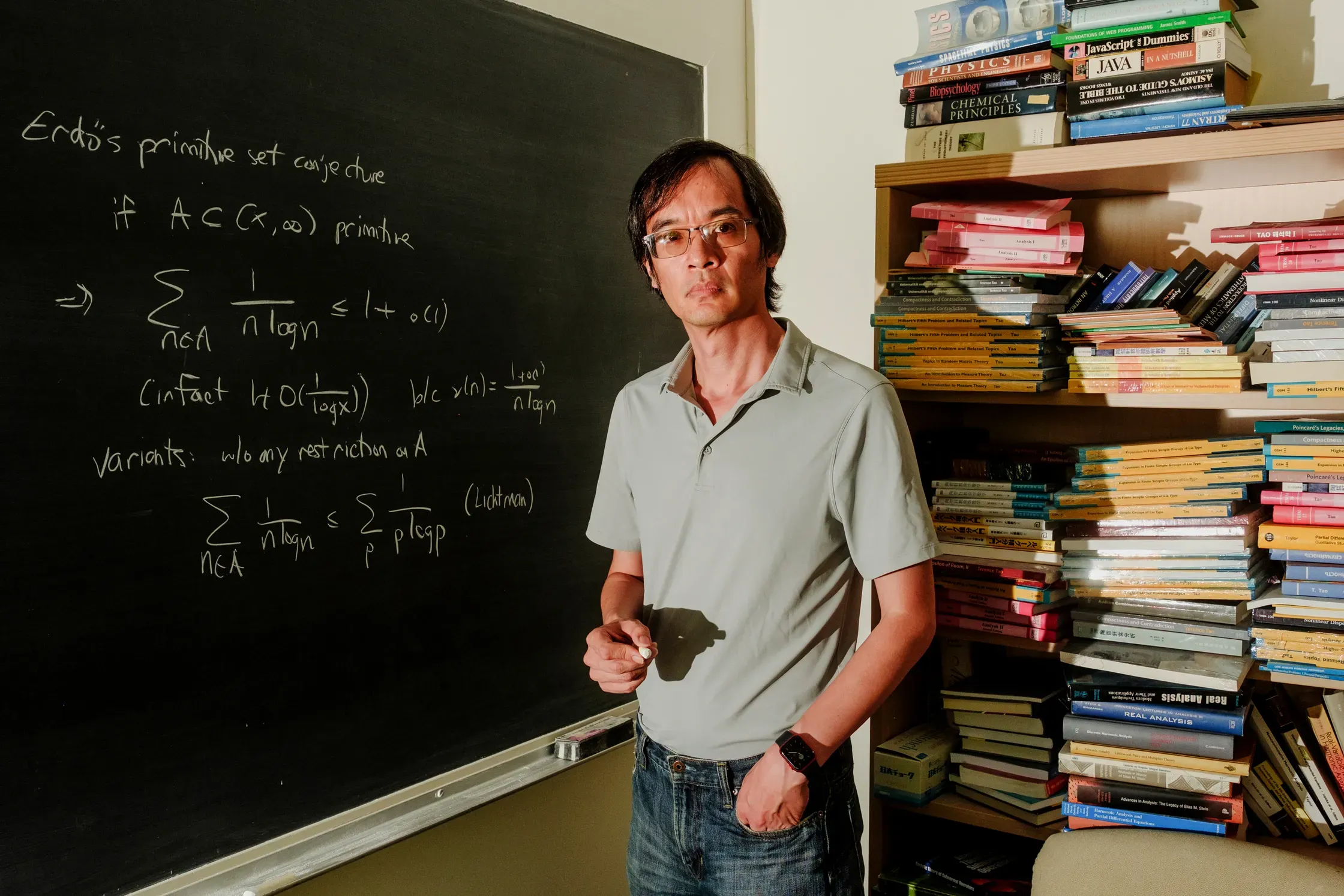
On September 8 this year, OpenAI announced that it had overcome the existence and smoothness problems of Navier-Stokes, one of the "Millennium Prize Problems" with a million-dollar reward. Three days later, 51-year-old Terence Tao appeared on the stage at the California Institute of Technology. In a rare move, he took off the shirt he usually wears during lectures and put on jeans and a black T-shirt with "The Great Wave off Kanagawa" printed on it.
"I experienced the weirdest week of my life."
He pointed at the crude PPT behind him and laughed at himself. Usually he might use AI to make a fancy presentation, but this time he only used the most basic software.What makes Tao Zhexuan anxious is the loss of control of the entire disciplinary ecology. Starting from the beginning of 2026, large models such as GPT-5.2 Pro and Claude Fable 5 have successively solved multiple Erdős problems and Jacobi conjectures that have troubled the academic community for decades. In early October, OpenAI released 372 new results on unsolved mathematical problems in one breath. However, these AI-generated answers often lack derivation details. They are full of common sense that undergraduates can understand at a glance, but only a few lines are written at the most critical logical leap. Mathematics journals are flooded with massive AI papers, and the submitters sometimes cannot even understand their own papers. They rely entirely on human mathematicians to provide free labor for voluntary review and verification.
"We have to slow down, the speed right now is crazy."
Tao Zhexuan pointed out that the mathematical world has entered an era of "proof overflow" from "proof scarcity" before 2025. In mathematical research, the final answer is often not that important. It is the methodological innovations on the way to the answer that really move the discipline forward, and now the slow thinking process on which new questions are born is being destroyed.Black-box operation and giant rush to issue stocks caused public outrage
In addition to the crushing computing power, mathematicians are also deeply disturbed by the closed approach and vicious competition of AI giants.
In August this year, Anthropic mathematician Levent Alperger posted a long string of plus and minus characters on the social platform Jody Williamson, a mathematician at the University of Sydney, feels that the entire mathematical garden has been sprayed with herbicide, which is like giving humans the ultimate answer of "42" but depriving them of all thought processes.
The announcement of the Navier Stokes issue in September turned into a Rashomon. The day before OpenAI’s official announcement, New York University professor Tristan Buckmaster issued a statement saying that he and Alperger had made significant progress on the problem with the help of tools including OpenAI’s public model, and OpenAI, which burned millions of dollars in computing power, claimed to have completed the solution in less than a week. Buckmaster suspected that OpenAI had obtained his research data in the background, but OpenAI denied it. Buckmaster revealed that Sebastian Bubeck, the head of the OpenAI team, had offered to list him as an author of the paper on the condition that Alperger from competitor Anthropic be kicked off the signature list. When Buckmaster refused and was about to go public with the matter, he was asked directly why he wanted to ruin his career.
This controversy prompted Terence Tao and 25 other Fields Medal winners to jointly publish an open letter. The letter warned that problem solving and insight are being decoupled. Over-reliance on AI is equivalent to skipping daydreaming, debate and in-depth thinking. Humans will understand less and less in the future.
The most pressing problem is how to train the next generation
Earlier this year, Tao Zhexuan was called the "evangelist" of AI by the media because of his conversations with OpenAI executives and cooperation in launching an AI mathematics project. But now he's harping on the value of "cognitive friction." He likened the current crisis to the urban transformation of cars replacing horse-drawn carriages. Sidewalks must be preserved in the city, and all spaces cannot be transformed into cars only, because no one wants to live in that kind of city.
In Tao Zhexuan's view,
the most urgent crisis right now is how to train graduate students.
In the past, graduate students needed to spend months studying moderately difficult topics and learn to think like a mathematician through trial and error. Now, AI can solve such problems in a few hours. He compared learning mathematics to watching the soap opera "Emily in Paris" with his wife. Although the plot is clichéd, it is full of fun. If the audience is only shown a few-sentence synopsis of the plot, the meaning of watching the show is completely lost, and it will not allow people to learn to film on their own.This sense of "lost fun" is spreading in academia. MIT mathematician John Usher, who played for the NFL's Baltimore Ravens, spent ten years studying the problem of Gaussian elimination. In order not to be preempted by AI, he spent $200 per month to subscribe to GPT-5.6 Sol and Claude Fable 5, fed his research steps to AI, and finally got a correct but extremely ugly proof, which was then polished and published manually. Although the results were preserved, Usher bluntly said that it was no fun at all, because the most fascinating part of mathematics is precisely the struggle of groping in the dark, and writing out all the answers directly is the most boring part.
However, the older generation of scholars still retains an optimism. Charlie Fefferman, a 77-year-old Princeton University professor who wrote the official description of the Navier-Stokes problem, believes that OpenAI’s proof is most likely correct. He compared doing mathematics to "the devil's chess that you can regret." Even if you have a thousand stupid ideas, as long as you have one brilliant idea, you are a good mathematician. He believes that in the past, some ideas with only a 5% success rate were forced to give up because they took a lifetime to verify. Now if the results can be tested in just two days, mathematicians will become more courageous and imaginative.
Comments