
Abstract:
On October 26, it was reported that Anthropic had submitted IPO documents to the U.S. securities regulator. This AI company that has risen rapidly with Claude and programming tools has finally come under the spotlight of the capital market. This was supposed to be a business success story.
In the past few years, Anthropic has gradually become one of the most watched companies in the enterprise AI market. It builds strength in programming, embeds model capabilities into developer workflows, and provides higher value services to enterprise customers. According to data disclosed by Reuters, Anthropic's revenue in 2025 will reach US$4.59 billion, and revenue in the first half of 2026 will further increase to US$16.29 billion.
But the prospectus documents also revealed another side: in the first half of 2026, Anthropic’s net loss reached US$80.7 billion. Of this amount, approximately US$72.4 billion came from changes in the fair value of convertible notes and did not reflect cash outflows. The true operating loss was approximately $693 million.
But what makes it difficult for investors to breathe easy is that Anthropic’s prospectus gave a commitment of at least US$518 billion in computing power procurement over the next ten years, about 80% of which cannot be canceled or needs to be paid regardless of usage.
In this IPO, Anthropic plans to raise US$100 billion. Since its establishment, Anthropic has raised a total of US$150 billion.
The U.S. stock market has already expressed concerns about the huge expenditure on artificial intelligence infrastructure, and Anthropic’s listing has aroused the fragile nerves of the market.
Industry insiders commented that this listing is of great importance. If it does not go smoothly, the entire market will be dragged down.
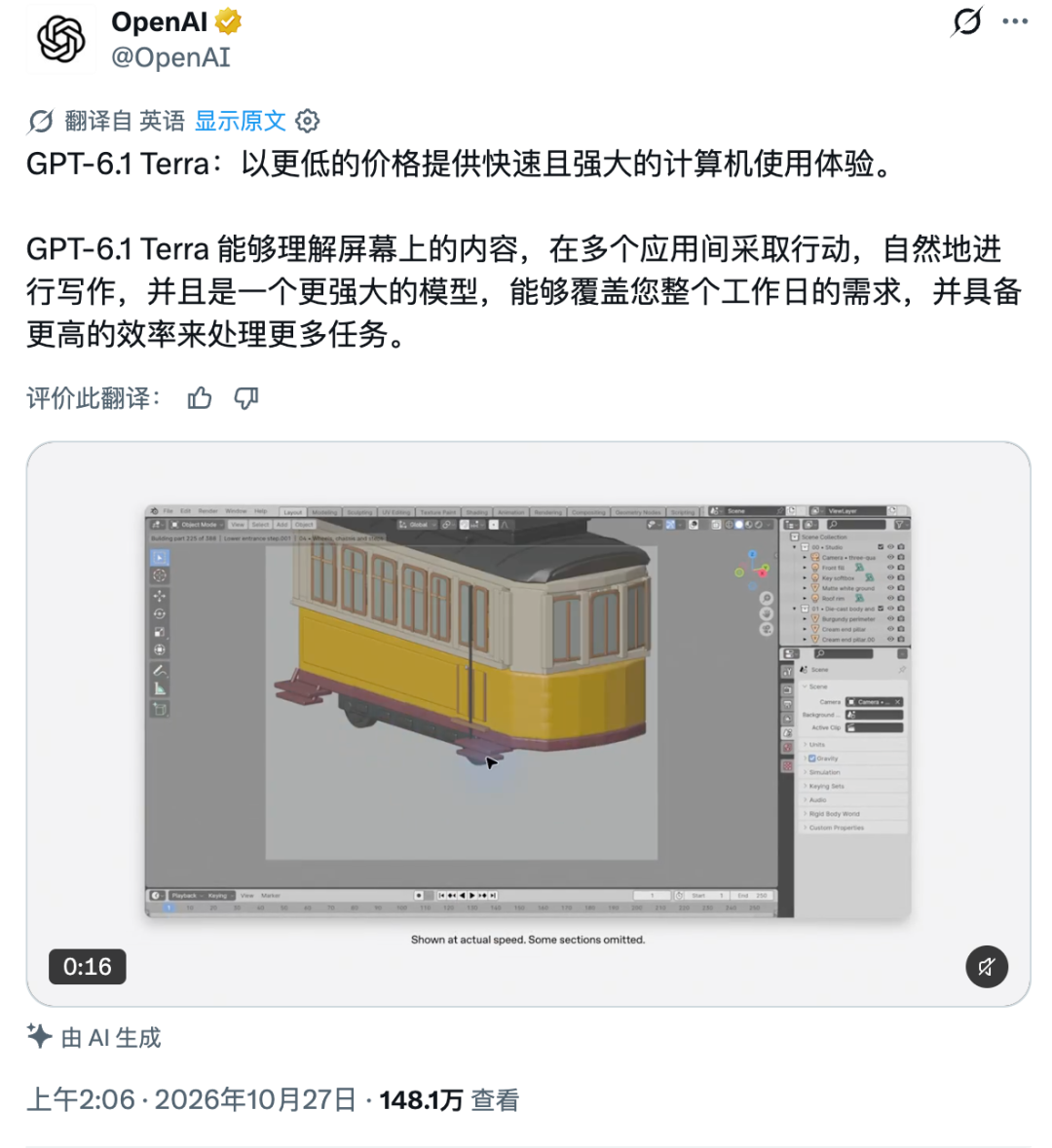
OpenAI, which was once following Anthropic, has also been turning frequently recently. On the one hand, it is turning to low-priced models. On October 26, OpenAI released a new generation of mid-range model GPT-6.1 Terra, which uses lower call prices and computer operation capabilities as important selling points.
On this side of the ocean, DeepSeek, which has always focused on cost-effectiveness, has raised its current financing plan several times. The latest news is that its new round of financing exceeds 100 billion yuan, and it has embarked on a bold path of expansion. A number of people familiar with the matter revealed to Phoenix Technology that DeepSeek's team has been expanding rapidly recently, and "the money raised must always be spent in reasonable places." The more financing, the more things DeepSeek has to do.
The global AI competition is becoming more intense than ever.
Anthropic, a commercial model, suffered a huge loss of US$80.7 billion
In the global AI industry, Anthropic has always been a representative frame of reference.
Unlike products that mainly rely on consumer traffic, Anthropic starts from programming and enterprise services and gradually establishes its own business path. Claude has accumulated users among the developer community, and enterprise customers purchase model capabilities through API calls, paid subscriptions, etc. A model is not just a chat window, but a production tool that goes into software development, knowledge processing, and business processes.
The appeal of this path is straightforward: enterprises are willing to pay for tools that can improve productivity, and high-value scenarios usually have clearer payment logic than ordinary consumer applications.
Especially in the field of programming, the value of AI is no longer just reflected in whether it answers questions accurately, but in its ability to complete code writing, debugging, testing and complex task execution. For enterprises, if the model can shorten the development cycle and reduce duplication of work, there will be a relatively concrete basis for payment.
When an AI track CEO communicated with Ifeng.com Technology, he believed that Anthropic is an important example of the AI business model. "Everyone initially discovered that AI coding has strong commercial transformation capabilities. This first came from Anthropic. Now Anthropic has started to make AI pharmaceuticals, and there will definitely be others to follow in the future."
But the quality of income and the quality of profits are two different things.
According to Reuters' review of Anthropic's prospectus documents, the company's operating loss in 2025 will be approximately US$8.06 billion, and its operating loss in the first half of 2026 will be approximately US$693 million. Its computing and infrastructure spending during the same period was nearly $9 billion, a significant increase from approximately $2.3 billion in the same period last year.
This means that Anthropic's business is indeed expanding rapidly, but the resource costs to support business expansion cannot be ignored.

Every Token sold by a model company is not generated out of thin air. Training requires computing power, and inference requires computing power. The expansion of user scale and increase in task complexity will also continue to increase the consumption of computing resources. Especially when AI moves from simple question answering to programming agents and complex task execution, the model may require more rounds of reasoning, calling tools, and repeated verification, and the cost structure behind a single task will also change.
Just because corporate customers are willing to pay does not mean that the business naturally has a high enough profit margin. If revenue growth requires continuous investment in more computing power to maintain, there may not be a simple positive correlation between scale expansion and profit improvement.
Another pressure Anthropic faces is its long-term computing power purchase commitment. Reuters reported that the company has signed large-scale cloud services, computing resources and infrastructure agreements with multiple partners, with related commitments exceeding US$500 billion in the next ten years.
Anthropic's business is not without progress. Instead, revenue growth and enterprise customer expansion suggest the market is paying for its model capabilities. But what puzzles the outside world is the business model itself. As model capabilities continue to improve, can inference costs decrease simultaneously? When more jobs are handed over to AI, can the price customers are willing to pay cover the full cost of models, computing power, and service delivery?
With the support of various "chain owners", there is always another way to open source
If Anthropic represents a route that starts from high-value scenarios and gradually builds commercial revenue, then another revelation that DeepSeek brings to the industry is that the cost itself can also become part of the model's competitiveness.
DeepSeek caused an early shock in the industry. One of the important reasons is that it made the market re-examine the cost of training and using large models. The outside world has focused on the performance of its model and the related disclosure of training costs. But for commercialization, what is more important than a certain training number is whether the low cost can be extended to model deployment, inference and actual use.
OpenRouter data shows that in terms of call volume, DeepSeek's model has ranked first on the platform's weekly list for three consecutive weeks. In addition, models such as minimax, Zhipu and Tencent have also long been among the top five platforms in terms of call volume.
DeepSeek's route provides a direction worthy of study: model capabilities are not limited to the implementation path of continuously increasing parameters and stacking computing power. Architecture design, training methods, inference efficiency, and resource scheduling may all affect the final unit cost.
More importantly, lower costs will change the way models get to market.
These will be two completely different development ideas.
The U.S. Department of Homeland Security recently ordered federal agencies to completely remove DeepSeek products and third-party services developed based on its models. DeepSeek almost simultaneously announced that it would fully open source its internal inference framework DeepInfer and be compatible with the two major computing platforms of NVIDIA and Huawei Ascend. Behind the dramatic comparison, it points to the same fact: DeepSeek has been placed in the front row of global AI competition, and the way it has chosen to respond is not to shrink, but to spread its technology base wider.
Recently, many media reported that DeepSeek is about to complete approximately 100 billion yuan in financing. Since September, the scale of this round of financing has been "chased up": the initial plan was 50 billion, which was raised to 80 billion midway, and finally fell to 100 billion. Including the first round of about 51 billion yuan in June, DeepSeek has attracted a total of about 150 billion yuan in half a year, and its pre-money valuation remains at 500 billion yuan.
The investment lineup is unprecedented. According to statistics from the self-media "The Tide of Money", this round of financing has brought together more than 20 investment institutions. Old shareholders in the previous round, such as IDG Capital, Shixiang Technology, Zhengxingu Capital, Monolith, CATL, Tencent and Guozhi Investment, continue to participate in this round of financing. New investors include China Mobile, China Telecom, China Life Investment, GigaDevice's Stony Brook Capital, SMIC Juyuan, Boyu Capital, CPE Yuanfeng, Gaorong Capital, Legend Capital, CITIC Investment, Meituan Longzhu, Hengdian Capital, Geely Capital and other institutions. It is also understood that this round of financing has attracted the indirect participation of a large number of listed companies and industrial capital, including Muyuan Co., Ltd., Zhihu, Century Huatong, Perfect World, Giant Network, Dahua Co., Ltd., etc. It is difficult to list all the participants.
It is not difficult to see that Liang Wenfeng attaches great importance to industrial value when choosing investors. For example, in terms of energy, it has solid reserves in the Ningde system and the GigaDevice innovation system that is closely tied to domestic memory chips.
In the face of huge investment, DeepSeek is also facing the trouble of "spending money". A person close to DeepSeek told ifeng.com that DeepSeek is planning a new growth route for investors, which includes massive expansion of the team.
As soon as the first round of financing of about 51 billion yuan in June was settled, DeepSeek issued a recruitment announcement on June 25, clearly proposing to "at least double the size of all departments" and open 33 positions at one time, covering seven major sectors: technology research and development, computing infrastructure, product implementation, cutting-edge algorithm research, and comprehensive functions. It even recruits data center infrastructure jobs in Ulanqab.
In September, Cui Tianyi, the leader of the DeepSeek Harness team, released about 150 recruitment quotas at one time on social platforms. In his original words, the demand was "unprecedented." DeepSeek is also generous when it comes to employee benefits. It is reported that DeepSeek offered an intern in the Yao Class of Tsinghua University a pre-tax daily salary of 5,500 yuan, and a monthly salary of more than 120,000 yuan; the monthly salary range for core system R&D engineer positions recruited by the school is between 60,000 and 90,000 yuan.
But Liang Wenfeng has always maintained simplicity and low-key. A person close to DeepSeek told ifeng.com that DeepSeek's offices are mainly in Beijing and Hangzhou, and Liang Wenfeng has been renting a house in Beijing for a long time, and the room layout has always been very simple.
Value for money begins to dominate everything
Among the many AI giants, OpenAI has always been the most swaying.
They initially pursued the upper limit of model intelligence, and once wanted to win the C-end market. They even fantasized about being a "WeChat in the AI era" to connect everything.
But in the face of huge losses and overtaken revenue, OpenAI once again learned from Anthropic and conquered the field of AI coding in order to achieve better commercialization.
Nowadays, OpenAI’s approach is becoming more and more DeepSeek. On September 23 this year, GPT-6 Sol and Luna were released at the same time. Luna’s API input price was hit to US$0.1 per million tokens, which is a floor price.
On October 7, half a month later, OpenAI pushed Luna directly to free users, covering the entire ChatGPT population; paying users received Sol, and free users received Luna.
GPT-6.1 Terra, released on October 26, is positioned in OpenAI’s mid-range model series, focusing on computer operations and daily office tasks. Its API standard price is 50% lower than the previous generation GPT-5.6 Terra; OpenAI also claims that in some task tests, Terra can complete the work at a cost far lower than the flagship model.
However, some people in the industry believe that "OpenAI is still in the swing stage. It can be seen from the fact that they are making embodied intelligence models. Compared with Anthropic, OpenAI is often very swingy, but it will soon be educated by the market and do profitable business."
After all, the volume of the large model market is obvious to all. If you cannot continue to establish advantages and make a good homepage, it will soon be short-lived.
Comments