
Abstract:
Today is such a lively day. Anthropic filed for an IPO over there, and OpenAI released its latest model GPT-6.1 Terra. Its positioning is to "provide fast and powerful computer operation capabilities at a lower price", combining detailed visual reasoning, precise computer operation capabilities with clearer and more natural writing performance.
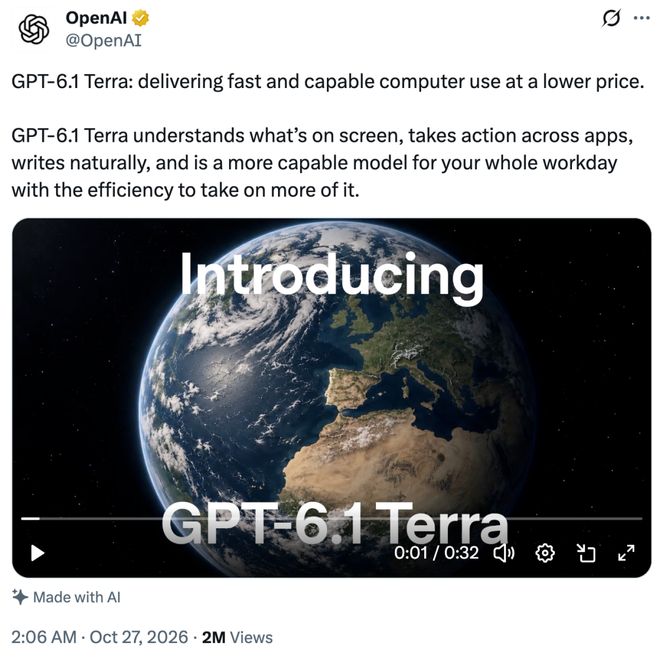
Sam Altman said excitedly, "GPT-6.1 Terra will open a new era of computer operation."

Compared with GPT-5.6 Terra, GPT-6.1 Terra's capabilities have been significantly improved. It is especially good at handling communication and computer operation tasks in daily work, from drafting proposals and interpreting technical drawings to filling out forms and editing videos.
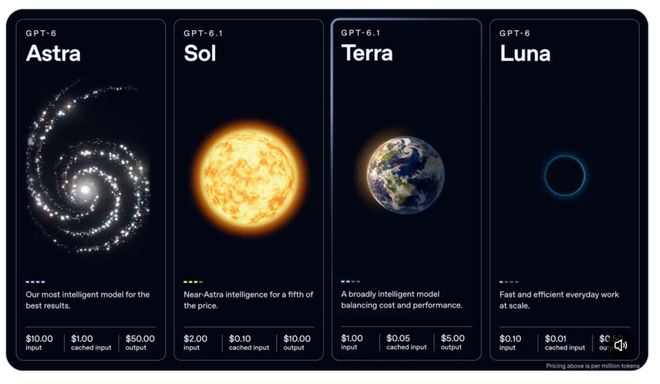
Terra continues to expand the balance between smart performance and cost across its model lines, providing users with a better combination of speed, power and price. Its standard API pricing is as follows:
Input Token: 1 USD per million
Cached input token: $0.05 per million
Output Token: $5 per million
Standard API price is 50% lower than GPT-5.6 Terra and GPT-6.1 Sol. This allows developers to automate large tasks at a lower cost, such as reading incoming invoices and entering the relevant information into accounting software.
Starting today, GPT-6.1 Terra is available in ChatGPT Work and Codex to all Plus, Pro, Enterprise, and Edu users. Developers can also call the model through the OpenAI API, and the model ID is gpt-6.1-terra.
In addition, using GPT-6.1 Terra in ChatGPT Work and Codex can also make your plan quota play a greater role. With the same amount of usage, more tasks can be completed than GPT-5.6 Terra; compared with GPT-6.1 Sol or GPT-6 Astra, the number of tasks that can be completed will be much higher.
From visual understanding to practical operation
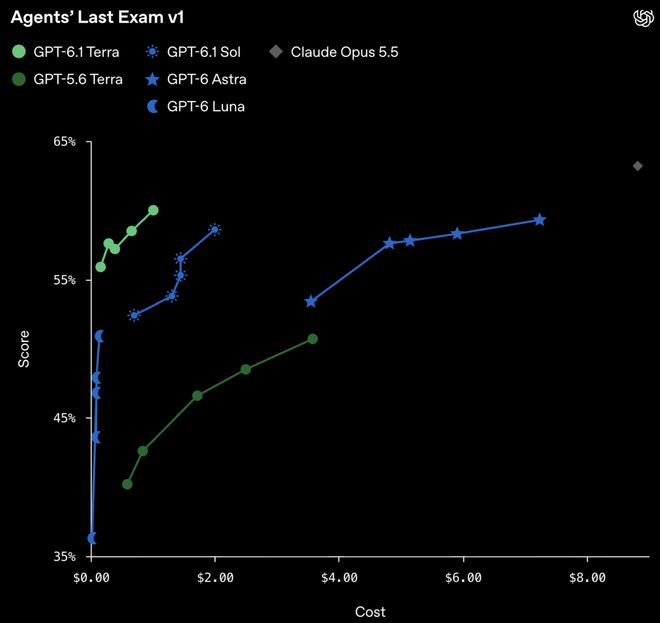
OpenAI uses the Agents' Last Exam benchmark to evaluate GPT-6.1 Terra's computer capabilities. The benchmark covers specialized tasks such as creating 3D models from architectural drawings and reviewing animated footage shot-by-shot to produce a timecoded record for the restoration team.
At medium inference intensity, GPT-6.1 Terra scores 15 percentage points higher than GPT-5.6 Terra at about one-third the cost. Even compared to GPT-6 Astra, its performance is comparable, but the price per token is only one-tenth of the latter.
At the highest inference intensity, Terra's token usage efficiency is more than three times that of Claude Opus 5.5, and the price of each token is only one-quarter of the latter. Therefore, the cost of completing the same task can be reduced to about one-ninth.
Terra also runs much faster, completing tasks more than three times faster than GPT-6 Astra and GPT-6.1 Sol.
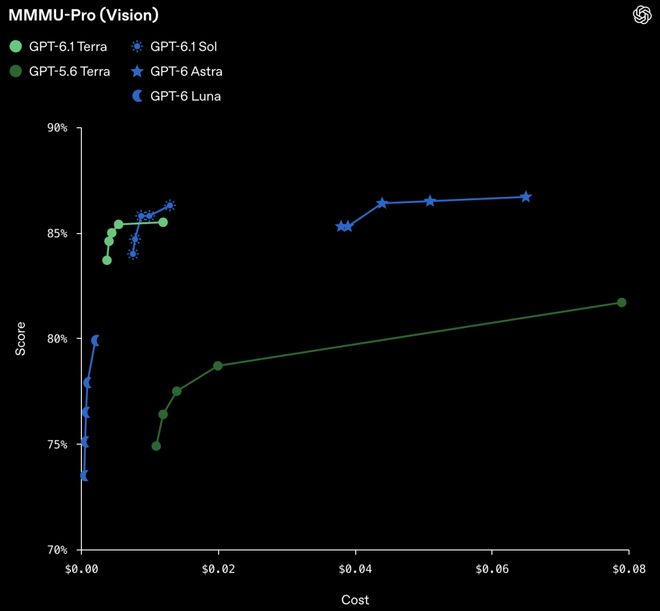
On the visual inference benchmark MMMU-Pro, GPT-6.1 Terra outperforms GPT-5.6 Terra at all inference strength settings. It scores even close to OpenAI’s most capable cutting-edge models, GPT-6 Astra and GPT-6.1 Sol, but at a much lower cost.
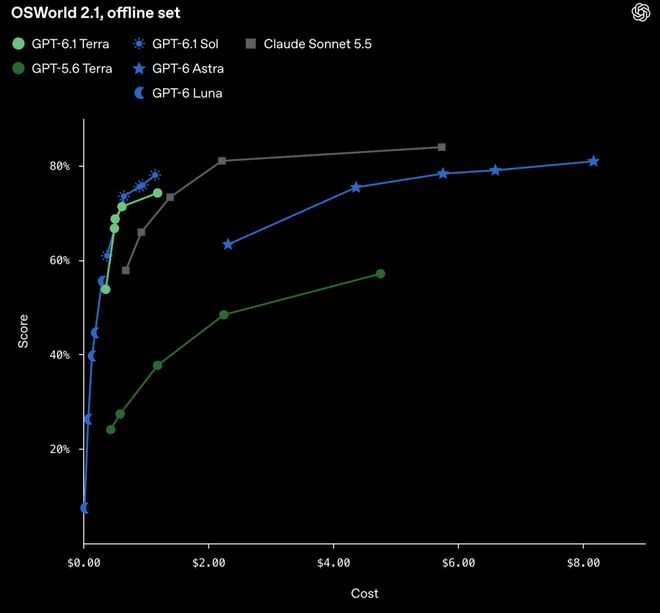
OSWorld 2.1 is used to test whether an AI agent can operate a desktop application to complete multi-step tasks, such as creating 3D models from technical drawings. At moderate inference intensity, GPT-6.1 Terra already outperforms the best performance of GPT-5.6 Terra at a much lower cost per task.
Significant improvement in factual accuracy and programming capabilities
This year, OpenAI has put a lot of effort into reducing hallucinations and factual errors in its models.
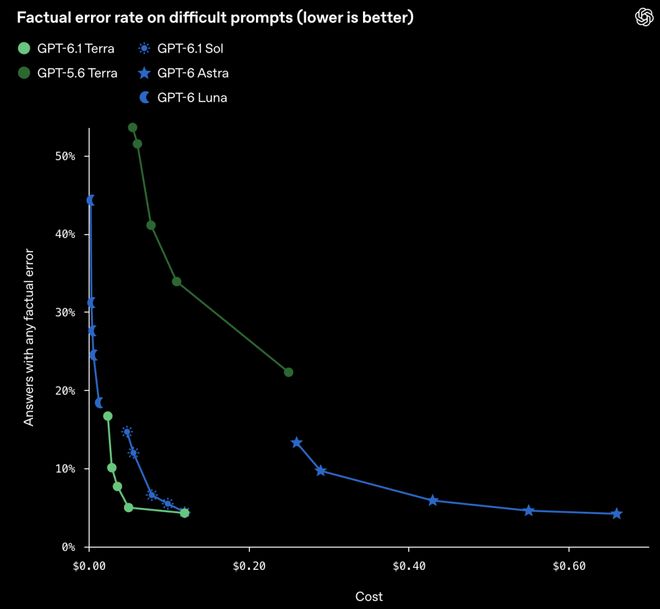
On its in-house designed, error-prone prompt word benchmark, GPT-6.1 Terra's error rate dropped by nearly 37 percentage points from GPT-5.6 Terra's 53.6% to 16.7% at low inference intensity.
At the highest inference intensity, the error rate also dropped by 18 percentage points to 4.3%, which is very close to the error rates of GPT-6 Astra and GPT-6.1 Sol.
The software engineering capabilities of GPT-6.1 Terra have also been greatly improved compared to GPT-5.6 Terra.
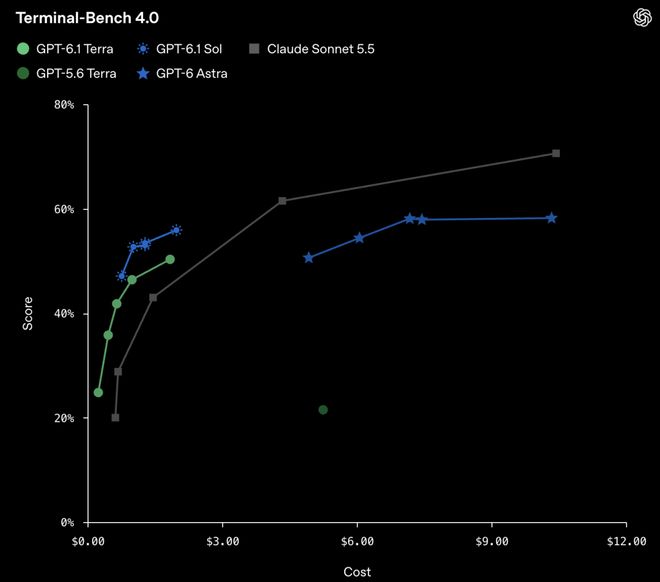
Terminal-Bench 4.0 is used to test the ability of programming agents to solve problems through the command line, such as fixing a web page whose layout shifts when the page is loaded. At the highest inference intensity, GPT-6.1 Terra is able to solve 50.3% of the tasks, more than double GPT-5.6 Terra’s published score of 21.5%. For the most complex programming tasks, GPT-6.1 Sol and GPT-6 Astra are still the better choices.
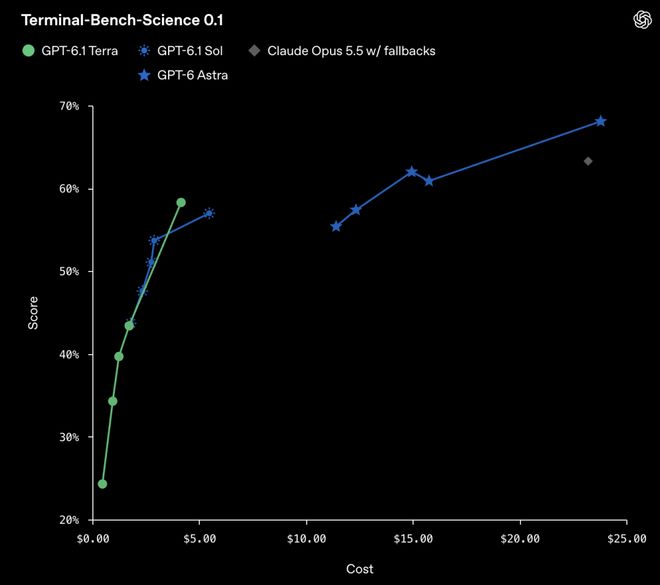
Terminal-Bench-Science 0.1 is used to test whether an agent can complete scientific research tasks by writing and running code, such as tracking cell division in a time-lapse video.
At the highest inference intensity, GPT-6.1 Terra outperforms GPT-6.1 Sol while costing less. It scores within 5 percentage points of Opus 5.5 at an estimated cost of less than one-fifth as much.
Security and Alignment
While making powerful AI more efficient and easier to use, we are also continuing to train, test and improve security protection mechanisms.
According to OpenAI’s Preparedness Framework, GPT-6.1 Terra reaches a “Critical” level capability threshold in the field of network security, while retaining the security protection measures developed for GPT-6 Astra.
GPT-6.1 Terra also inherits the alignment improvements of the GPT-6 series. According to reviews, compared with GPT-5.6 Terra, GPT-6.1 Terra is more likely to limit operations to the scope specified by the user and truthfully inform users of their own capabilities limitations and possible obstacles.
In the prompt word injection test, GPT-6.1 Terra also showed strong resistance to attacks that try to divert the model away from the user's original task through malicious instructions.
Please see the model card for model details:
Model card address: https://deploymentsafety.openai.com/gpt-6-1-terra/gpt-6-1-terra.pdf
Blog address: https://openai.com/index/introducing-gpt-6-1-terra
Comments