
Abstract:
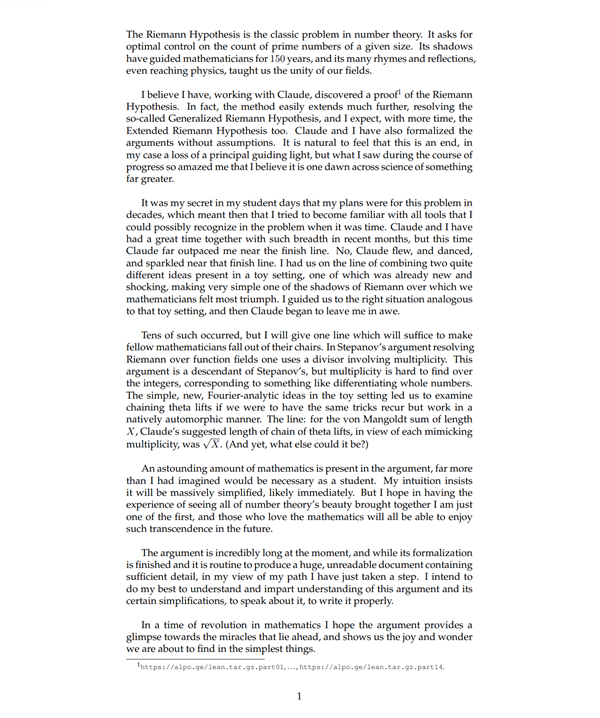
Recently, the world of mathematics has ushered in a major breakthrough that may have historic significance. The Riemann Hypothesis, a world-class mathematical problem that has troubled mankind for 167 years, is expected to be overcome with the assistance of artificial intelligence. On November 20, mathematician Levent Alperger of the AI company Anthropic issued a statement on his personal website,
stating that with the assistance of the large AI model Claude, he had found a method to prove the Riemann Hypothesis and its generalized form, the Generalized Riemann Hypothesis.
This news quickly attracted the attention of the global mathematics community.
According to the Beijing News, Qiu Chengtong, a famous mathematician, dean of Qiuzhen Academy at Tsinghua University, and Fields Medal winner, responded to this.
Qiu Chengtong said:
"This is a great contribution. It can also be said to have shocked the whole world. It means that mathematics has entered a new era."
In Qiu's view, artificial intelligence will become an indispensable part of scientific research in the future, but how to determine valuable research directions and raise important questions still requires human creativity.
He hopes that young scholars, especially young Chinese mathematicians, can develop their own theories on this basis. This is also an important opportunity for further development of Chinese mathematics research.
It is understood that Alperger did not publish a complete mathematical paper in the traditional form this time, but instead published about 17 million lines of Lean formal proof code.
According to him, the draft natural language proof generated by Claude during the research process exceeds 250,000 pages.
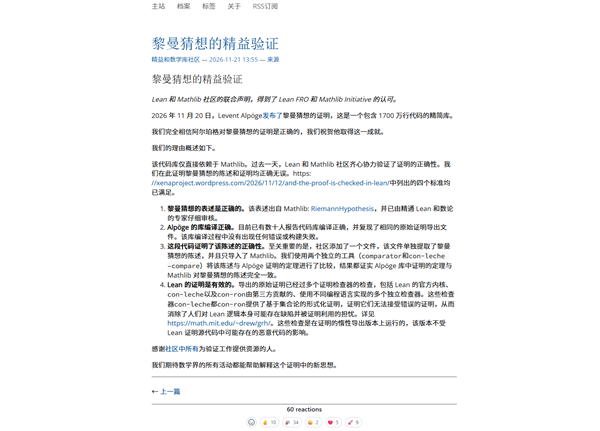
On November 21,
Lean and the Mathlib community issued a joint statement confirming that the propositional statement and formal proof of the Riemann Hypothesis are correct.
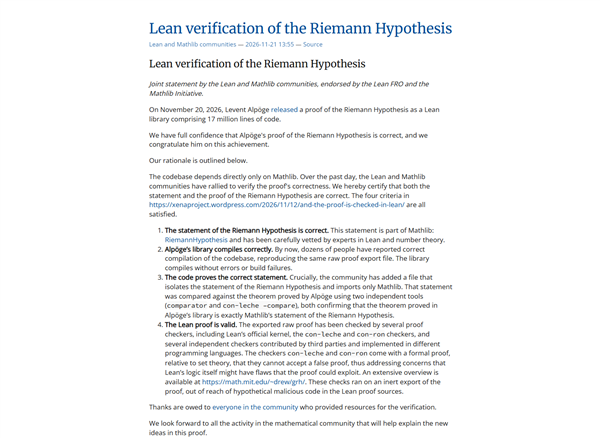
However, the mathematical community still needs to further understand and study its proof process.
As of now, the official website of the Clay Mathematics Institute still lists the Riemann Hypothesis as an unsolved mathematical problem.
So, what exactly is the Riemann Hypothesis, and why has it attracted so much attention from the global mathematics community?
The Riemann Hypothesis was proposed by the German mathematician Bernhard Riemann in 1859. It is one of the most important mathematical problems in the field of modern number theory. Its core involves the distribution of prime numbers.
The so-called prime number refers to a natural number that is greater than 1 and has only two positive factors, 1 and itself, such as 2, 3, 5, 7, 11, etc.
Prime numbers are the basic elements that make up integers, but their distribution seems messy. How to accurately describe the distribution of prime numbers has always been an important research topic in the mathematical community.
By studying the Riemann ζ (Zeta) function, Riemann discovered that it has a profound connection with the distribution of prime numbers, and proposed that the real part of all non-trivial zero points of this function is 1/2.
If the Riemann Hypothesis is proven, humans will be able to describe the distribution of prime numbers more accurately and promote the development of number theory and related mathematical fields.
In 2000, the Clay Institute of Mathematics in the United States listed the Riemann Hypothesis among the seven millennium mathematical problems and set a reward of up to US$1 million for it.
If the proof completed with the assistance of AI is finally recognized by the mathematical community, it will not only become a milestone in the history of mathematics, but also open up a new path for artificial intelligence to participate in basic scientific research.
Comments