
Abstract:
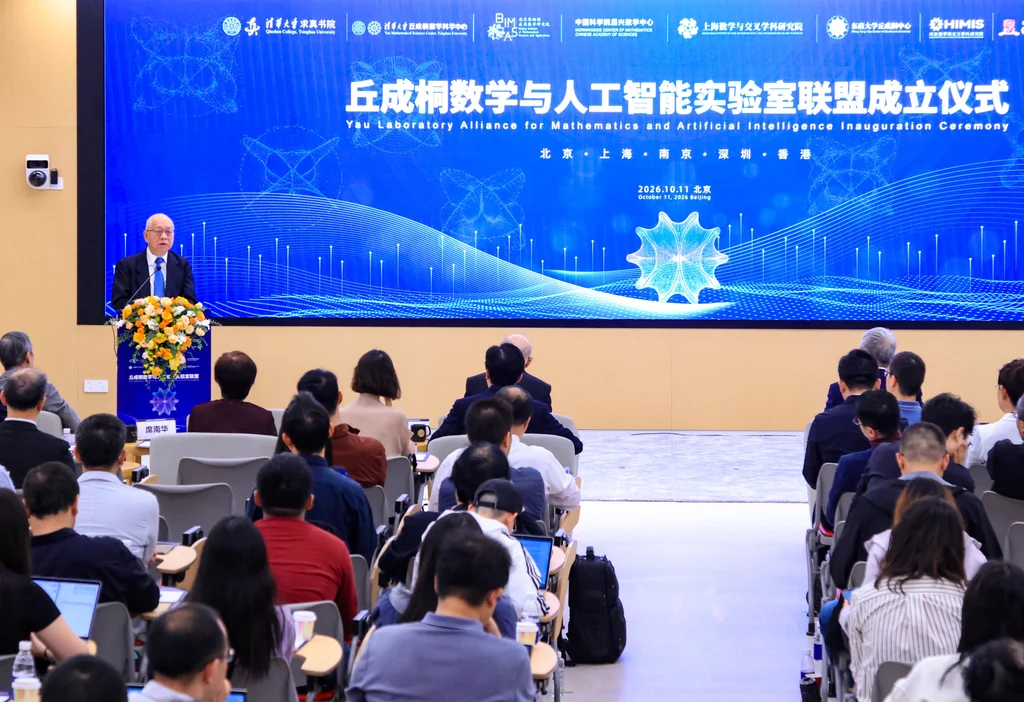
The Yau Mathematics and Artificial Intelligence Laboratory Alliance was established at Tsinghua University on October 11. It plans to bring together about 1,000 mathematicians and researchers to promote the integration of artificial intelligence, mathematics and interdisciplinary research. Fields Medal winner and Tsinghua University Chair Professor Qiu Chengtong serves as the leader of the alliance. He said that China still lags behind the United States in using AI to promote cutting-edge science, and its domestic scientific research capabilities on large models are not yet at the world's leading level. The alliance hopes to integrate talents and resources to independently develop special models for mathematical sciences.
The alliance is jointly established by eight institutions, including Qiuzhen Academy of Tsinghua University, Yau Shing-tung Mathematical Sciences Center of Tsinghua University, Beijing Yanqi Lake Institute of Applied Mathematics, Morningside Mathematics Center of the Chinese Academy of Sciences, Shanghai Institute of Mathematics and Interdisciplinary Studies, Southeast University Yau Shing-tung Center, Hetao Institute of Mathematics and Interdisciplinary Sciences (Shenzhen), and Zhizhen Institute of Interdisciplinary Mathematics of the Chinese University of Hong Kong. The first mathematics and artificial intelligence laboratory is located at Tsinghua Qiuzhen Academy and is jointly established with the Yau Mathematical Science Center; the alliance also plans to build laboratories in Beijing, Shanghai, Nanjing, Shenzhen and Hong Kong to collaborate by sharing model training resources, formal mathematics libraries and computing power platforms.
The current focus of the alliance includes the development of large mathematics-specific models, the use of AI to assist conjecture discovery and formal proof, the development of explainable artificial intelligence, and the promotion of the intersection of mathematics and quantum computing, life sciences, finance and other fields. The alliance also plans to carry out talent training and international cooperation, and establish the "Journal of AI-Assisted Mathematics". The establishment event announced more than ten research results and directions, involving geometry, quantum computing, life sciences, as well as mathematical problems such as degenerate Arnold conjecture and Sylvester conjecture. The maturity of these projects is not the same. Some are research directions and cannot be regarded as completed and peer-reviewed results.
One case that has attracted attention is the cooperation between Tsinghua Yau Mathematical Science Center and Shanghai Institute of Mathematics and Interdisciplinary Studies to study seven-dimensional homotopic spheres. The research paper, currently available as a preprint, reports that smooth seven-dimensional homotopic spheres for all 28 classes of oriented diffeomorphisms construct Riemannian metrics with strictly positive cross-section curvature. According to the alliance, AI helps the team explore proof strategies and simplify calculations; the computational algebra system is used to verify identities and interval bounds, and generate reproducible calculation certificates. The research conception, proof and final demonstration are still undertaken by mathematicians, so this result is not independently proved by AI.
AI’s ability to generate mathematical results in batches has also triggered discussions on academic standards. Xi Nanhua, academician of the Chinese Academy of Sciences and chairman of the Chinese Mathematical Society, pointed out that the pace of companies releasing AI-generated results conflicts with the tradition of rigorous verification and peer review in the mathematics community, and erroneous content that has not been fully tested may leak out; he believes that the mathematics community and the AI industry need to jointly establish rules recognized by all parties. Recently, OpenAI has disclosed a batch of mathematical manuscripts and proof materials generated by internal models. Its official warehouse currently lists 719 manuscripts, divided into 372 groups, and explains that the results are in different stages of verification. About 42% of the main results have been formalized by Lean, and there may still be problems with the results that have not yet been formalized. This also highlights that in addition to improving exploration efficiency, AI-assisted mathematical research must also solve the problems of verification, reproduction and responsibility attribution.
Qiu Chengtong believes that AI can generate a large number of proofs and calculation results, but raising insightful new questions and forming mathematical intuition and creative judgment are still important roles of human researchers. After the alliance is established, how to transform large model capabilities into verifiable mathematical discoveries and establish matching academic standards will be the key to its subsequent work.
Comments