
Abstract:
On August 30, local time, OpenClaw released its largest update to date, officially launching OpenClaw 2.0. This update was completed by 933 contributors, 569 of whom were first-time contributors to the project, and included a total of more than 16,000 pull requests. The full release notes have been made public simultaneously.
Visit:
https://docs.openclaw.ai/start/getting-started

This update covers almost all parts of OpenClaw, including installation, messaging, memory, skills, models, automation, browser and native applications, plug-ins, and security mechanisms. It also fixes a large number of long-standing issues. The project team initially only wanted to simplify the installation process and rebuild the browser application into a first-class user experience. However, to truly do these two things, the cleanup and transformation work must be extended to other parts of OpenClaw, which ultimately led to the birth of OpenClaw 2.0.
This update took nearly two months. Previously, OpenClaw released 106 versions in 230 days, and most versions were only one or two days apart. Therefore, no new version was released for nearly seven weeks and it was not in line with the project's usual rhythm. While releases have slowed, development progress has actually sped up significantly. As the team scale expanded, the workload and advancement speed exceeded the carrying capacity of OpenClaw's original infrastructure and existing release process, so the team redid the product foundation and delivery process at the same time.
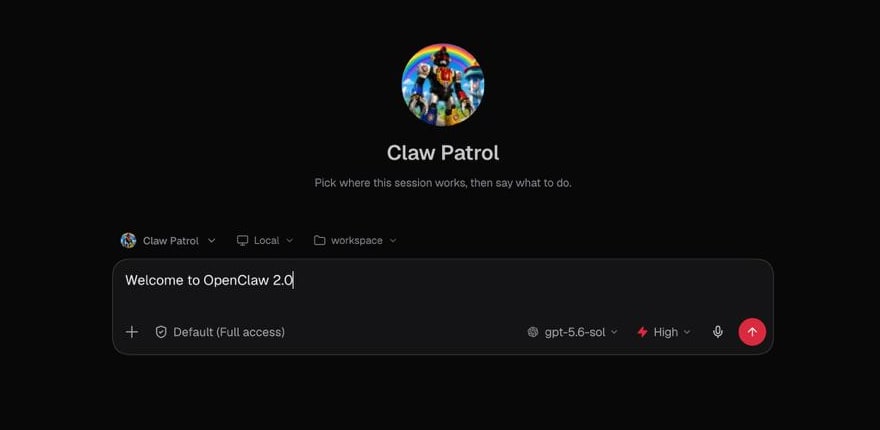
The increase in development speed culminated in an extremely large version update, with approximately half of all merged pull requests in the project's history concentrated in this release. Therefore, the team invested extra time to ensure that the new version is suitable for both new users who are starting to use OpenClaw from scratch and users who are upgrading existing Claw, so as to avoid problems with the original functions or usage environment caused by the pursuit of rapid release.
To allow users to have a truly useful Claw faster is the primary goal of this transformation. The installation process is considered to be the link that needs to be simplified most, so for the first installation, OpenClaw will give priority to using the resources already on the user's computer, including existing ChatGPT or Claude subscriptions, API keys, and local models. The team has deleted or simplified a large number of configuration steps and moved the remaining settings out of the initial installation process to allow users to start the first conversation more quickly; subsequent configuration can be completed step by step through communication with Claw.
The browser app is often where users come into contact with OpenClaw and have their first conversation, so the team completely rebuilt it to make it a first-class entry point. From there, users can continue completing setup, return to work in progress, or follow task progress in real time if needed. The rebuilt browser application will directly open the conversation interface with Claw.
A useful Claw doesn't need to be complicated. A simple workflow can be enough to generate real value: For example, let Claw monitor the inbox for your child’s school emails and send users reminders via Telegram whenever important information such as assignment due dates or upcoming events are discovered. It only requires checking an inbox, identifying a few important items, and sending the results to a fixed location, which is practical enough.
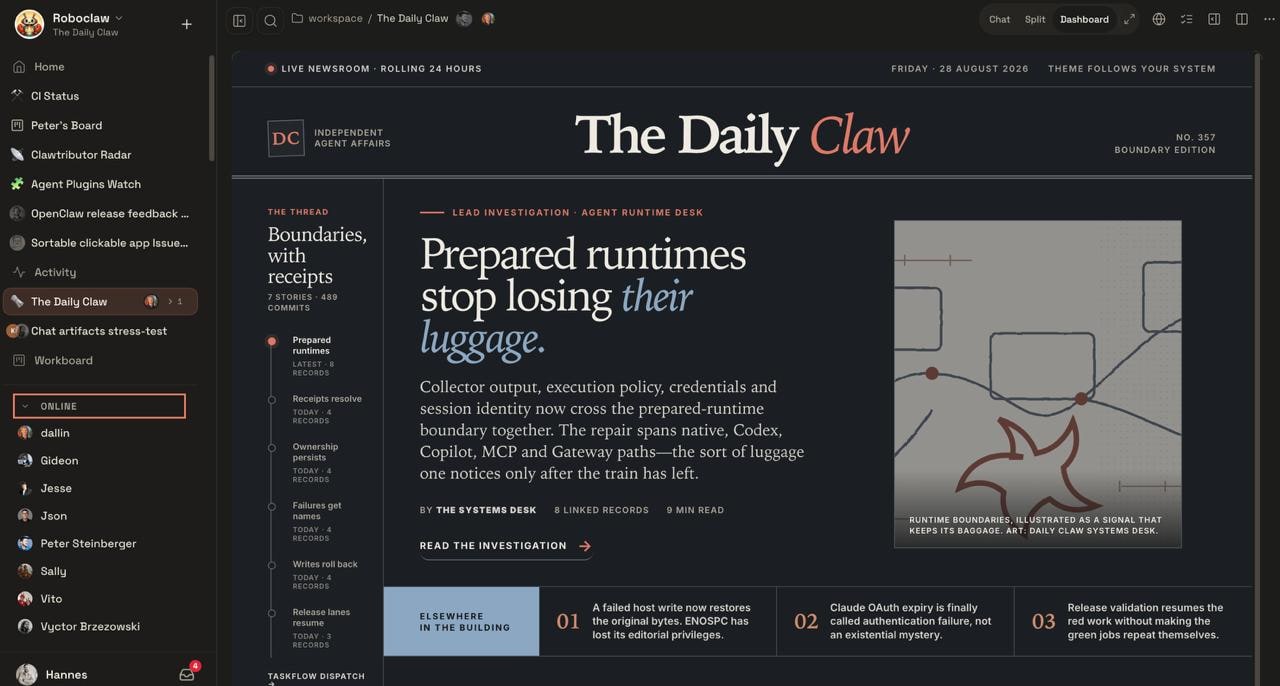
On this basis, tasks can be naturally extended to more scenarios without becoming more difficult to use. For example, the user's brother asked via iMessage which iPad to buy for his father. Users no longer need to search for receipts in emails. They only need to tell Claw that Brother Claw has just sent a message, and then ask Claw to find the answer and send the result to the other party. Claw can directly complete the entire process.
During the development of this version, the OpenClaw team also experienced similar changes within the team. As teams increasingly use their own Claws to complete work, they begin to want to share tasks, collaborate on tasks, and sometimes even hand over complete tasks to other members. However, in the past OpenClaw was unable to add other team members to the same job without losing information that Claw already had.
Shared cloud sessions solve this problem and enable multi-person collaboration in OpenClaw. Now, team members can join live work or hand off tasks to others while retaining full context. The OpenClaw team is currently leveraging this multi-person collaboration model to jointly develop OpenClaw.
Overall, the use of OpenClaw can start with a useful workflow and continue to expand according to the user's needs. It can be gradually connected to more areas of the user's life and work, and can be used with family or teams when the user needs it. The project team believes that this model has changed the relationship between people and software: software is no longer just a product designed by others somewhere and that users can only passively accept, but a tool that can act according to the user's instructions, adjust around personal life and work, and is truly owned by the user.
The OpenClaw team stated that they are not trying to sell a certain product here, nor are they asking users to entrust their future to a certain company, a certain model or a certain artificial intelligence service provider. Since OpenClaw is an open source project, it belongs to the people who use it and participate in building it. The team invites users to use OpenClaw, builds projects with them, and directly calls out problems when projects go wrong.
Comments