
Abstract:
After Google’s latest education product policy caused widespread controversy, DuckDuckGo, a search engine focusing on privacy protection, quickly seized the opportunity and began to actively promote its services to schools across the United States in an attempt to gain more share in the education market that has long been dominated by Google.
The incident originated from the new management policy recently launched by Google for K-12 education users. According to relevant arrangements, schools can turn off artificial intelligence tools such as Gemini, but if they completely refuse to enable AI functions, student accounts will also lose access to Google search services. Google believes that search and artificial intelligence capabilities have been deeply integrated, so it cannot provide a separate search version that completely strips away AI functions.
This decision quickly triggered discussions in the education community and the public. Many teachers and school administrators believe that students still need traditional search tools in the learning process, rather than AI directly giving answers. Critics worry that overreliance on AI-generated content could undermine students’ ability to conduct independent research and critical thinking.
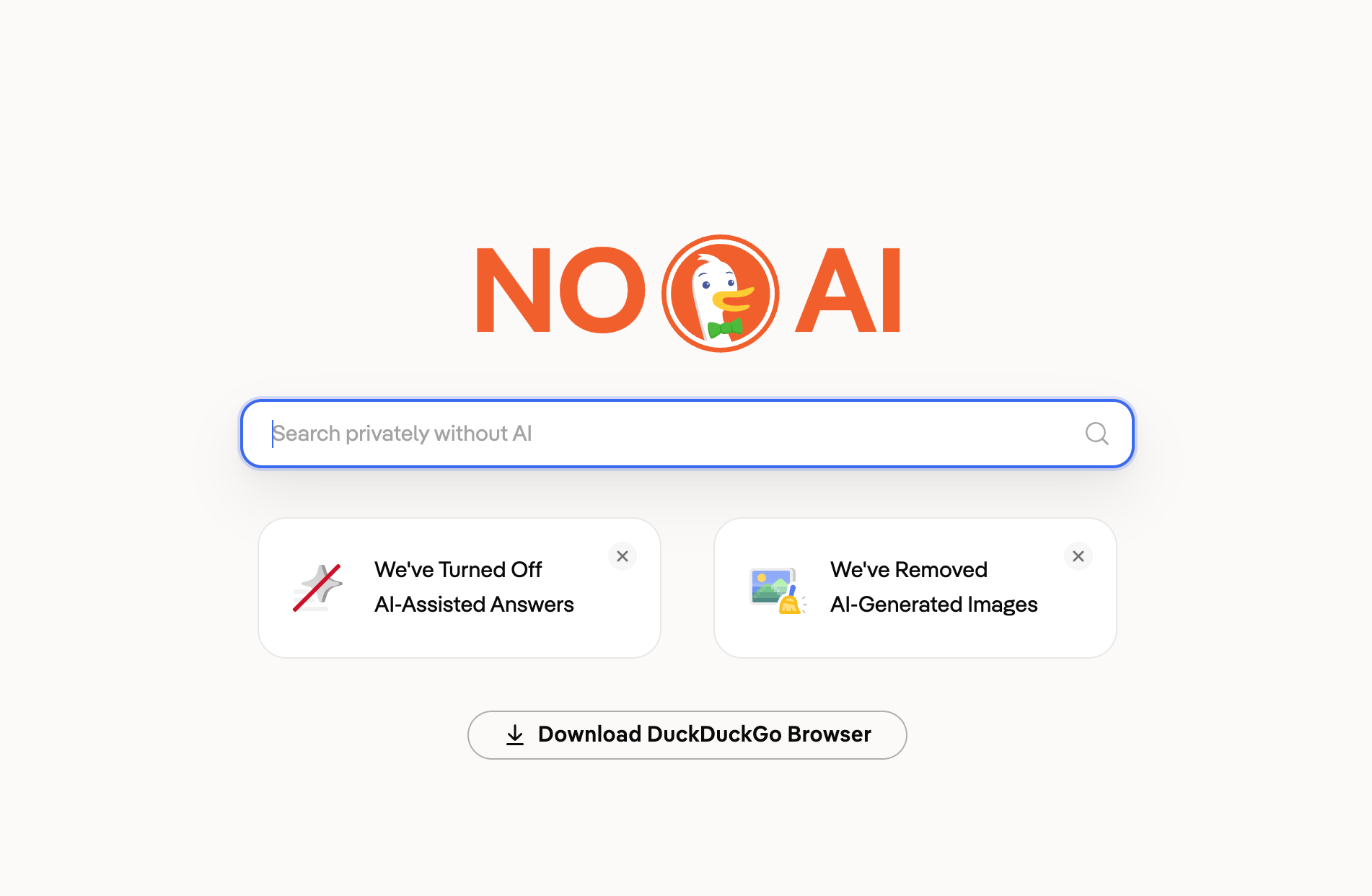
Faced with controversy, DuckDuckGo publicly extended an olive branch to schools. Company founder and CEO Gabrielle Weinberg posted on social media to introduce schools to how to set DuckDuckGo as the default search engine, and expressed that the company is willing to provide migration and deployment assistance to educational institutions.
Camille Bazbaz, Chief Public Affairs Officer of DuckDuckGo, issued a more direct criticism. He said that forcing students to accept artificial intelligence capabilities is a typical behavior of market dominance, and called on schools to prove through practical actions that they still have the right to choose.
DuckDuckGo further stated in an interview with the media that Google is fully capable of providing schools with a search version that does not include AI functions, but it is unwilling to do so. The company believes that students do not need AI summarization, chatbots or automatically generated content to complete basic information retrieval and academic research.
In order to attract educational users, DuckDuckGo emphasizes that its search engine can provide a more traditional search experience. Users do not need to receive AI-generated summaries, nor are they forced to use smart chat tools. At the same time, DuckDuckGo allows users to freely turn on or off AI-related functions without losing the search service itself.
In fact, this controversy also reflects the current general disagreement about artificial intelligence tools in the education community. On the one hand, more and more students and teachers have integrated AI into their daily learning and work processes; on the other hand, many educators still hope to maintain a learning environment that is not affected by generative AI.
Google has previously launched a new feature called "Guided Learning", hoping to alleviate the education community's concerns about AI by gradually guiding students to think and solve problems instead of directly providing answers. However, for some schools, what they really want is the option to turn off AI functions completely.
As the controversy continued to ferment, Google provided further explanations. The company says the new policy is designed to give schools more control, not less choice. According to Google, Gemini, Gemini Notebook and related AI functions will be turned off by default in the future, and schools can enable them one by one according to their own needs.
However, for those schools that want to retain search capabilities while completely excluding AI content, the problem has not yet been fundamentally solved. It is against this background that DuckDuckGo is trying to establish itself as an alternative to the education market. As more and more schools re-evaluate the role of AI in the classroom, the search engine, long known for its privacy and decentralization concepts, also sees a rare opportunity to challenge Google's education dominance.
Comments