
Abstract:
Cleverly CEO Nicholas Verity, who runs a business in Los Angeles, has been advertising on Google for seven years. About eight months ago, he noticed an anomaly in Google search advertising: He set aside about $2,000 in Google advertising budget every day, but part of it was always unspent—there was not enough traffic to browse and click on the ads, and the budget could not be exhausted.
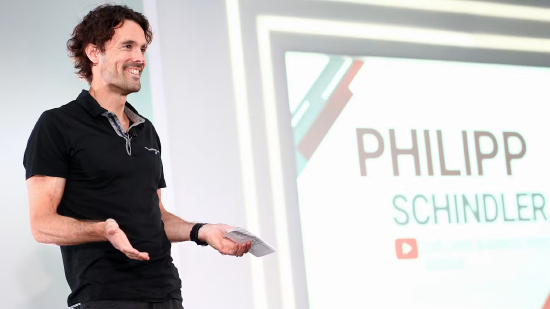
Google Chief Commercial Officer Philip Schindler.
He believes that the root cause is that more and more people are using AI chatbots to conduct information research online. "I originally wanted to invest more money in Google, but I feel that this part of the search traffic has been diverted to the scenario where everyone uses large models to conduct their own research."
For more than two decades, relying on its search engine monopoly and built-in automated advertising system, Google has built one of the most profitable advertising businesses in history. But now Google's own AI layout is eroding this business, putting growth under pressure; at the same time, Meta's advertising revenue has grown more than twice as fast as Google's search advertising, and OpenAI has also begun to enter the advertising market.
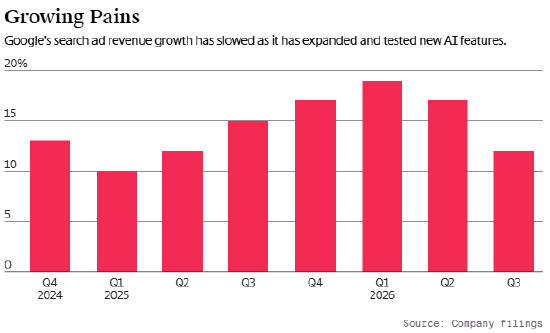
On October 29, the day after Google’s earnings report was released, Alphabet’s stock price fell nearly 13%. The financial report shows that the full-year search advertising growth rate in the third quarter fell to 12% from 17% in the second quarter. Chief Commercial Officer Philipp Schindler said that the slowdown in growth is partly due to
AI Mode
The monetization ability is weak. This is Google’s search AI version of ChatGPT. Google did not separately disclose the advertising revenue contributed by AI functions and traditional search, but the decline in growth rate shows that when users use AI mode, Google makes less money than traditional search.Before the release of this quarterly financial report, Google had already launched AI summary and AI dialogue functions on a large scale as an alternative to traditional search, and it continued to experiment with advertising delivery forms in these functions. Other companies have experienced similar pain when launching new products. When Meta launched the Reels short video function to compete with TikTok in February 2022, advertising growth also suffered a setback. However, the following year it attracted advertisers through discount policies and AI tools, and advertising revenue growth rebounded. As the use of AI models and AI summaries continues to rise, Google’s advertising growth may also see a rebound.
Google management has been trying to reassure investors and advertisers by emphasizing the opportunities in AI. Google uses AI to determine which search terms are suitable for triggering ads, determine the landing page after users click on the ads, and automatically generate different versions of creatives.
Under the table, Google is negotiating cooperation and evaluating potential acquisitions, hoping to make advertising in AI scenarios more valuable.
Even so, six advertisers and agencies said that many advertisers have been disappointed and began to shift their budgets to other platforms, including Meta. Like Google, Meta also provides automated creative tools to help conversions, but the ads placed by Meta's new AI products (such as the Muse agent) will not compete with the main information flow ads; its ads are displayed next to short videos and social updates.
Farhad Difcha, CEO of marketing agency AccuraCast, who is responsible for purchasing ads for multiple brands, said: "This year, real viable options outside of Google have emerged on the market, such as ChatGPT ads and Meta. We will reallocate budgets based on delivery results."
Great changes in the industry
Google will launch AI Overviews in May 2024, which is AI-generated content displayed above the search results. The AI mode was launched after nearly a year, and the two products started to receive advertisements only a few months after they were launched. Traditional web search ads rely on keyword placement, while ads in AI summaries and AI modes are no longer bound to keywords, but are displayed together with long prompt words and multiple rounds of dialogue. Advertisers can neither purchase Google AI search scene ads separately, nor can they choose not to run ads within the AI function.
AI summaries and conversational bots are one of the biggest changes in the search industry since the shift from desktop to mobile in 2016, and they also bring a risk: AI may cannibalize Google’s $224.5 billion annual search advertising business.
However, for several consecutive quarters, Google's search advertising revenue did not show weakness at first. But as usage of Google’s AI features increases, search revenue growth begins to slow.
On the one hand, the slowdown in growth is due to Google's deliberate control of advertising density to avoid excessive advertising and inconsistent advertising formats that will discourage AI search users; on the other hand, it is also a period of pain for new products - Google is still exploring how to place ads in conversation scenes and set billing methods, rather than continuing to use the keyword advertising model.
A Google spokesperson said in a statement: "We adopt a prudent strategy and prioritize creating the best user experience, which lays a long-term solid foundation for customers and our business. Our advertising experiments in AI summaries and AI models have made good progress, and are now being monetized at scale, using advertising formats that can bring verifiable return on investment to advertisers."
Google's advertising business faces a core problem: users' behavior habits when using AI functions are completely different from web search. Google said that the prompt words entered by users in AI mode are about three times longer than traditional searches, with richer contextual information and deeper questions. For example: users will search for "Which tent is best for a week-long hike in the Sierra Mountains in September" instead of simply searching for "tent."
Optmyzr is a Google advertising management software manufacturer. Its CEO Fred Valais has worked in Google's advertising department for nearly ten years. He said that this kind of browsing habit means that users are often not ready to place an order, and the probability of clicking on an advertisement and completing a transaction after clicking is lower.
Valais calculated based on 21,000 advertising accounts hosted by Optmyzr (a large number of which are small and micro business accounts): in the third quarter, the transaction conversion rate of ad clicks on Google's entire platform (including search) fell by 1.4% compared with the second quarter; the return on advertising expenditure (revenue per dollar invested in advertising) fell by 2.9%, which was the second consecutive quarter of decline after falling by 3.8% in the second quarter.
Advertisers have reported that Google displays fewer ads in AI mode than in traditional search. In the past year, this has pushed up the cost per click: there have been fewer ad spaces, but the number of bidding advertisers has remained the same, and Google’s automated bidding mechanism has driven up advertising prices.
The innovation in search patterns also brings new attribution problems. Advertising agencies said that when users conduct product research in AI chatbots such as ChatGPT and then complete purchases on Google, it is difficult for advertisers to trace the steps that led to the transaction. Before the popularity of chatbots, consumers usually searched on Google, clicked on ads, and placed orders, and advertisers could directly attribute the transaction to the ad.
Another problem that troubles advertisers: Google combines AI summaries, AI mode advertising data and traditional search statistics. Advertisers cannot separately view the effectiveness of AI scene advertising. It is also difficult to see clearly the placement and display timing of the ad, and why the AI chose to push this ad.
Google explained that because the AI function is still in the large-scale stage, it does not provide independent reports for the time being. In response to advertisers' concerns, Google has added a reporting function to its advertising account, which can trigger information such as search terms for ads. It has also launched creative tools such as Asset Studio, which relies on Gemini Omni and Nano Banana models to generate advertising images and video materials.
Nick Stoltz, chief strategy officer of Measured, an advertising measurement company that mainly serves large retailers, said: "These features are essentially adapting to the changes in search paradigms brought about by AI."
Victor Battista, global head of search at Jellyfish, a London-based digital marketing agency, said advertisers are providing Google with richer product information, such as detailed product descriptions, to help Google AI determine what type of conversation to push its own ads. Battista also mentioned that many advertisers now focus more on impressions (the number of times an ad is viewed) rather than click-through rates.
“The focus of value has shifted from clicks to exposure, and many searches did not result in clicks. Brands are now competing to be recommended in the answers given by AI.”
People familiar with the matter revealed that Google’s corporate development team is also evaluating the acquisition of AI advertising creative tools. Although Google itself has provided AI advertising production tools to advertisers, such tools are now facing the impact of competing products such as Higgsfield, Runway, and Typeface; more and more companies are using these AI tools directly to replace traditional advertising agencies.
At the same time, Google is also implementing cooperation to enhance the value of advertising to advertisers.
Google is paying Hightouch to guide advertisers to the startup's customer data-sharing tool, according to people familiar with the matter.
Informed sources explained that AI has amplified an old problem: when Google pushes ads, it often does not know what products the advertiser's customers have purchased before, and many small and medium-sized advertisers will not synchronize this kind of data to Google.
Google has also reached cooperation with Adswerve, CustomerLabs, Datahash, Fifty-five, Jellyfish, Lytics, Tealium, Treasure Data, Zapier and other companies to help advertisers connect their own data to the Google advertising system.
Comments