
Abstract:
The World Meteorological Organization stated that the El Niño phenomenon forming in the Pacific Ocean will increase global temperatures by another 0.1 to 0.2 degrees Celsius, causing the world to be in an abnormally high temperature state from the remainder of 2026 until early 2027.
The United Nations agency released a "State of the Climate Report" at the opening of the 31st United Nations Climate Change Conference (COP31) in Turkey on November 9, stating that 2026 is already expected to be one of the hottest years on record; global temperatures in September were 1.47 degrees Celsius (2.65 degrees Fahrenheit) higher than the pre-industrial average.
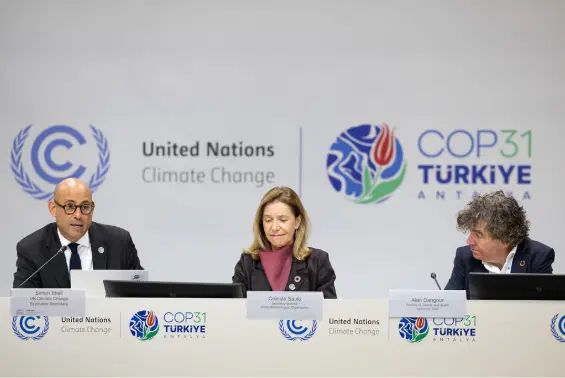
Celeste Saulo, Secretary-General of the World Meteorological Organization, said: "Our weather system is being intensified and disturbed, and El Niño will amplify various climate risks. The El Niño phenomenon and the current global climate in 2026 give the term 'record breaking' a new realistic meaning."
Data released by Copernicus, the European climate monitoring agency, show that global temperatures in 2026 are expected to rise by more than 1.5 degrees Celsius compared with pre-industrial levels. 2024 has exceeded this threshold and is the hottest year on record. The United Nations predicts that global temperatures will remain above this threshold for a long period of time. It is predicted that under the best-case scenario, global warming will still reach 1.8 degrees Celsius this century, but to achieve this goal, man-made greenhouse gas emissions must be significantly reduced, and the reduction intensity must be far beyond the current commitments made by countries. The United Nations warns that even if countries fulfill their current commitments to reduce emissions, global warming will still reach 2.6 degrees Celsius this century.
Saulo said at a press conference in Antalya, Turkey: "Unfortunately, in the face of continued climate warming, human beings are struggling to adapt, and the warming curve has not reversed. Although countries have ambitions to reduce emissions, based on the current level of carbon dioxide emissions, we cannot achieve the 1.5 degrees Celsius temperature control goal."
The 2026 El Niño will be the strongest in history. This weather phenomenon will change global temperature and rainfall patterns, changing the probability of droughts, floods, high temperatures and other extreme disasters in various places. The World Meteorological Organization predicts that this El Niño will last until February of the following year, with temperature anomalies in the central and eastern equatorial Pacific reaching up to 3.7 degrees Celsius, while the value in March was only 0.2 degrees Celsius.
Simon Steele, Executive Secretary of the United Nations Framework Convention on Climate Change, said: "Super strong El Niño is amplifying the effects of climate change and bringing about a double fatal impact. The climate crisis has now evolved into a global public health crisis comparable to a pandemic - from toxic pollution to extreme heat, various climate disasters continue to impact the medical and health systems and infrastructure."
The World Meteorological Organization states that between 2017 and 2026, global sea levels will rise by an average of 3.9 millimeters (0.15 inches) per year; from 1993 to 2002, the average annual rise will be only 2.4 millimeters. The agency said that ocean heat will continue to rise in 2026, indicating that the earth's overall heat absorption rate is accelerating. The warming and expansion of sea water is one of the causes of sea level rise, and the melting of sea ice is another major factor. The World Meteorological Organization found that the maximum Arctic sea ice coverage in March 2026 reached the lowest or second-lowest value on record.
The report points out that the impact of extreme weather on renewable energy sources around the world in 2025 will be different: European solar power generation is higher than average, wind power generation is lower than average, and electricity demand caused by temperature is also lower than average; while hydropower and precipitation in central and southern Africa are less than average, and electricity demand is higher.
Other data shows that the number of countries that have established climate early warning systems has increased from 56 ten years ago to 136 in 2025. This brings the world one step closer to the United Nations goal of making climate early warning services available to everyone in the world by the end of 2027.
Comments