
Abstract:
Nordic countries such as Norway, Sweden and Finland have long been considered the cooler parts of Europe, and even when the continent experiences severe heat waves, these countries generally do not experience particularly extreme heat. However, a latest study by the Finnish Meteorological Institute points out that high temperatures of 40°C can no longer be regarded as an impossible weather phenomenon in the Nordic region. As climate change continues to advance, the probability of such extreme temperatures is significantly increasing.
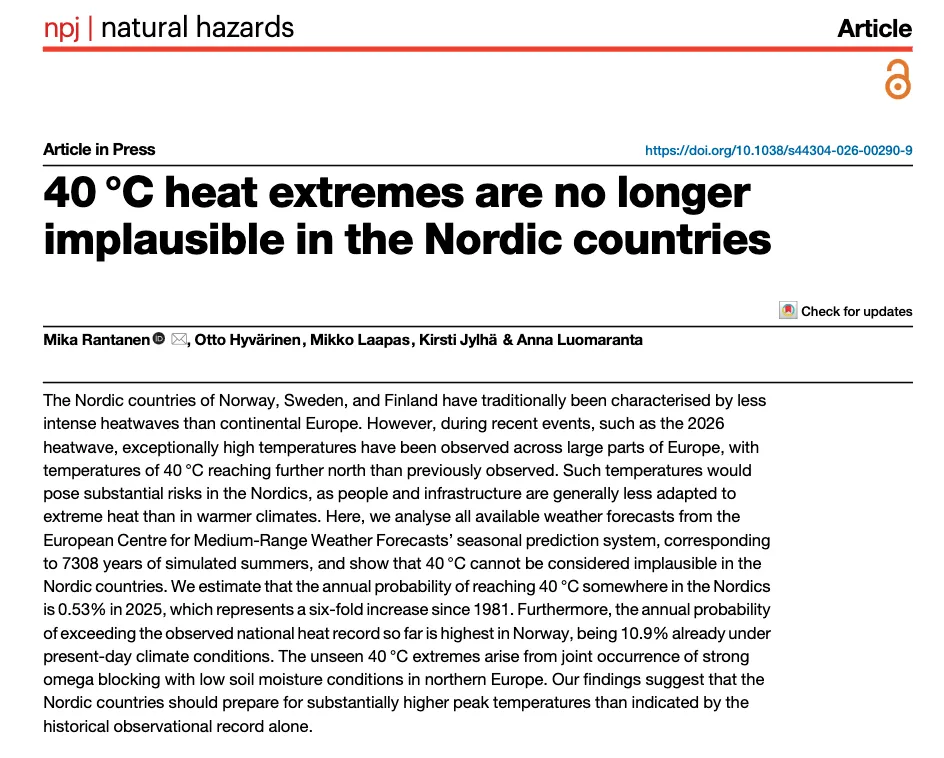
The researchers analyzed data from the European Center for Medium-Range Weather Forecasts (ECMWF)'s Seasonal Climate Prediction System, using a cumulative simulation results equivalent to 7,308 summers to assess the possibility of extreme high temperatures in Northern Europe.
The conclusion drawn by the study is quite interesting: Based on the climate conditions in 2025, the probability that a certain location in the Nordic region will reach 40°C within a year is about 0.53%, with a 95% confidence interval of 0.38% to 0.70%. Although this probability is still low, it has increased six times compared with 1981.
In other words, a high temperature of 40°C is still a rare event in Northern Europe, but it can no longer be simply classified as an extreme to almost impossible weather scenario.
The study also found that the risk of extreme heat in Norway is of particular concern. Based on current climate conditions, the probability that Norway will break its record for the highest temperature in history within a year has reached 10.9%. This means that even without considering further climate change in the future, it is already a very realistic possibility for Norway to exceed the current national high temperature record.
Why is it possible for northern Europe to experience high temperatures of 40°C? The key, the researchers say, is that two meteorological and surface conditions may occur at the same time: strong Omega Blocking, and unusually dry soil in northern Europe.
Omega blocking is a special form of atmospheric circulation. On weather maps, high-altitude circulation takes on a shape similar to the Greek letter Ω. A high-pressure system stays in a certain area for a long time and is surrounded by low-pressure systems on both sides. This structure can significantly slow down weather systems, allowing hot weather to persist for days or even weeks.
Under the control of strong high pressure, the air sinks and is continuously compressed, cloud formation is suppressed, and the ground receives more solar radiation. If this state persists, surface temperatures may continue to rise.
Soil moisture is another key factor. Normally, some of the energy from solar radiation is used to evaporate water from soil and plants, helping to lower surface temperatures. But when the soil is already severely dry, the evaporative cooling effect is reduced, and more of the sun's energy is converted directly into heat at the surface and near-surface air.
If a strong omega blockage coincides with low soil moisture, an unusually intense and long-lasting heat wave could develop in northern Europe, ultimately exceeding the temperature range shown in past meteorological observations.
Researchers emphasize that relying solely on actual temperature records over the past few decades is no longer sufficient to fully assess the risks of extreme heat that Northern Europe may face in the future. Just because weather has never happened in history doesn't mean it won't happen in the future.
This study also has a realistic background worthy of attention: Europe has already experienced an unusually strong heat wave in 2026, with the high temperature range extending northward, and some areas experiencing extreme temperatures that were less common in the past. Researchers are reassessing extreme climate risks in the Nordic region based on recent high temperature events in Europe.
For Nordic society, the impact of high temperatures of 40°C may be particularly serious. In contrast to countries such as Spain, Italy or Greece, which have long adapted to hot summers, residents, buildings and urban infrastructure in Norway, Sweden and Finland are generally not designed for such extreme heat conditions.
Many residences lack air conditioning systems, and public buildings and transportation facilities may not be equipped to handle sustained high temperatures. Local residents have relatively limited experience in protecting against extreme heat waves. Once high temperatures approach 40°C, the elderly, children and people with underlying diseases may face greater health risks.
In addition, extreme heat may also affect railway operations, power supply, road facilities and agricultural production. Nordic forests are vast, and continued dry and hot weather may also increase the risk of forest fires.
Researchers believe that Nordic countries should re-examine existing climate adaptation and infrastructure planning standards, and can no longer simply use the highest temperature in history as the upper limit of possible extreme weather in the future. Urban buildings, public transport, healthcare systems and energy networks all need to account for higher peak temperatures than in the past.
This research was completed by Mika Rantanen, Otto Hyvärinen, Mikko Laapas, Kirsti Jylhä, Anna Luomaranta and others from the Finnish Meteorological Institute. The paper was published in the journal npj Natural Hazards on October 31, 2026.
The most important warning of the study is not that high temperatures of 40°C will occur frequently in Northern Europe, but that this kind of weather, which was considered extremely unlikely in the past, has entered the scope that needs to be carefully included in risk assessment. For Nordic countries accustomed to cool summers, the focus of future climate adaptation efforts may need to shift from dealing with ordinary heat waves to preventing truly extreme heat.
Comments