
Abstract:
Associate researcher Xu Wenfang and researcher Liu Juxiu of the South China Botanical Garden of the Chinese Academy of Sciences, together with researchers from Peking University Professor Yuan Wenping, found that since 1979, the start time of global land heat waves has been significantly earlier, the end time has been significantly delayed, and the heat wave season has been significantly extended; since the 21st century, the proportion of land area where rapid onset first heat waves occurred has increased significantly in the area affected by heat waves in that year. On September 23, the relevant results were published in Nature Climate Change.
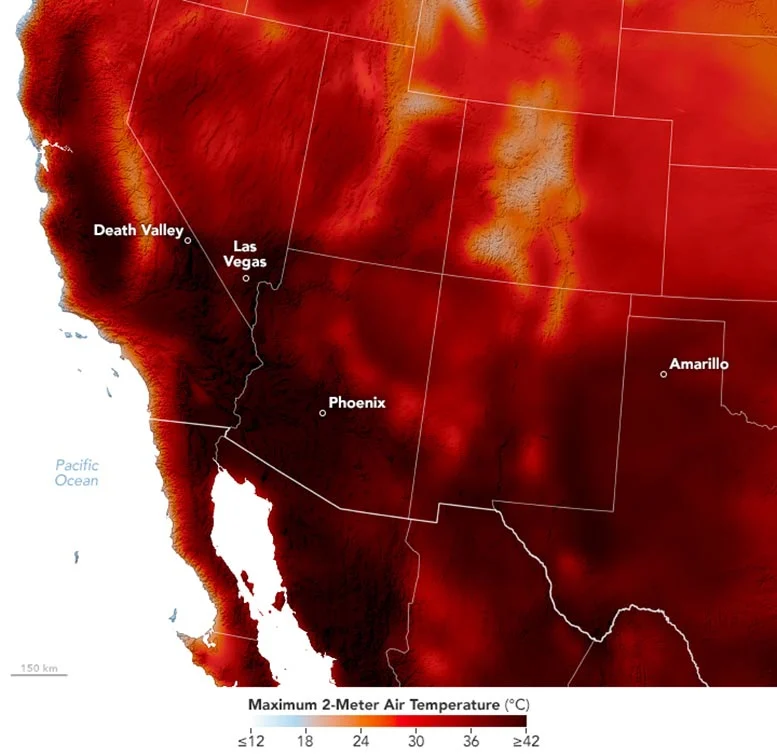
In recent years, extreme high temperatures have become an important issue in global climate risk management. In 2024, United Nations Secretary-General Guterres issued the "Call to Action on Extreme Heat", calling on the international community to strengthen coordinated responses to extreme heat. On July 31, 2026, Guterres once again issued a warning about extreme global heat, pointing out that the earth is heating up faster than humans can take response actions, and emphasized strengthening thermal health action plans and early warnings. This summer, many places in Europe experienced severe high temperatures. Western Europe experienced the hottest June on record, with local temperatures in many countries exceeding 40 degrees Celsius. Extreme heat and its health risks have once again attracted widespread attention. In the context of continued global warming, are heat waves not only becoming more frequent, intense and persistent, but are they also coming earlier and developing faster?
Based on global climate data from 1979 to 2023, the research team systematically analyzed long-term changes in the start and end times of global terrestrial heat waves, the length of heat wave seasons, and the starting speed of the first heat wave each year, and used multiple independent climate data sets to cross-validate the results. The results show that the first heat wave on land around the world has occurred earlier by about 3.3 days on average every 10 years, and by about 2 weeks overall in the past 45 years. The end of the last heat wave has been delayed by about 5.4 days on average every 10 years, and by about 24 days overall in 45 years. The heat wave season has been extended by about 8.7 days on average every 10 years, and by about 39 days overall in 45 years. From a spatial perspective, 72.0% of the world's land areas show a trend of early onset of heat waves, 79.6% of areas show a trend of delayed end of heat waves, and 92.1% of areas show a trend of prolonged heat wave seasons. The changes in arid areas are generally more obvious.
The research team further divided the first heat wave each year into three start types: fast, medium and slow based on the relative time from the start to the temperature peak. The results found that from 2001 to 2023, the proportion of the land area of the first heat wave with rapid onset to the area affected by the heat wave in that year showed a significant upward trend, indicating that the first heat wave on land around the world has shown a trend of transitioning to a rapid onset in recent years. This means that characterizing high temperature risks requires not only focusing on "how hot it is" and "how long it lasts", but also "when it arrives" and "how quickly it reaches the peak temperature."
This study deepens the understanding of long-term changes in global heat waves from the two dimensions of heat wave occurrence time and starting speed. Previous studies have paid more attention to the frequency, intensity, duration and scope of heat waves. This study shows that when a heat wave starts, when it ends and how quickly it reaches its peak are also important indicators for understanding and assessing high temperature risks. The study also found that extended heat wave seasons increase the risk of crops experiencing high temperatures during critical growth stages. From 2001 to 2023, the heat wave exposure area of some major crops in the world during key reproductive growth stages such as flowering and silking increased by 1.6% to 13.3% compared with 1979-2000. The impact of heat waves further expanded to the early and late stages of the crop growth period.
Xu Wenfang, the first author and co-corresponding author of the paper, pointed out that in the past, we paid more attention to whether heat waves became more frequent, stronger, and longer-lasting. The study further shows that the timing and initiation of heat waves are also changing. If heat waves come earlier and peak faster, the time window left for societies and ecosystems to prepare and adapt may be further shortened. Therefore, it is necessary to improve the timeliness of heat wave monitoring, early warning and emergency response, and promote the timely transformation of early warning information into risk response actions.
This discovery also provides a new scientific perspective for improving extreme high temperature risk monitoring and early warning. The United Nations is promoting the improvement of global extreme weather warning capabilities through the "Early Warnings for All" initiative. Research shows that in high temperature monitoring and risk assessment, in addition to temperature intensity and duration, further attention should be paid to when the heat wave starts, when it ends, and the peak speed of the event, which will help to more comprehensively identify the changing high temperature risks and provide scientific basis for the development of adaptation measures in the fields of public health, agricultural production, ecological protection, and energy security.
Comments