
Abstract:
As the area with the highest concentration of mountain glaciers in middle and low latitudes, the alpine glaciers in western my country are called "solid reservoirs" in arid areas. Driven by climate warming, a large number of glaciers continue to shrink and small glaciers continue to die, which not only changes the regional water resources endowment, but also triggers chain disasters such as ice avalanches and glacial lake outbursts. Wang Feiteng, a researcher at the Northwest Institute of Ecological Environment and Resources, Chinese Academy of Sciences, has long been involved in glacier observation. Relying on decades of continuous monitoring data, he explained to reporters the profound changes taking place in the cryosphere in western my country. A related paper was published in the Journal of Glaciology.
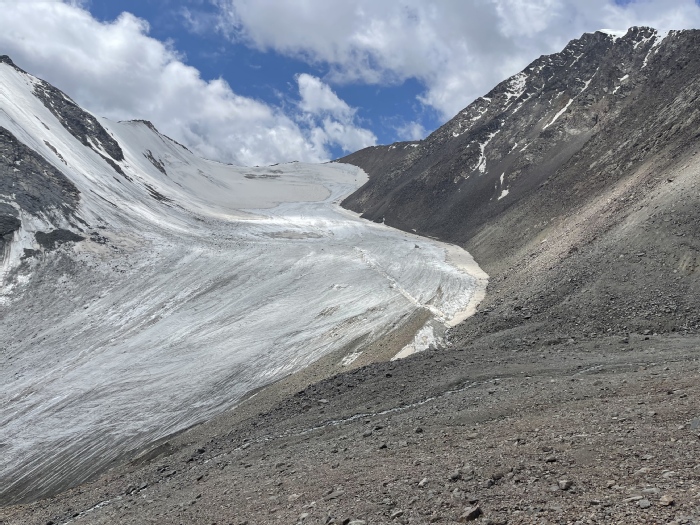
The No. 1 Glacier at the source of the Urumqi River in the Tianshan Mountains. Photo by Wang Feiteng
Accelerating melting: small glaciers become the first "victims" of climate warming
my country's glaciers are mainly distributed in the five major mountain systems of Kunlun Mountains, Tianshan Mountains, Nyenchen Tanglha Mountains, Himalayas and Karakoram Mountains. The glacier area and ice reserves in Xinjiang and Tibet account for about 90% of the country's total. The third China Glacier Inventory shows that as of around 2020, the country's glacier area is about 46,000 square kilometers, with a total of about 69,000 glaciers. However, compared with the baseline data in the 1960s, the total area of glaciers in my country has decreased by about 26%, and about 7,000 small glaciers have completely disappeared. In just more than ten years from 2008 to 2020, the area of glaciers has shrunk by about 6%, and glaciers have entered a rapid retreat channel.
“The death of glaciers is not a general shrinkage. Most of the first to disappear are small glaciers with an area of less than 0.1 square kilometers.” Wang Feiteng told reporters. From the first to the second glacier inventory, more than 6,000 glaciers have disappeared across the country, two-thirds of which are micro glaciers. Small glaciers have limited ice reserves and are particularly sensitive to temperature fluctuations. Combined with reduced snow supply and reduced ice and snow albedo, they can easily lose the material conditions for their continued existence. Terrain elevation and slope aspect also further amplify the risk of extinction.
From a basin scale, the number of glaciers dying in the inflow area is about twice that of the outflow area. The risk of small glaciers is particularly prominent in the Irtysh River, Yellow River, Ili River, Turpan, Hami and other river basins, and is concentrated in the Altai Mountains, Tianshan Mountains and Qilian Mountains.
The No. 1 Glacier at the source of the Urumqi River in the Tianshan Mountains is the reference glacier with the longest observation period in my country, and has witnessed the entire process of the glacier from slow retreat to severe material loss. At the beginning of the observation in 1959, the glacier area was 1.95 square kilometers. In 1993, it split into the east and west branches. In 2023, the total area was only 1.496 square kilometers.
"The observation results from 2023 to 2024 are worthy of vigilance. The proportion of the accumulation area of this glacier is zero, which means that there is no area in the entire glacier that can rely on snow to offset ablation losses." Wang Feiteng said that the glacier mass balance in that year reached ?1815 millimeters of water equivalent; the cumulative material loss from 1960 to 2024 reached 26.02 meters of water equivalent. In 2024, the material loss hit the lowest record in the history of observation, and ablation has entered a new stage. Observations over the past few decades have clearly shown that glacier change is no longer a long-term prediction, but an ongoing reality.
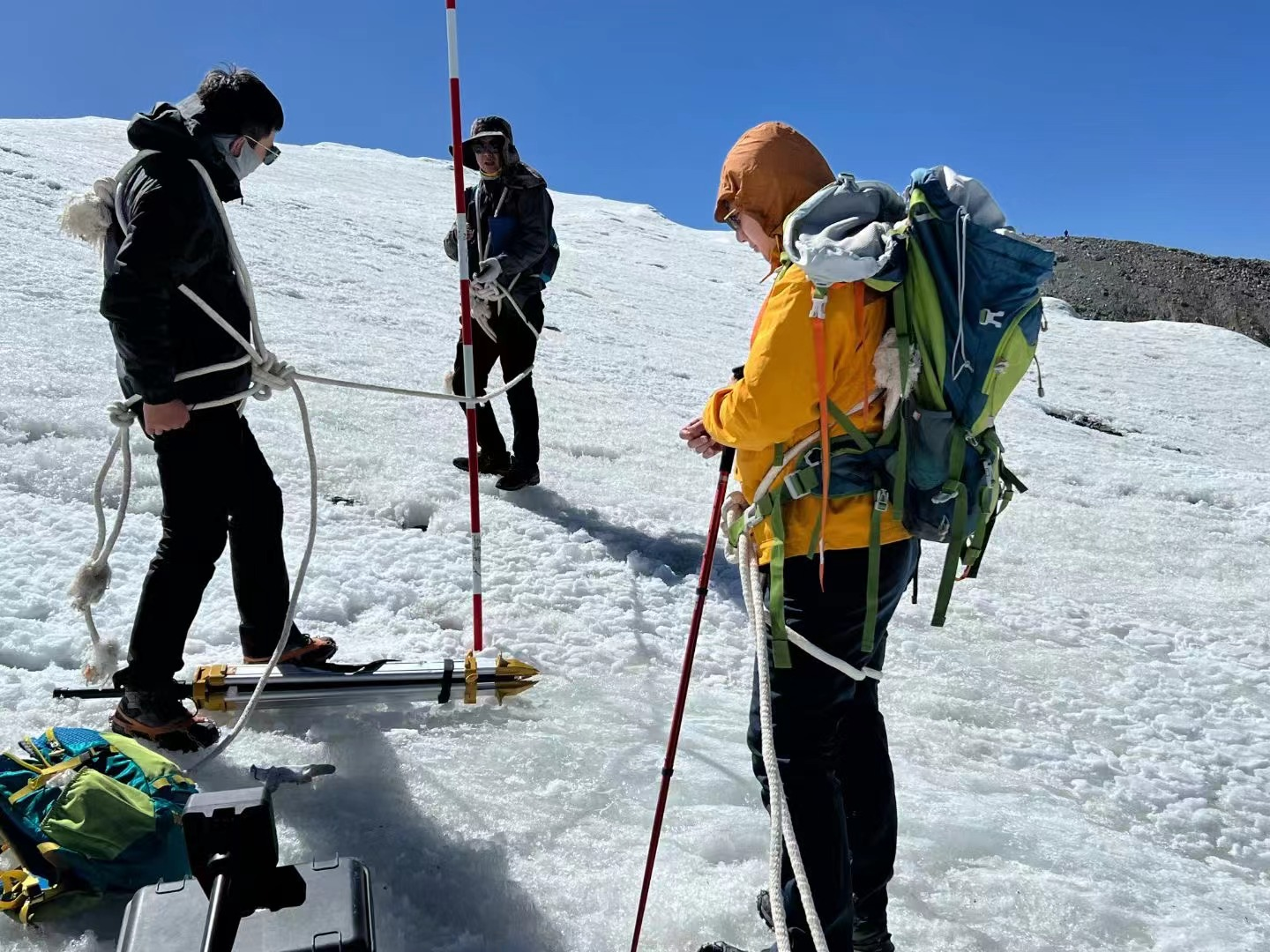
Researchers observe the mass balance of the Muztagh Peak glacier. Photo by Wang Feiteng
Chain reaction: changes in water resources coupled with cryosphere chain disasters
Glaciers are known as the "solid reservoirs" in the arid areas of the west, playing a natural regulating role in downstream river runoff. Many people simply believe that as glaciers melt, river water will continue to increase, but scientific observations reveal that this is only a short-term phenomenon.
"In the early stages of climate warming, the accelerated melting of glaciers will indeed lead to a temporary increase in runoff in the basin, but this window period is not sustainable." Wang Feiteng explained that as ice reserves continue to be depleted, when the volume of the glacier drops below the threshold, the meltwater supply capacity will gradually weaken, and the basin will experience a transition from "increasing water" to "decreasing water." For Xinjiang, the Hexi Corridor and the inland watersheds of Central Asia, shrinking glaciers coupled with fluctuations in precipitation will significantly increase uncertainty in water resources in the future, putting agricultural irrigation and alpine ecosystems under pressure.
What requires more vigilance than changes in water resources is the disaster risk caused by mountain instability. As glaciers thin and permafrost degrades, the stable structures of mountain rock, soil, and ice are broken, and the probability of ice avalanches, ice-rock avalanches, glacier surges, and glacier lake outbursts increases. The warming rate of the Tibetan Plateau is about 0.42°C every 10 years, which is twice the global average rate. The warming directly changes the temperature and mechanical state of the ice body and reduces the stability of the glacier.
Wang Feiteng particularly emphasized the chain characteristics of cryosphere disasters: "It is rarely a single disaster outbreak, but often forms a complete chain: glacier retreat causes glacier lakes to expand, ice avalanches or rock avalanches fall into lakes, trigger glacier lake outbursts, and conduct downstream to form floods and debris flows, threatening the safety of residential areas, roads, ports and other infrastructure along the way." The Karakoram Mountains, Pamir Plateau, and West Kunlun Mountains are the concentrated distribution areas of leaping glaciers in my country, and are also key areas for preventing glacier lake outburst disasters. The expanding glacial lakes have become dangerous hazards hanging high in the mountains and river valleys.
The impact of glacier melting has long been limited to the ends of the glacier tongue, and is transmitted downstream to the population's production and living space. The disappearance of a glacier is the fading of a blue patch on the map; large-scale glacier retreat changes the entire regional water cycle, ecological pattern and disaster background.
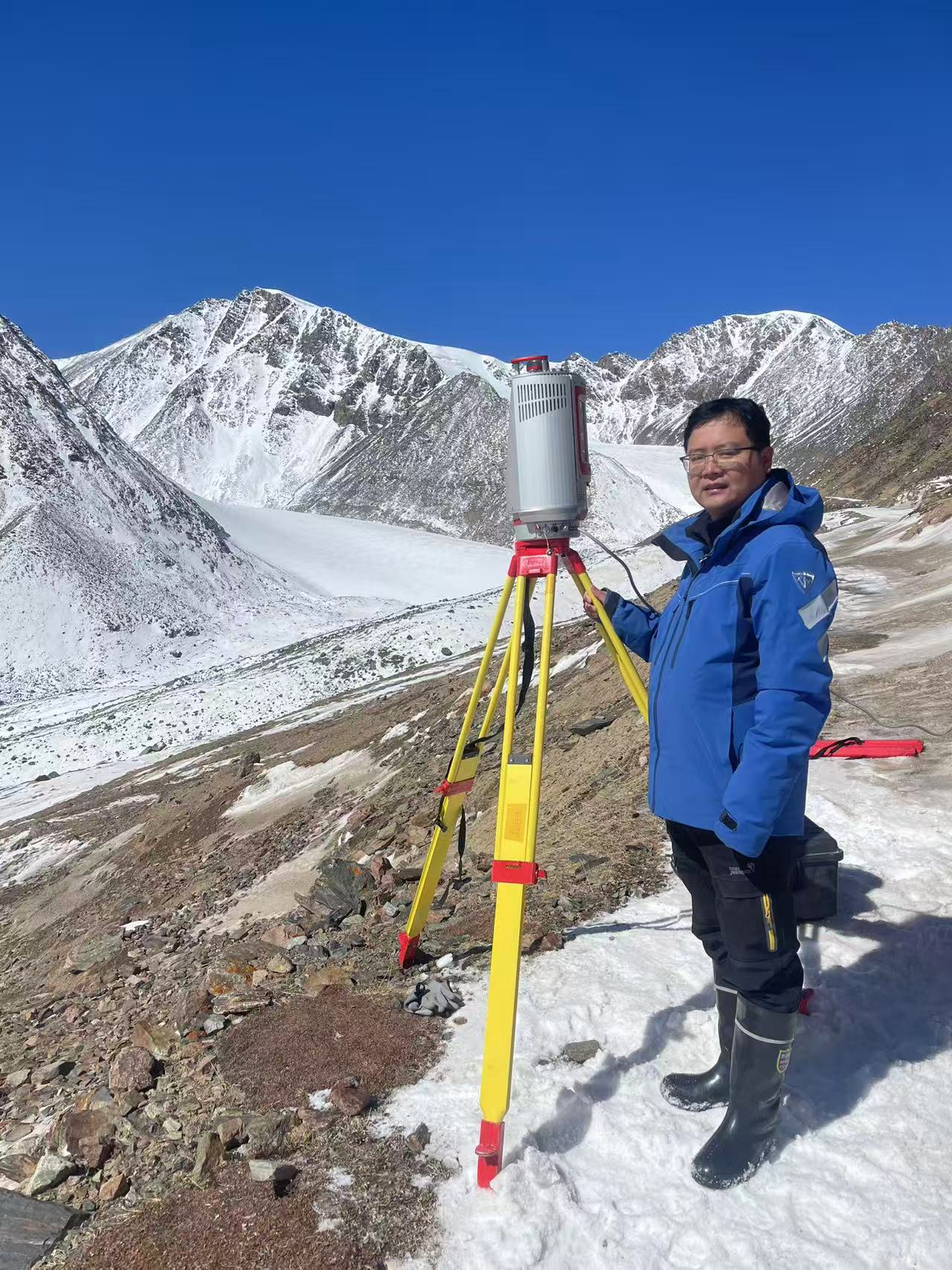
Wang Feiteng is at the No. 1 Glacier at the source of the Urumqi River in the Tianshan Mountains. Photo provided by interviewee
From observation to early warning: establishing a future-oriented glacier risk prevention and control system
After seeing clearly the changes in glaciers, how to identify risks and give early warning is the most important proposition in cryosphere science at the moment.
Currently, the Northwest Institute of Ecology, Environment and Resources of the Chinese Academy of Sciences has built a glacier ground observation network with a span of about 1,700 kilometers based on the Tianshan No. 1 Glacier Observation Station, covering key points such as the Musi Island Glacier in the Altai Mountains and the No. 16 Muztagh Glacier in the Pamirs. At the same time, it integrates domestic high-resolution remote sensing, drone aerial survey, ground-based radar, and three-dimensional laser scanning to achieve comprehensive monitoring of glacier area, thickness, movement speed, and hazard hazards.
"In the past, we answered more questions about 'How much have the glaciers melted?' Now our scientific research focus is turning to three practical questions: Which glaciers are dying rapidly? Which glaciers are already in a state of instability? Once a disaster occurs, which areas will be affected?" Wang Feiteng said.
He believes that in response to changes in the cryosphere, it is necessary to dynamically update the glacier database, strengthen regular monitoring of multi-source remote sensing, carry out key real-time observations of high-risk glaciers, and transform research results into risk zoning and early warning products to serve disaster prevention and reduction and water resources management.
"Glaciers will not disappear overnight, but decades of continuous monitoring data have given us a clear signal. Climate change is reshaping the alpine world, and our preparations must be ahead of the accelerated degradation of glaciers and the occurrence of disasters." Wang Feiteng said. The change of glaciers is never an isolated event in no-man's land. It is related to water security and ecological stability in arid areas, as well as the security of border infrastructure. Understanding the signals sent by glaciers is to protect the future of sustainable development in the western region.
Related paper information: https://doi.org/10.1017/jog.2026.10205
Comments