
Abstract:
According to the latest research in geophysics, the planet we live in is undergoing a seemingly paradoxical deformation process: in different measurement dimensions, the Earth is "becoming rounder and flatter at the same time."
A research team led by Christopher Kotsakis, a geologist at the Aristotle University of Thessaloniki, Greece, published a paper in the Journal of Geophysical Research: Solid Earth and pointed out that this morphological reshaping process is significantly accelerating, and the accelerated melting of the polar ice caps is one of the core drivers of this phenomenon.
Affected by the centrifugal force of rotation, the earth is not a perfect sphere, but an ellipsoid with a slight bulge at the equator and a slight flattening at the poles. For a long time, the earth's surface has been undergoing a glacial isostatic adjustment (GIA) - since the glaciers retreated at the end of the last ice age about 11,000 years ago, the earth's crust, which once bore the weight of the huge ice sheet, has been elastically rebounding extremely slowly. Observations in the 1980s and 1990s have shown that the Earth's geoid as a whole is slowly evolving closer to a sphere along with this rebound process.
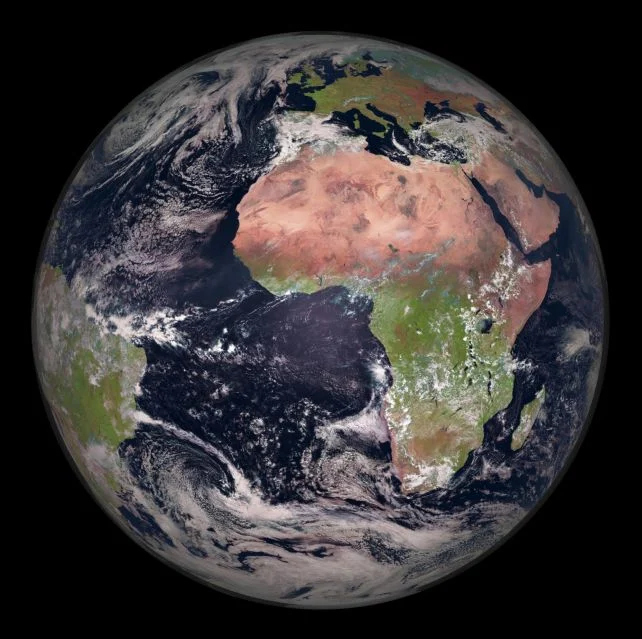
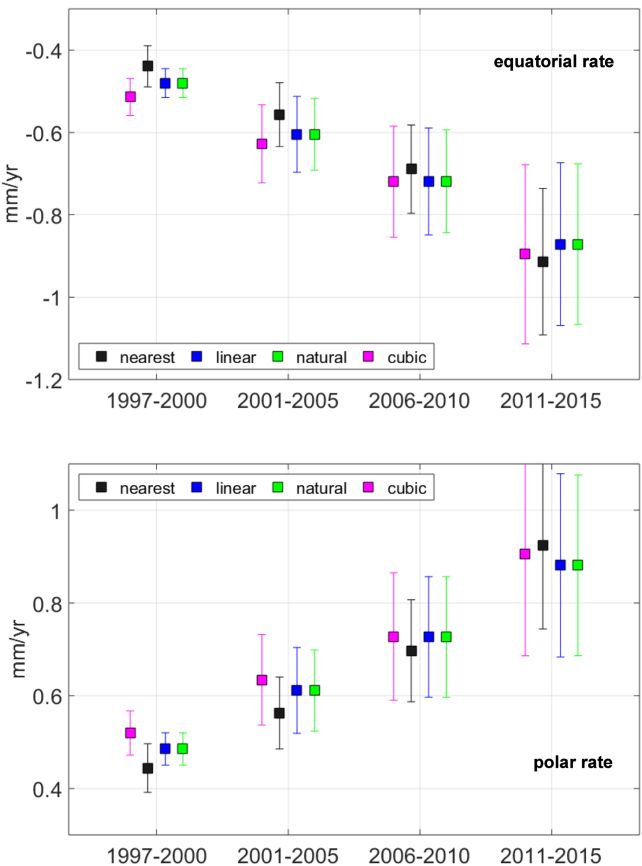
However, the latest global satellite navigation system (GNSS) measured data breaks this gentle trend. By comparing high-precision monitoring records from 1997 to 2015, scientific researchers found that the rising rate of the solid crust in the polar regions doubled in less than 20 years, accelerating from the initial about 0.5 millimeters per year to 1 millimeter per year; at the same time, the solid land around the equator continued to sink at a gradually increasing rate. The uplift of the poles coupled with the sinking of the equator means that the outer shell of the "solid earth" represented by rocks is actually getting higher and steeper, its geometric oblateness is decreasing, and the overall shape is accelerating to become "rounder."
What is puzzling is that, contrary to the rounding of the geometric outline of the solid crust, the "Geoid" (Geoid), which represents the earth's mass distribution and gravity equipotential surface, has shown a trend of continuous flattening during the same period. The research team explained that this seemingly conflicting "double transformation" is physically consistent. With global warming, huge glaciers in Greenland and Antarctica have melted rapidly. The rocky crust that was originally suppressed in the polar regions quickly rebounded upward after being relieved of its heavy load, shaping a more rounded solid surface. However, the massive amounts of ice water produced by melting did not stay at the poles, but flowed to the mid- and low-latitude oceans in large quantities, causing the center of gravity of the earth's surface to accumulate and shift toward the equator.
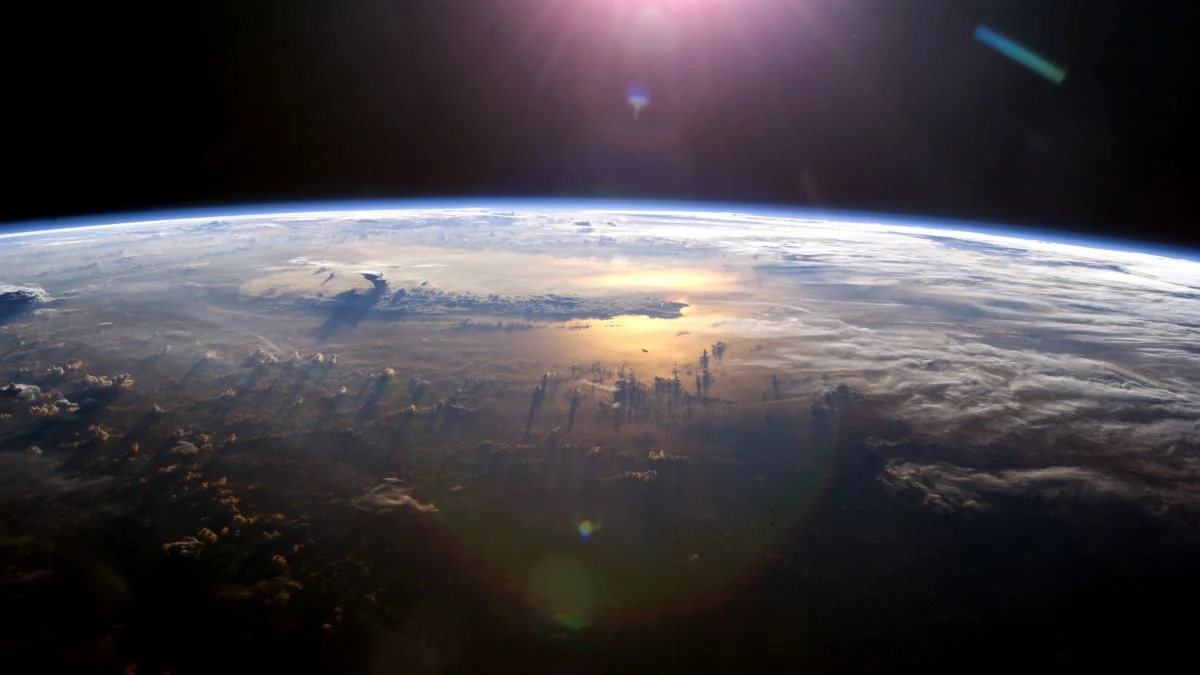
Because the gravitational field directly responds to changes in mass distribution, a large amount of water mass flows into low latitudes, which intensifies the abnormal gravitational bulge near the equator, thereby pulling the geoid to become flatter. Scientists pointed out that this research not only clearly reveals the profound reconstruction of the physical shape of the earth caused by climate change, but also provides a key dynamic model correction basis for high-precision satellite orbit measurement, global sea level rise benchmark calibration, and polar crust deformation monitoring.
Comments