
Abstract:
Two latest studies published in the international academic journal Science Advances point out that Saturn's icy moon Enceladus shows a more optimistic prospect in the search for extraterrestrial life than previously recognized. Research has revealed that the formation process of the satellite's ice jets is like a natural sample preparation system, which can effectively separate and concentrate ocean components, thereby greatly reducing the difficulty of detecting biomarkers. At the same time, laboratory simulation experiments have successfully confirmed that methane-producing microorganisms in the Earth's deep sea can survive and metabolize in simulated extreme alkaline environments and restrictive conditions of Enceladus.
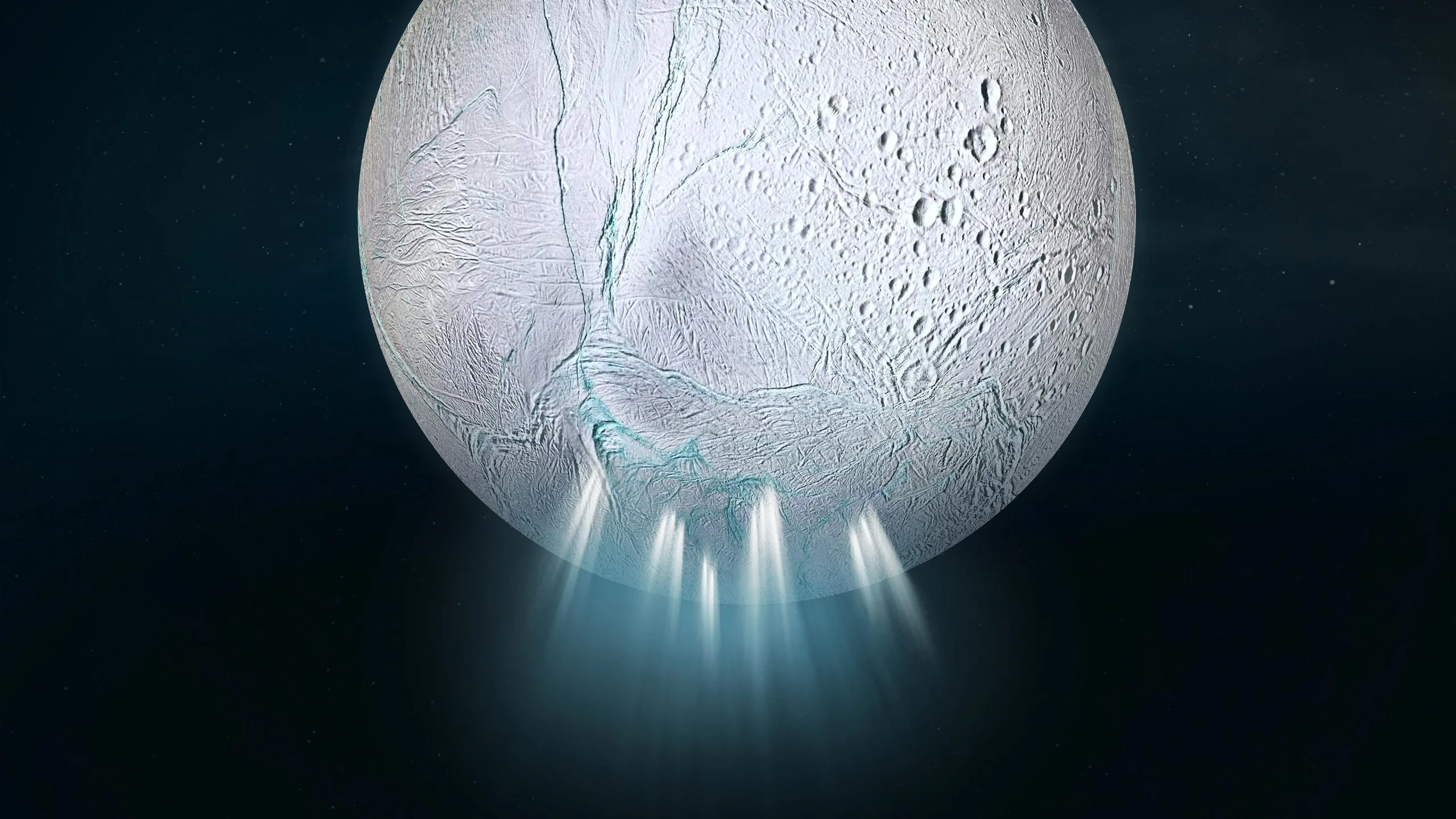
Enceladus hides a global liquid ocean under its frozen surface, and sprays water vapor plumes hundreds of kilometers into space through the Antarctic rift, allowing spacecraft to directly capture ocean samples without drilling through kilometers of solid ice. Previous Cassini missions have passed through the plume multiple times, detecting salts, organic molecules and evidence of hydrothermal activity on the seafloor.
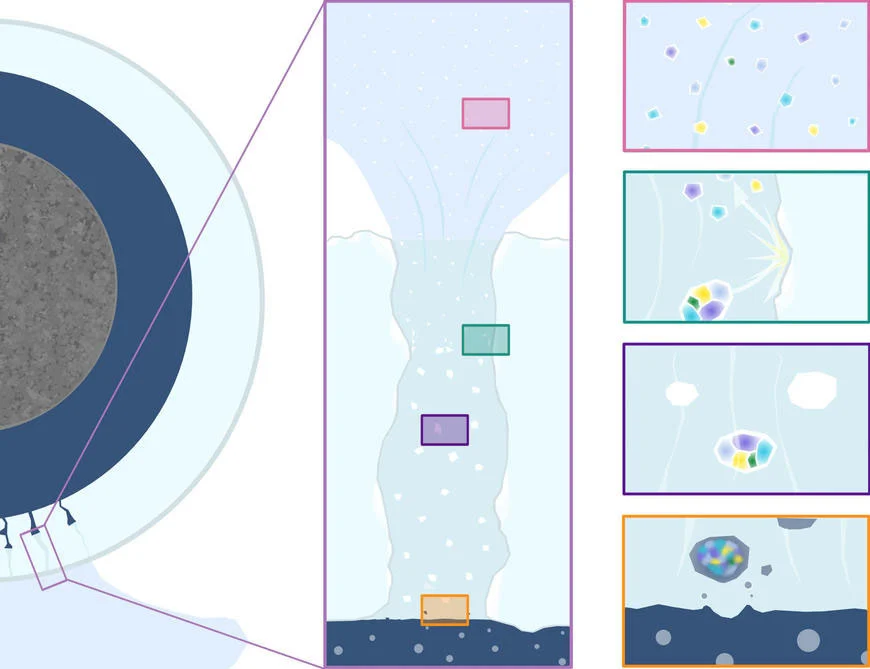
In the first study led by Frank Postberg, a planetary scientist at Freie Universität Berlin, an international team combined Cassini observation data, experimental physics and theoretical models to restore the physical and chemical changes of the plume ice particles before they took off. The study found that when the tiny water droplets produced by the bursting of bubbles on the ocean surface rise with the water vapor in the ice crevices, they do not freeze as a whole instantly. During the progressive freezing process, various substances originally dissolved in seawater will be physically separated and enriched, and different salts (such as sodium chloride and sodium carbonate) and organic components will be unevenly distributed in different areas of the water droplets. These water droplets accelerate to thousands of kilometers per hour in the cracks and collide with the ice wall and break into particles of several microns, causing some ice particles to carry specific components that are much higher than the concentration of the original seawater.
Scientific researchers pointed out that this natural concentration mechanism is of great significance for searching for traces of life. If cellular debris or microbial material is present in seawater, freezing and impact fragmentation processes will also separate and highly concentrate it into a very small number of ice particles. This means that future detectors will not need to analyze a uniformly mixed average sample, but will be able to more easily identify key biometric markers by directly scanning individual particles using existing detection technology. Previous relevant ground simulation tests have confirmed that dedicated airborne analytical instruments are fully capable of detecting microbial cell-level substances contained in such single particles.
In another experimental study led by the University of Munich (LMU), scientists verified whether the ocean environment of Enceladus actually supports life functions. Enceladus' ocean is thought to be characterized by extremely high alkalinity (pH of 10 to 11), extremely low oxygen levels, and extremely low concentrations of dissolved carbon dioxide. The researchers highly restored the special water chemical environment and water-rock interaction process in the laboratory, and introduced an archaea from the earth's deep-sea hot springs - Methanothermococcus okinawensis. The microorganism does not require sunlight and oxygen, and relies on the hydrogen and carbon dioxide released by the water-rock reaction to produce methane to obtain energy.
The experimental results exceeded the research team’s expectations. At first, the microorganism was unable to grow in a standard medium with extremely high pH and lack of carbon dioxide. However, in a complete simulation of the geochemical environment of Enceladus (including a hydrogen release system through water-rock interaction), the strain successfully adapted to the extreme carbon dioxide-deficient environment, maintained metabolism, and continued to produce methane. The experiment provides direct evidence that one of Earth's oldest metabolic pathways is fully capable of operating in the extreme alkaline environment typical of Enceladus.
The researchers concluded that Enceladus not only has liquid water, chemical energy input from water-rock interaction, and abundant organic matter, but also has natural channels that continuously transport high-concentration enriched samples to space. These findings provide clear technical guidance and theoretical support for future deep space life detection missions on Enceladus.
Comments