
Abstract:
A new study involving researchers including members of the International Union for Conservation of Nature (IUCN)'s Crocodile and Turtle Specialist Group shows that the once endangered Seychelles giant tortoise has made an astonishing recovery. At present, the number of this iconic giant reptile has exceeded the population of the Seychelles, making it one of the most successful large animal conservation cases in the world.
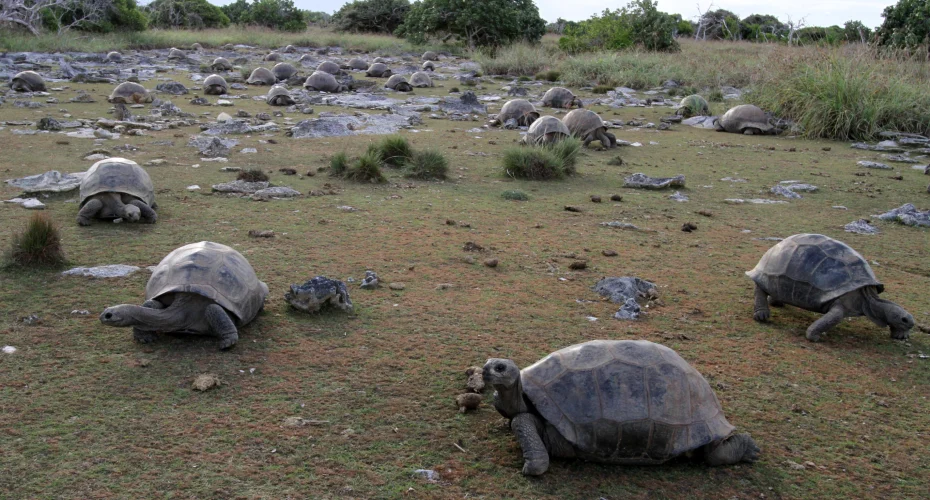
The Seychelles giant tortoise is one of the most representative animals in the Indian Ocean. Adult individuals can weigh more than 250 kilograms and often live more than a hundred years. Historically, this type of large tortoise was widely distributed on many islands in the Indian Ocean. However, with the advent of the European Age of Navigation, a large number of sailors and colonists fished and transported them as a food source, and the giant tortoise populations on many islands were almost completely wiped out.
By the 19th century, Seychelles giant tortoises were at risk, with only a few populations surviving on remote islands. The most important of these refuges is Aldabra Atoll. Due to its remoteness and limited development, the area is the last important home for giant tortoises.
Researchers note that Aldabra Atoll subsequently received protected status, creating key conditions for the giant tortoise population to recover. After decades of strict protection, the giant tortoise population continues to grow and gradually returns to a scale rarely seen in history.
The latest assessment shows that the current number of giant tortoises in the Seychelles has reached about 200,000, while the national population of the Seychelles is only slightly more than 100,000. This means that the number of giant tortoises has exceeded the total number of local residents, forming an extremely rare phenomenon in the modern world highly influenced by human activities.
Scientists believe that this is not just a simple case of species recovery, but also represents the reconstruction of ecosystem functions. As large herbivores, giant tortoises play an important role in island ecosystems. They affect the evolution of the entire ecological environment by feeding on plants, spreading seeds and changing vegetation structure.
As giant tortoise populations recover, they are retaking ecological functions that have been missing for hundreds of years, research shows. Some plant species even rely on giant tortoises to spread their seeds, and the passages and changes in vegetation formed by giant tortoises' activities will also affect the living environment of other animals.
The successful recovery of the Seychelles giant tortoise is in stark contrast to many endangered large animals, the research team said. Many large terrestrial animals around the world still face threats such as habitat loss, illegal hunting and climate change. The Seychelles case proves that with long-term protection measures, stable habitats and continuous management investment, large-scale recovery is still possible even if the population has fallen to extremely low levels.
However, researchers also caution that success does not mean that the risk has disappeared. Rising sea levels, extreme weather, and invasive alien species may still pose challenges to island ecosystems. Continued monitoring and conservation efforts will be needed in the future to ensure that this recovery gain is maintained over the long term.
The research team believes that the development process of the Seychelles giant tortoise from being almost extinct to exceeding the national population is one of the most inspiring success stories in the field of global wildlife conservation. It not only shows what conservation measures can achieve, but also provides an important reference for conservation projects around the world that are working to save endangered species.
Comments