
Abstract:
Japanese scientists re-examined a dinosaur fossil that had been forgotten for more than 20 years and found that it belonged to a relatively small iguanodon dinosaur. This fossil is about 90 to 88 million years old and was unearthed in Fukushima Prefecture, Japan. It comes from the shallow sea environment sediments at that time. Research results show that in the late Cretaceous, the coastal areas of East Asia where Japan is located not only lived with huge iguanodon dinosaurs, but also small members with a length of only about 3 meters, indicating that the coastal ecosystem during this period was more diverse than previously thought.
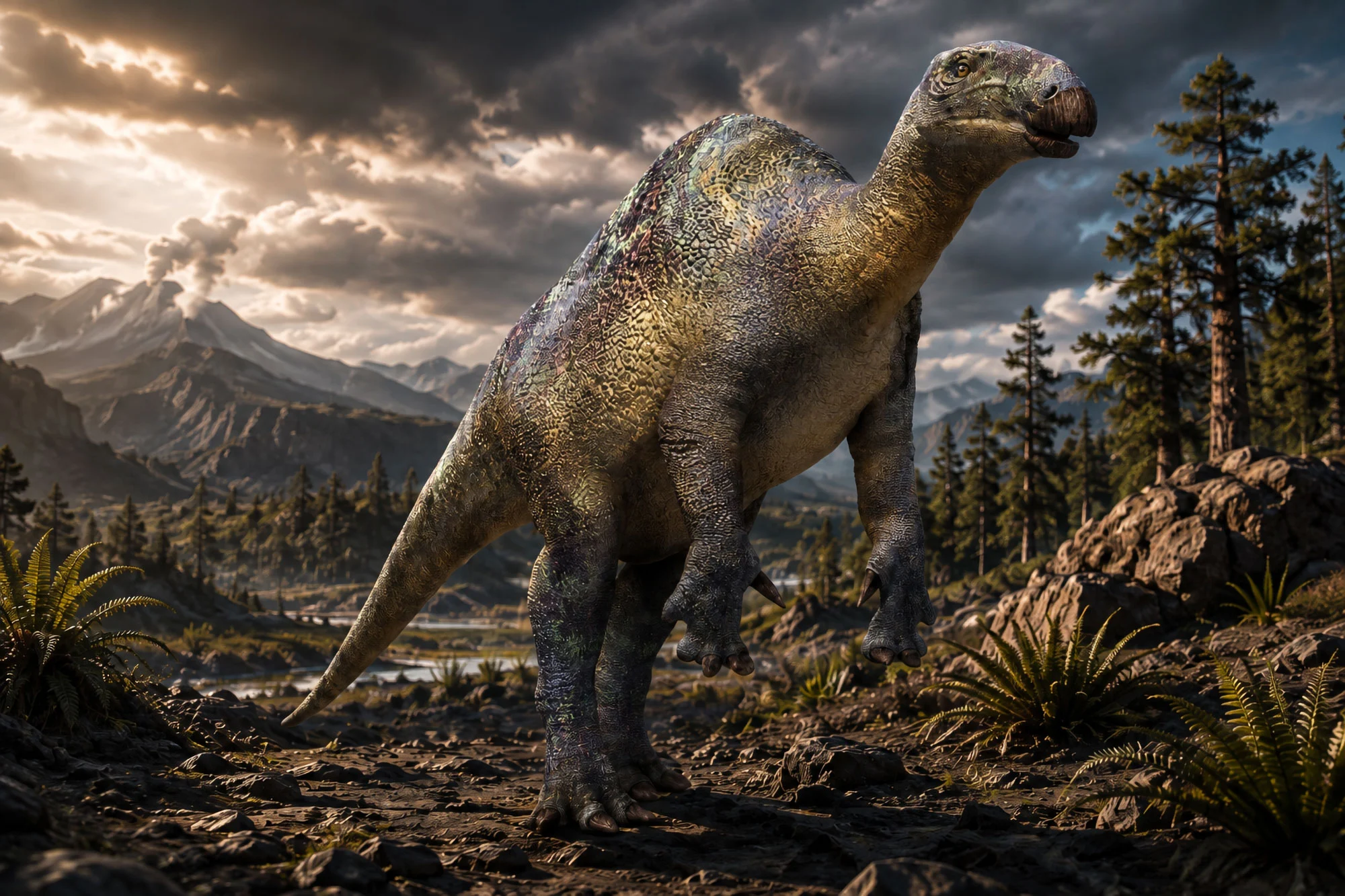
This special fossil was first discovered in 1999 near the Iwaki Area Bivalve Fossil Museum in Iwaki City, Fukushima Prefecture. It was formed in the late Cretaceous period about 90 million to 88 million years ago. Today's Japanese archipelago was far from forming its current geographical layout at that time. This area was part of the eastern edge of Laurasia, and related sediments were mainly formed in a shallow sea environment.
When the fossil was first discovered, researchers initially thought it might belong to a hadrosaur-like dinosaur. However, since there was only an isolated skeleton at that time, the research work quickly stalled, and the fossil was subsequently kept in the museum for more than 20 years without further study for a long time.
Until recently, paleontologists from Japan's University of Tsukuba and other institutions re-examined the specimen and discovered that it actually had a more special significance. Researchers confirmed that this is the right sternum plate of a dinosaur. Its unique axe-like shape and bone structure are closer to those of iguanodon.
Iguanodon is a large group of plant-eating ornithischian dinosaurs that lasted from the late Jurassic to the end of the Cretaceous, and had a very wide distribution range in the northern hemisphere at that time. Their size differences are also very obvious, ranging from small members about 2 meters in length to large members over 10 meters in length, some of which later evolved into groups closely related to hadrosaurs.
The researchers estimated the dinosaur's overall size based on its proportional relationship to the bones of other iguanodontids. The results showed that it was only about 3 meters long.
For an iguanodon, this is already quite small. Previously discovered iguanodon fossils in the same formation in Japan showed that significantly larger members once lived there, including large iguanodons about 8 meters long. Therefore, the discovery of this small dinosaur fossil means that iguanodon dinosaurs with very different body sizes may have coexisted in the same ancient Japanese coastal environment.
The researchers believe that this body size difference is important for understanding East Asian coastal ecosystems during the Late Cretaceous. In the past, Japanese dinosaur fossil records were relatively scattered, with most specimens containing only teeth or other isolated bones, making it difficult for scientists to determine how diverse the local dinosaur community was at that time.
Japan lies on the eastern edge of the Cretaceous continent of Laurasia, so the fossil record here is of particular value for studying how dinosaurs spread between Asia, North America and Europe. Iguanodonts have dispersed many times between different regions of Laurasia, and Asia is particularly considered an important area for the diversification of this group.
In the past 20 years, new iguanodon fossils have been discovered in Japan, and these discoveries have gradually changed scientists' understanding of Japan's Cretaceous dinosaur ecology. Previous research has proven that large iguanodons could live in the ancient coastal environment in the area where Japan is today, and this discovery further proves that small iguanodons can also adapt to this ecological environment.
More importantly, this fossil does not come from a typical continental sedimentary layer, but from a rock layer formed in a shallow marine environment at that time. This means that the area where these dinosaurs lived was probably near the ancient coastline. Although iguanodons themselves were terrestrial herbivores, they could roam coastal plains, estuaries, and other terrestrial environments adjacent to the ocean, so these marine sediments occasionally preserve dinosaur remains from nearby terrestrial ecosystems.
Researchers believe that the fact that small and large iguanodons appeared in this area at the same time shows that the coastal environment of East Asia at that time had rich enough plant resources and different ecological niches to support the coexistence of herbivorous dinosaurs with obviously different body sizes.
This discovery also helps to understand the evolution of iguanodonts in East Asia. Iguanodon is not a dinosaur with a highly fixed body shape, but has experienced many body shape changes during its long evolutionary history. Resource distribution, competition relationships and ecological niche differences in different environments may push different branches to evolve towards larger or smaller sizes.
The researchers specifically pointed out that large iguanodons and members closely related to hadrosaurs have been discovered in Japan, so this small specimen of only about 3 meters long has further expanded the size range of known local iguanodons. It shows that the dinosaur community along the coast of Japan during the Late Cretaceous was not composed of a few large herbivorous dinosaurs, but may have had a more complex body structure and ecological division of labor.
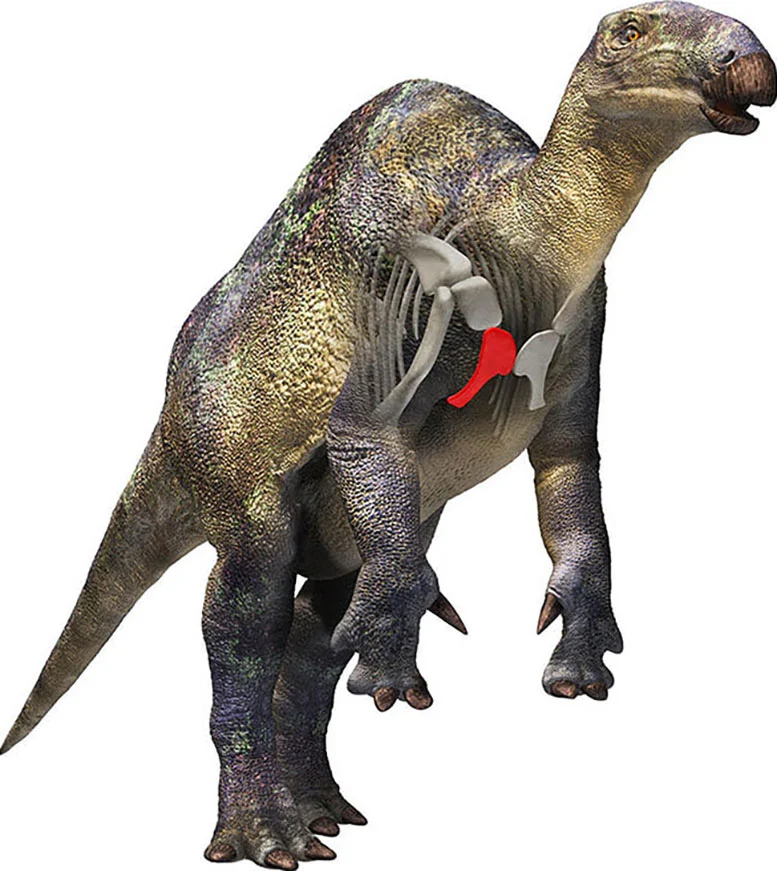
The fact that this fossil has been dormant in a museum for more than 20 years also reflects the importance of re-examining old specimens in paleontological research. When some fossils were first discovered, they were easily classified or even shelved for a long time due to the lack of complete skeletons or limited research methods. But as studies of comparative anatomy, three-dimensional imaging, and dinosaur classification continue to advance, isolated bones that were previously unremarkable may also provide new information.
This study did not discover a new genus of dinosaur, because this isolated sternum alone cannot be classified accurately enough, and it is currently impossible to determine which specific genus it belongs to.
However, this does not affect the scientific value of this fossil. For paleontologists, whether a specimen can be named a new species is not the only measure of its importance. It is also important to prove that a body type or ecological type existed that was not fully understood before.
Research results show that the coastal area of Japan about 90 million years ago may have been an ecosystem rich in dinosaur species. Large iguanodons move here, small iguanodons also occupy their own ecological niche, and the coast, shallow sea and terrestrial environments together form a complex paleoecological network.
As new Cretaceous fossils continue to be discovered in Japan and other parts of East Asia, scientists may be able to piece together a more complete picture of how dinosaurs lived, spread and evolved along the eastern coast of Asia during this period. This small dinosaur sternum, which had been forgotten for more than 20 years, provides an important piece of the puzzle for understanding the life world on Japan's ancient coastline 90 million years ago.
Comments